 ultimate-guide
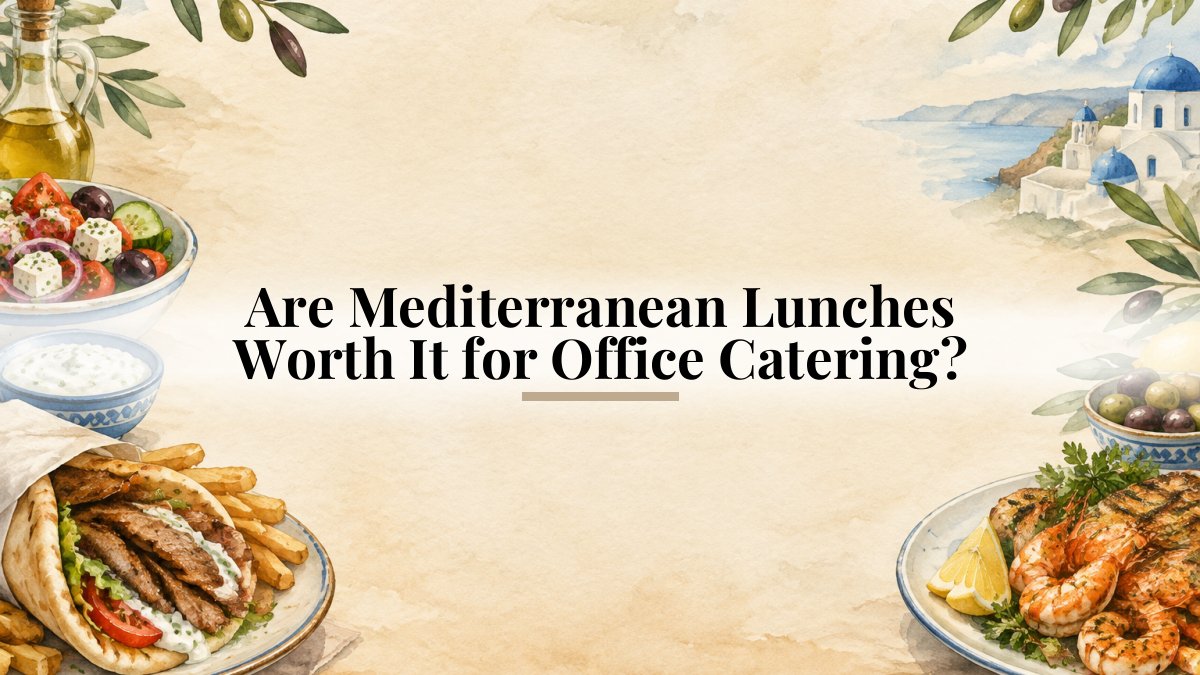
Are Mediterranean Lunches Worth It for Office Catering?
Last Updated: November 4, 2026
Quick Summary
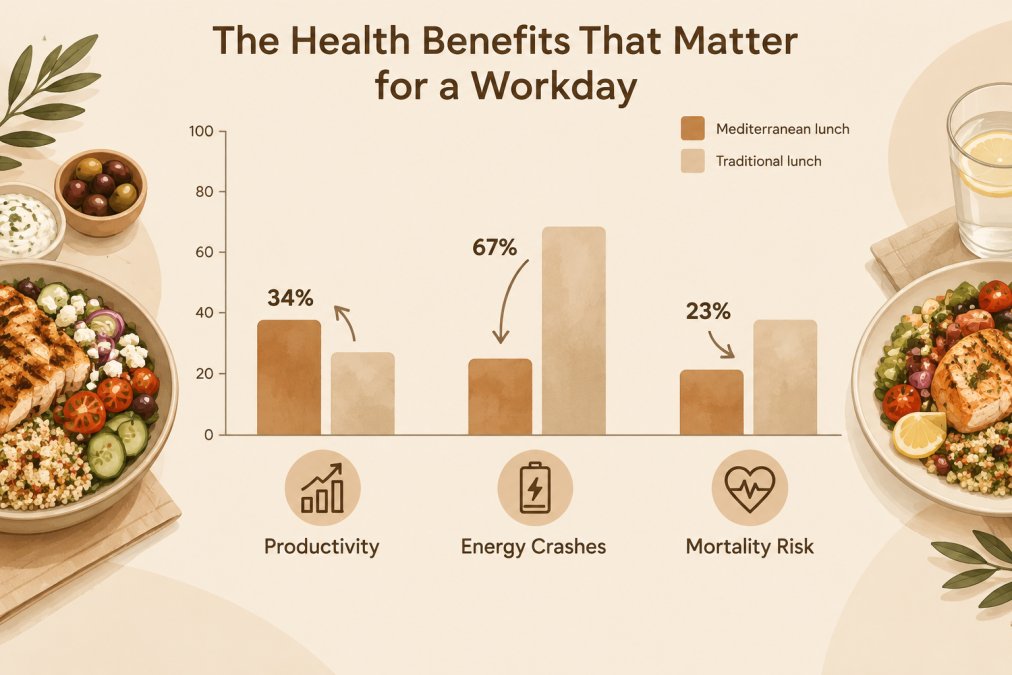
Mediterranean catering is worth it for office lunches because the eating pattern is linked to a 23% lower risk of dying from any cause and to reductions in major cardiac events, type 2 diabetes, and breast cancer. Build the menu around vegetables, legumes, whole grains, and olive oil rather than treating them as sides.
- Plan on roughly 1.5 to 2 servings per person across the menu, not one serving per dish.
- Build the menu in ratios: about half vegetables and salads, a quarter grains and legumes, a quarter proteins.
- For 10 people, order for 11 to 12 so nobody leaves hungry.
- Keep gluten-free items on their own labeled platter with their own utensils to avoid cross-contact.
- Ask the caterer how hot and cold items are transported and held to protect food safety.
Table of Contents
- Why Mediterranean Catering Belongs in the Office
- What the Mediterranean Eating Pattern Actually Includes
- The Health Benefits That Matter for a Workday
- How to Organize a Team Lunch for 10 People
- Mediterranean Diet Office Lunch Ideas That Travel Well
- Corporate Catering Healthy Options for Every Dietary Need
- Plan Your Next Team Meal with Parthenon
- Frequently Asked Questions
Why Mediterranean Catering Belongs in the Office
Office lunches have a reputation problem: heavy, beige, and followed by a 2 p.m. slump. Mediterranean catering solves that problem, and the evidence behind the eating pattern is unusually strong.
At Parthenon Greek Restaurant & Chevy Chase Lounge, we have served Greek food built on these principles since 1989, and Below, we break down what the Mediterranean eating pattern includes, which benefits matter during a workday, and how to order for a team of 10 without the logistics falling apart.
The short answer: yes, Mediterranean lunches are worth it, provided you build the menu around vegetables, legumes, whole grains, and olive oil rather than treating them as sides.
What the Mediterranean Eating Pattern Actually Includes
The Mediterranean diet is a plant-forward eating pattern built on vegetables, fruit, whole grains, legumes, nuts, seeds, and olive oil, with fish and poultry in moderate amounts and red meat rarely. For practical detail on Greek side dishes and how to build a balanced plate, the choices range from lemon potatoes and salads to vegetables, dips, and small plates for sharing. It is a pattern, not a single dish, which is why it translates so cleanly to a catering tray.
The emphasis lands on minimally processed foods and healthy unsaturated fats, especially extra virgin olive oil. Herbs and citrus do the seasoning work that salt and heavy sauces usually carry.
Foods to Build the Menu Around
- Grilled vegetables and raw salads with olive oil and lemon
- Legumes: chickpeas, lentils, white beans, and dips like hummus
- Whole grains such as bulgur, farro, and barley
- Nuts and seeds for crunch and satiety
- Olive oil as the primary fat
- Fish, chicken, and eggs in moderate portions
- Fresh fruit to close the meal
Foods to Limit at a Working Lunch
- Processed meats and heavy red meat dishes
- Fried items and cream-based sauces
- Refined white bread and pastries
- Sugary drinks and desserts
One honest caveat: olive oil and nuts are calorie-dense. The Cleveland Clinic's Mediterranean diet guidance notes that portion awareness still matters, even when every item is a healthy one. Catering portions should be generous with vegetables and measured with oils and nuts.
The Health Benefits That Matter for a Workday
A Mediterranean-style lunch is built on fiber, healthy fats, and vegetables rather than refined carbohydrates and heavy protein.
The long-term picture is stronger still. Research tracked by the U.S. Department of Veterans Affairs Health Services Research and Development service associates the Mediterranean diet with significant reductions in major cardiac events, new-onset type 2 diabetes, and breast cancer incidence. A review published in PMC links the pattern to protective effects against cardiovascular disease, stroke, obesity, hypertension, and several cancers.
It is not a cure-all, and it does not replace medical advice.
How to Organize a Team Lunch for 10 People
Organizing a team lunch for 10 people comes down to five decisions: headcount, dietary needs, menu mix, delivery timing, and serving setup. Get those right and a group of 10 is easier to feed than a group of 40. The difference between a smooth lunch and a chaotic one is almost never the food, it is whether someone planned the quantities, the holding setup, and the timing before the order was placed.
- Confirm the headcount and any guests. Ten becomes twelve quickly; order for 11 to 12 so nobody leaves hungry. For a buffet-style Mediterranean spread, plan on roughly 1.5 to 2 servings per person across the menu rather than one serving per dish, people take a little of several items, and running out of the salad while pita remains is the most common catering failure.
- Collect dietary needs in one message. Ask about vegetarian, vegan, gluten-free, dairy-free, and seafood aversions in a single form or email thread. A simple shared form beats a long email chain because it gives you a countable list.
- Build the menu in ratios. Roughly half vegetables and salads, a quarter grains and legumes, a quarter proteins, plus dips and bread. For 10 people that translates to about 4 to 5 vegetable or salad dishes, 2 to 3 grain or legume dishes, 2 protein dishes, and 2 to 3 dips with bread. This ratio keeps the plate balanced, keeps costs predictable, and means a vegetarian can build a full meal without a special order.
- Set the delivery window. Plan the delivery timing with the caterer so the food arrives before the lunch starts.
- Plan the serving setup. For 10 people, a simple counter setup with plates at one end and utensils at each dish is enough; you do not need a full buffet line.
Watch out: holding temperatures are the detail that quietly ruins office lunches. Hot foods held below safe holding temperatures and cold foods left out too long are both food-safety problems, and a 10-person lunch often means food sits out for an hour or more while people drift in. Ask the caterer how items are transported and held.
Budgeting is the other half of organization. Ask the caterer for a quote based on your headcount and menu, since pricing depends on quantity, dates, and delivery.
For a fuller walkthrough of timing and quantities, our guide to Greek Restaurant Catering for Office Events covers the step-by-step ordering process.
For a buffet-style Mediterranean spread for 10 people, these are the planning figures the article recommends.
| Item | Value | Note |
|---|---|---|
| Headcount to order for | 11 to 12 people | So nobody leaves hungry |
| Servings per person | Roughly 1.5 to 2 | Across the menu, not one per dish |
| Vegetable or salad dishes | 4 to 5 | About half the menu |
| Grain or legume dishes | 2 to 3 | About a quarter of the menu |
| Protein dishes | 2 | About a quarter of the menu |
| Dips with bread | 2 to 3 | Plus dips and bread |
| Serving setup | Simple counter setup | Plates at one end, utensils at each dish |
Mediterranean Diet Office Lunch Ideas That Travel Well
Mediterranean diet office lunch ideas work best when they survive a car ride. The dishes that hold up are the ones served at room temperature or gently warm, with dressings packed separately.
- Mezze spread: hummus, tzatziki, olives, and warm pita
- Village salad: cucumber, tomato, red onion, feta, olive oil, oregano
- Lemon potatoes: roasted and sturdy, good warm or at room temperature
- Grilled chicken or lamb skewers for the protein eaters
- Grilled fish for a lighter option, served with lemon
- Bulgur or lentil salad for fiber and staying power
- Fresh fruit and Greek yogurt to finish
If part of your team avoids seafood, our Greek lunch options for non-seafood eaters guide lists the plates that keep everyone covered.
Corporate Catering Healthy Options for Every Dietary Need
Corporate catering healthy options only work if every person at the table has something to eat. Mediterranean menus handle this better than most, because the core of the plate, vegetables, legumes, and grains, is naturally vegetarian and often vegan.
Plan for the common needs:
- Vegetarian and vegan: hummus, falafel, lentil salad, grilled vegetables, and olive-oil-dressed grains. A vegan plate should include a legume or grain main plus a vegetable and a dip so it has the same structure as the rest of the menu. Olive-oil and lemon dressings keep vegan items from depending on yogurt sauces.
- Gluten-free: salads, skewers, and rice or potato dishes, with pita kept separate. The risk is cross-contact, pita stacked on the same platter as gluten-free items, or the same tongs used for both. Ask for gluten-free items on their own labeled platter with their own utensils.
- Dairy-free: olive-oil-based dishes and vinegar or lemon dressings rather than yogurt sauces. Tzatziki and yogurt-based dips are common in Mediterranean menus, so confirm which dips are dairy-free and label them clearly.
- Seafood aversions: grilled chicken, lamb, and legume mains. Fish is a Mediterranean staple, but a menu with only fish as the protein leaves some people with a plate of sides; keep a poultry or legume main alongside it.
- Common allergens: nuts and sesame appear often in Mediterranean food, pine nuts in salads, tahini in hummus, sesame on bread. Ask the caterer to identify which dishes contain them and to keep a nut-free option available.
Watch out: cross-contact practices matter most for serious allergies, and a buffet-style office lunch is a high-risk format because guests serve themselves with shared utensils. If anyone has a serious allergy, ask the caterer how items are prepared and separated, request labeled platters, and consider individual packed portions for that person rather than relying on the buffet.
A practical way to cover everyone without ordering five separate menus is to build the spread in components: a base of vegetables and grains, a set of dips with at least one dairy-free and one gluten-free option, and two or three proteins spanning poultry, fish, and legumes. This component approach keeps the Mediterranean pattern intact for everyone while accommodating the common needs without special orders.
For offices with varied requirements, our corporate catering services guide walks through options and logistics.
Plan Your Next Team Meal with Parthenon
A Mediterranean office lunch is one of the few catering decisions that pleases the finance team and the people eating it. The food is fresh, the menu covers most dietary needs without special orders, and the health case is backed by research rather than marketing.
Parthenon Greek Restaurant & Chevy Chase Lounge has served authentic Greek cuisine since 1989, using imported Greek products and extra virgin olive oil in family recipes. Our private catering covers office lunches, meetings, and celebrations. If you would rather see the food in person first, you can Experience Greece in DC at our table before booking the office spread.
Ready to feed the team? Order Greek catering for your next office lunch and we will handle the menu, the timing, and the setup.
Frequently Asked Questions
What are the main health benefits of Mediterranean food for office workers?
The Mediterranean eating pattern is built on vegetables, whole grains, legumes, olive oil, fish, and nuts. Its fiber and healthy fats are a good fit for a workday lunch.
Are there any downsides to Mediterranean catering I should plan for?
Portion control is the one real caveat. Olive oil, nuts, and cheeses are calorie-dense, so a buffet where everyone piles on both can push past what a lighter lunch would deliver. The Cleveland Clinic notes that the diet's emphasis on fats means portions still matter. Ask your caterer how dressings and oils are served and what dessert options are available. That keeps the meal aligned with the pattern without turning a healthy lunch into a heavy one.
How does Mediterranean catering handle different dietary needs in one office?
It handles them better than most menus because the pattern is naturally plant-forward. Mediterranean dishes built on vegetables, legumes and grains can suit vegetarian needs, and fish and chicken cover pescatarians and meat eaters. Confirm which dishes meet each dietary need with your caterer. Confirm allergen details with your caterer in writing, especially for gluten in pita and wheat-based salads, and ask for labels on each tray.
Is Mediterranean catering cost-effective for corporate events?
Pricing depends on quantity, dates, and delivery, so ask for a quote based on your headcount and menu rather than comparing headline numbers. For a group of 10, a mix of two dips, one grain salad, one legume dish, a vegetable side, and one or two proteins usually lands well without over-ordering.
The next time the calendar says team lunch, skip the sandwich platter and order something your colleagues will actually remember. Get started with Parthenon Greek Restaurant & Chevy Chase Lounge and give your office a Mediterranean lunch built on fresh ingredients, imported olive oil, and decades of Greek hospitality.