 ultimate-guide
Guide to Mediterranean Dining Etiquette and Sharing Plates
Last Updated: November 4, 2026
Quick Summary
Mediterranean dining etiquette centers on sharing: meals are built to be social, with dishes passed around the table. Take a reasonable portion, use the serving utensils provided, and take from the dish nearest you. Customs vary by country and restaurant, so check portion sizes with the server before ordering.
- Wait for the host or eldest guest to begin the meal.
- Always use the serving spoon or tongs rather than your own utensils.
- Take a reasonable portion so others can take their share.
- Ask the server how many plates a table of your size should order.
- Order in waves, starting with cold meze and dips before grilled items.
Table of Contents
- Why Mediterranean Meals Are Built Around Sharing
- Basic Table Manners at a Greek Table
- Sharing Plates Etiquette: Serving Yourself Politely
- Greek Dining Etiquette Across Regions and Home Versus Restaurant
- Mediterranean Restaurant Ordering Tips for Shared Tables
- Greek Food for First-Time Diners: What to Order and Expect
- Booking Your Table for a Shared Greek Meal in DC
- Frequently Asked Questions
Why Mediterranean Meals Are Built Around Sharing
Mediterranean meals are designed to be social first. Qualitative research on family meals in Mediterranean countries highlights conviviality and social interaction as central parts of the dining experience (qualitative analysis of Mediterranean family meals). Food is meant to be passed, tasted and talked about, not portioned out in isolation.
Shared plates let a table sample many flavors at once. Meze-style spreads, dips, salads and grilled dishes all work this way, and the sharing itself is part of the appeal. Industry commentary on the trend notes that meals are increasingly treated as social events where plates are shared to sample multiple flavors (Roland Foods on social dining and communal sharing).
Basic Table Manners at a Greek Table
Good manners at a Greek table are mostly about patience and attention. Wait for the host or the eldest person at the table to begin, keep your elbows off the table, and keep your napkin on your lap. Bread is typically placed directly on the table rather than on a bread plate, and it is used to help move food, not as a utensil of its own.
Eating slowly matters too. Mindful eating with family and friends is linked to better digestion and less overeating (Fitness CF Gyms on mindful eating practices). A long, unhurried meal is the point, so there is no need to rush through courses.
Sharing Plates Etiquette: Serving Yourself Politely
When a dish arrives at the center of the table, take a reasonable portion, one that leaves enough for others to take their share. Taking a large pile of the best pieces and leaving the rest looks careless, even when no one says so.
Offer a dish to the people beside you before you help yourself, especially to anyone who has not yet been served. If you are unsure whether a shared item is meant for everyone or for a single diner, ask the server. Many dishes arrive in portions meant to be divided, but some are individual plates.
Using Serving Utensils Instead of Your Own
Always use the serving spoon or tongs provided with a shared dish. Reaching in with your own fork, or using your own utensils to lift food from the platter, is one of the most common missteps at a shared table. Once the food is on your own plate, you can eat with your normal utensils.
Taking Food From the Dish Nearest You
Etiquette generally favors taking from the dish closest to you rather than reaching across the table, a basic rule of mediterranean dining etiquette. Reaching across people can knock over glasses and crowd the people beside you. If a dish is out of reach, ask someone to pass it, and pass dishes along without setting them down in front of only one person.
Greek Dining Etiquette Across Regions and Home Versus Restaurant
Sharing customs are not uniform across the Mediterranean, and treating them as one set of rules is the fastest way to misread a table.
Greece sits toward the communal end, especially at tavernas and family tables. A Greek meal typically opens with a spread of meze and salads placed in the middle, and everyone takes from the dishes nearest them.
Italy is more mixed. In home settings, large serving platters of pasta or a secondo are common and diners take from the platter, but restaurants frequently plate individual portions, and ordering "family style" is a request rather than the default.
The practical takeaway is to read the table before you act. If dishes arrive in the center with serving utensils, sharing is expected. If each diner receives a plate with food already on it, keep to your own plate unless the host offers a taste.
At home, a shared meal usually means passing dishes freely and encouraging guests to take more, and the host often presses second helpings.
Watch out: assuming a restaurant dish is shareable because it is Mediterranean can leave a table short of food; confirm portion size and plating style with the server before the order is placed.
The article notes that sharing customs vary across the Mediterranean, and the table below compares how communal dining typically works in each setting.
| Setting | Typical sharing style | Practical tip |
|---|---|---|
| Greece (tavernas, family tables) | Communal meze and salads in the center | Take from the dish nearest you |
| Italy (home) | Large platters of pasta or secondo | Diners take from the platter |
| Italy (restaurant) | Individual plates by default | Ask for family style |
| Spain (bars, casual) | Tapas shared by default | Share small plates |
| Spain (menú del día) | Plated per person | Eat from your own plate |
| Restaurant, any region | Portion size varies | Ask the server before ordering |
Mediterranean Restaurant Ordering Tips for Shared Tables
Ordering a shared Mediterranean meal works best as a sequence rather than a single decision. Explore Parthenon's Greek menu, with meze, grilled seafood and lamb, to plan which dishes to share.
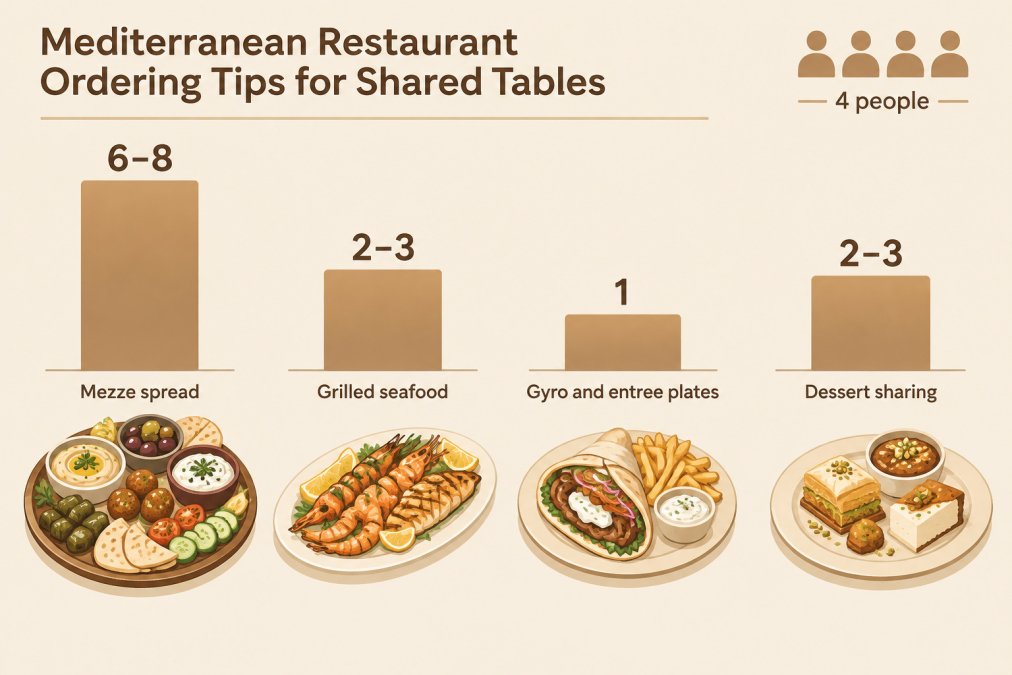
Start by asking the server two questions: which dishes are designed for sharing, and roughly how many plates a table of your size should order. Portion sizes vary by restaurant, so ask your server how many plates a table of your size should order.
- Mezze spread: 6 to 8 small dishes
- Grilled seafood: 2 to 3 platters
- Entree plates: one per diner
- Dessert: 2 to 3 plates to share
Order in waves rather than all at once. Ask for the cold meze and dips first, then add grilled items once the table has made progress.
When the food arrives, set the sharing expectation out loud. A simple line such as "we're sharing everything, so please pass plates to the left" prevents the awkward moment when one diner assumes a dish is personal.
Splitting the bill is easier if it is settled before the meal. Decide up front whether the table is splitting evenly or by what each person ordered, and say so when you order so no one is surprised.
Dietary needs deserve a sentence before the food arrives, not after. Tell the server about allergies, religious restrictions, and vegetarian or vegan choices when you order, and ask which shared dishes contain nuts, sesame, dairy, gluten, or shellfish.
Watch out: double-dipping into a shared dip or sauce after taking a bite is the most common hygiene misstep at a mezze table; spoon a portion onto your plate first, and keep your used utensils out of the communal dish.
Greek Food for First-Time Diners: What to Order and Expect
If Greek food is new to you, begin with the dishes that are easiest to share: a dip such as tzatziki, a Greek village salad, and spanakopita. Then move on to grilled mains like seafood or lamb. Our guide to what to order at a Greek restaurant walks through building a first meal step by step (What to Order at a Greek Restaurant: A First-Timer's Guide), and our overview of traditional Greek dishes explains the classics (Traditional Greek Dishes: A Guide to the Classics).
Expect generous portions, a relaxed pace and a meal that unfolds over time. Most first-time diners find the sharing format is the easiest part to enjoy. If you'd like to try these dishes with a group, you can book a table at Experience Greece in DC and share the meal together.
Booking Your Table for a Shared Greek Meal in DC
Plan ahead for a group, since shared meals are easiest to organize when everyone is seated together. You can reserve lunch, dinner, weekend Greek brunch or a celebration at Parthenon Restaurant in Chevy Chase, Washington, DC (reserve a table at Parthenon). If you are visiting our Bethesda location instead, our Bethesda page has the local details (Greek restaurant in Bethesda, MD).
For a simple next step, book your table and bring your appetite for sharing.
Frequently Asked Questions
What is the etiquette for sharing food at a Mediterranean restaurant?
Share dishes by placing them in the center of the table and letting everyone serve themselves. Use the serving utensil provided with each dish rather than your own fork or spoon. Take a moderate portion you can finish, and offer dishes to others before taking seconds. Wait for the table's pace rather than starting alone, and pass plates clockwise unless the table signals otherwise. Greek and broader Mediterranean meals are social, so lingering over the shared dishes is part of the courtesy.
How do you serve yourself from a shared plate politely?
Reach for the dish nearest you first, then move to items farther away by asking someone to pass them rather than reaching across the table. Take a modest amount on your own plate, using the serving spoon or tongs. Avoid picking through the platter to choose specific pieces. If you want more of something, wait until the dish comes around again. Offering a dish to your neighbor before you take from it is a simple gesture that sets a friendly tone.
Should you wait for everyone before eating Mediterranean food?
At a formal dinner or when the host has signaled a start, wait for everyone to be served before taking the first bite. At a casual restaurant meal with small plates, it is common to begin once your own plate is ready, and many tables start sharing as dishes arrive. When in doubt, watch the host. Greek hosts often encourage guests to begin, and saying opa or simply enjoying the first dish signals that the meal has started.
What are common Greek dining customs?
Greek meals are slow, shared, and conversational. Mezze-style small dishes are ordered for the table, bread is used to scoop and sample, and drinks are often poured for others before yourself. Lingering after the meal is normal, and rushing to leave can seem impolite. Hospitality is central: guests are often offered more food, and declining politely with thanks and a compliment to the cook is appreciated. Tipping at restaurants in the United States remains customary, typically 18 to 20 percent of the pre-tax bill.
Is it polite to use your own fork to take food from a shared dish?
It is generally considered impolite to take food from a communal dish with your personal fork, because it introduces your utensil into shared food. Use the serving spoon, tongs, or spatula placed with the dish. If a dish has no serving utensil, ask the server for one. Once food is on your plate, you may eat it with your own fork. Using the correct serving tool also reduces hygiene concerns when sharing plates among several people.
How do you order a balanced selection of sharing plates?
Aim for variety across textures and main ingredients: one or two cold or fresh starters, a hot dish or two, a seafood or grilled item, and a vegetable plate. Ask the server how large each dish is and how many it serves, since portions vary. For a table of four, a common approach is three to four starters and one or two larger mains to share. Confirm with the table before ordering, and ask about dietary needs so the selection works for everyone.
What should you do if you have dietary restrictions at a shared meal?
Tell your server about restrictions such as vegetarian, gluten-free, or shellfish allergies when you order, so they can point out dishes and confirm how they are prepared. At a shared table, mention your needs to the host early and choose dishes you can eat comfortably. If a dish contains something you avoid, you can decline politely by saying thank you and that it does not agree with you, without needing a detailed explanation. Serving utensils also help prevent cross-contact with other dishes.
Is there enough variety at a Greek restaurant for guests who do not eat seafood?
Yes. Greek menus typically include a wide range of meat, vegetable, cheese, and grain dishes alongside seafood. Non-seafood sharing plates often include spanakopita, dolmades, hummus-style spreads, grilled chicken, lamb, and salads. Ask the server for recommendations, since many dishes can be adjusted.