 ultimate-guide
Wedding Catering Cost Per Person 2026: Pricing Guide
Table of Contents
- Wedding Catering Cost Per Person: 2026 Pricing Overview
- Price Ranges by Catering Service Style
- Wedding Catering Cost for 100 Guests
- Wedding Catering Cost for 200 Guests
- Food-Only Versus Food-and-Drink Costs
- Cheap Wedding Catering Ideas That Don't Sacrifice Quality
- Wedding Catering Quote Comparison: What to Look For
- How Guest Count and Location Affect Total Cost
- Frequently Asked Questions
Last Updated: October 21, 2026
Wedding Catering Cost Per Person: 2026 Pricing Overview
Planning a wedding involves dozens of decisions, and catering often ranks as one of the biggest budget items. Understanding wedding catering cost per person in 2026 helps you allocate resources wisely and avoid sticker shock when quotes arrive.
Wedding catering cost per person varies dramatically based on service style, menu selections, location, guest count, and whether beverages are included. National estimates range from modest to premium, but the real number depends on what you're actually paying for. The most common mistake is comparing quotes that include different services.
What's Included in Per-Person Quotes
When a caterer quotes a per-person price, that number should tell you exactly what you're getting. Unfortunately, many quotes lack transparency about inclusions.
A per-person quote typically covers food preparation, plating, and service staff. But "service staff" can mean anything from one server per 20 guests to full table service with multiple visits. Some quotes include bar service and beverages; others don't. Rental costs, linens, plates, glasses, tables, chairs, may be bundled into the per-person rate or charged separately as line items.
Always ask caterers to itemize what their per-person price includes. Request clarification on staff ratios, equipment rentals, setup and breakdown, and whether gratuity is included or added on top. This prevents unpleasant surprises and makes quotes genuinely comparable.
How Service Style Affects Price
The way food is served to your guests drives the per-person cost more than almost any other factor. Each service style has distinct labor and logistics requirements that directly impact pricing.
Different service styles demand different staffing levels and preparation methods. A plated dinner requires more kitchen staff and servers than a buffet. Family-style service, where dishes are placed on tables for guests to serve themselves, typically costs less than plated but more than buffet. Understanding these trade-offs helps you match service style to both your budget and the experience you want your guests to have.
Price Ranges by Catering Service Style
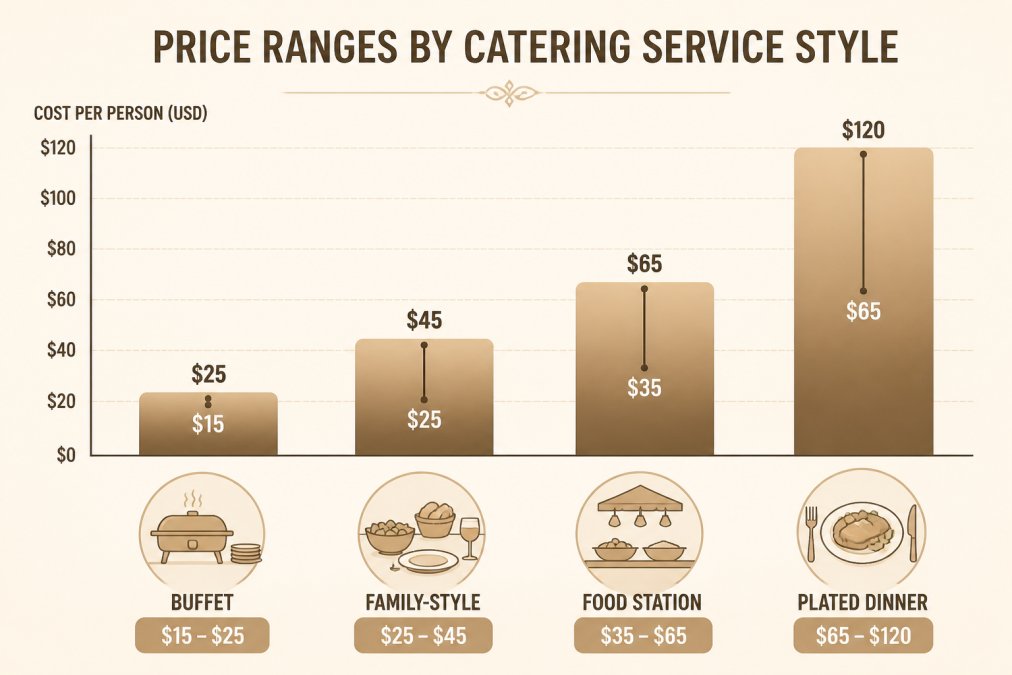
Service style is the primary lever that moves wedding catering cost per person up or down. Each approach has distinct labor, timing, and presentation requirements.
Buffet Service Pricing
Buffet service is the most budget-conscious option. Guests serve themselves from a line of dishes, which reduces the number of servers needed and simplifies kitchen logistics.
Buffet catering typically requires fewer staff members per guest, since servers only maintain food stations rather than delivering individual plates. Setup is faster, and the caterer needs less specialized plating expertise. This efficiency translates directly to lower per-person costs compared to other service styles.
The trade-off: buffet service can feel less formal, and food temperature control becomes more challenging with dishes sitting on warming trays. Some guests may miss items if they arrive late to the buffet line. Despite these considerations, buffet remains a practical choice for large events where budget matters.
Plated Dinner Pricing
Plated dinner service represents the premium end of service styles. Each guest receives an individually prepared plate delivered by a server, creating a formal, restaurant-quality experience.
Plated service demands more kitchen staff, more servers, and careful coordination of timing and presentation. Every plate must match in appearance and temperature. This labor intensity is why plated dinner carries the highest per-person cost among service styles. The experience feels elevated, and guests perceive higher value, but the operational complexity and staffing requirements add significant cost.
Family-Style and Food-Station Pricing
Family-style service falls between buffet and plated in both cost and formality. Large platters and bowls are placed on tables, and guests pass dishes around family-table style. This approach feels more interactive and personal than buffet while requiring fewer servers than plated service.
Food-station service, where different cuisines or cooking styles are set up at separate stations around the venue, offers visual interest and variety. Guests move between stations, creating a more social, interactive experience. Labor costs fall between buffet and family-style, since stations require monitoring but not the full server-per-table ratio of plated service.
Wedding Catering Cost for 100 Guests
A 100-guest wedding is a common milestone where per-person pricing becomes critical because the total cost scales dramatically. Small differences in per-person rates compound into thousands of dollars when multiplied across 100 people.
At this guest count, you have enough volume to negotiate better rates from caterers, but not so many that you're locked into the most basic options. Many caterers offer tiered pricing that rewards larger events.
Guest count also affects your flexibility with menu options. Some caterers offer limited menus for small events but open broader selections at 100+ guests. Dietary accommodations, gluten-free options, vegetarian selections, allergies, become easier to manage with higher volume, since the caterer can prepare these items more efficiently.
Wedding Catering Cost for 200 Guests
At 200 guests, wedding catering cost per person often decreases compared to smaller events, assuming you're working with the same caterer. Larger events spread fixed costs, setup, breakdown, kitchen coordination, across more people, which improves per-person economics.
However, 200 guests introduces new logistical challenges. You may need multiple service lines to prevent bottlenecks during buffet or station service. More servers are required regardless of service style. Venue capacity, equipment rental, and coordination complexity all increase, which can offset the per-person savings.
At this scale, negotiating package deals and multi-course menus becomes more worthwhile. Caterers often build in volume discounts that make premium service styles more affordable.
Food-Only Versus Food-and-Drink Costs
One of the largest variables in wedding catering cost per person is whether beverages are included. Food-only catering separates the food cost from the bar program, which allows you to control costs more precisely.
Food-only pricing covers the meal but not alcohol, soft drinks, coffee, or tea. You can arrange beverages separately through the venue's bar, a separate beverage vendor, or a hybrid approach. This separation gives you flexibility: perhaps you want premium wine but basic beer, or you want to limit bar hours to contain costs.
Beverage and Open Bar Pricing
An open bar, where guests order drinks without limit, adds significant cost per person. Full open bars (beer, wine, and liquor) are the most expensive option. Beer-and-wine-only bars cost less but may feel limiting to guests accustomed to cocktails.
Limited bar options include hosted bar during cocktail hour only, with a cash bar afterward. This approach caps your liability while still offering hospitality. Some couples choose a signature cocktail plus beer and wine, which simplifies bartending and controls costs compared to a full liquor selection.
Beverage costs vary by region, venue, and whether the caterer or venue provides the bar. Always clarify whether the per-person catering quote includes any beverages or whether bar costs are entirely separate.
Cheap Wedding Catering Ideas That Don't Sacrifice Quality
Budget-conscious couples often assume lower cost means lower quality, but smart choices can deliver excellent food and service at reduced per-person rates. The key is prioritizing where quality matters most to your guests.
Buffet or family-style service cuts labor costs without compromising food quality. Focus your menu on fewer, exceptional dishes rather than many mediocre options.
Off-peak timing, Friday afternoon, Sunday brunch, or weekday events, often qualifies for lower catering rates than Saturday evening. Seasonal menus using ingredients at peak availability cost less than out-of-season selections.
Consider Greek cuisine and Mediterranean flavors, which deliver impressive presentation and authentic taste at accessible price points. At Experience Greece in DC, we've seen couples stretch catering budgets by 20-30% by embracing Mediterranean options that feel elevated but cost less than contemporary American menus.
Reduce the bar program by offering wine and beer only, or by hosting the bar during limited hours. Negotiate with your caterer on staffing ratios for buffet service.
Wedding Catering Quote Comparison: What to Look For
Comparing catering quotes requires more than just looking at per-person prices. A $40-per-person quote and a $60-per-person quote may include completely different services, making direct comparison impossible.
Create a standardized request for proposals that specifies exactly what you want: service style, number of servers, menu details, rental inclusions, setup and breakdown, bar service, and staffing ratios. Ask each caterer to respond to the same specifications. This forces apples-to-apples comparison and reveals which caterers offer genuine value versus which are simply cheaper.
Understanding Service Charges, Labor, and Gratuity
Many catering quotes separate food cost from service charges, labor, and gratuity. Understanding these line items prevents sticker shock when the final invoice arrives.
Service charges are typically 18-22% of the food and beverage total and cover staffing, coordination, and logistics.
Labor costs may be itemized separately if you're requesting additional services like a passed hors d'oeuvres hour before dinner or a separate dessert station. Each add-on requires additional staff and coordination time.
Always ask: "Is gratuity included in your quoted per-person price, or is it added on top?" This single question can reveal a $2,000-$4,000 difference on a 100-guest wedding.
Sample Itemized Invoice Breakdown
Here's what a transparent catering invoice should look like:
| Line Item | Quantity | Unit Price | Total |
|---|---|---|---|
| Plated Dinner (per person) | 100 | [Price] | [Total] |
| Beverage Service (per person) | 100 | [Price] | [Total] |
| Service Charge (18%) | , | , | [Total] |
| Rental Equipment (plates, linens, etc.) | , | , | [Total] |
| Gratuity (20% of subtotal) | , | , | [Total] |
| Grand Total | , | , | [Total] |
This breakdown shows exactly what you're paying for. If a caterer won't provide this level of detail, that's a red flag. Transparency in catering quotes prevents disputes and ensures you understand your true cost per person.
How Guest Count and Location Affect Total Cost
Two factors beyond your control, where you live and how many guests attend, shape wedding catering cost per person more than almost anything else. Urban markets with higher labor and ingredient costs charge more than rural areas.
Guest count compounds this effect. Very small weddings (under 50 guests) often have higher per-person costs because caterers can't achieve efficiency. Very large weddings (300+ guests) may see per-person savings but face new logistical challenges and venue constraints.
Location-specific demand also matters. Peak wedding season (May-October) commands premium pricing compared to winter months. Saturday evenings are the most expensive time slot; Friday afternoons or Sunday brunches offer better rates.
When planning your catering budget, research what's typical in your specific market. A per-person estimate from a national average may not reflect your local reality.
Wedding catering cost per person in 2026 depends on service style, menu choices, beverages, and your specific location. To explore how Mediterranean cuisine can deliver exceptional value for your wedding, Experience Greece in DC and discuss your catering needs with our team.
Frequently Asked Questions
What is typically included in a wedding catering cost per person?
Per-person quotes usually cover the food itself, basic service staff, and setup and cleanup. However, inclusions vary widely. Some quotes include beverages and gratuity; others don't. Always ask whether the per-person price covers food only, food plus non-alcoholic drinks, or food plus full bar service. Service charges, delivery fees, rental items (plates, linens, tables), and taxes are often quoted separately. Request an itemized breakdown so you know exactly what you're paying for.
How much should I budget for wedding catering in 2026?
Budget depends on your service style, menu complexity, and guest count. Pricing depends on your service style, menu complexity, and guest count. Service charges, gratuity, taxes, and beverages will add to the food cost. Regional pricing varies; urban areas and destination weddings cost more.
How can I compare wedding catering quotes accurately?
Request quotes from multiple caterers using the same guest count, menu selections, and service style. Ensure each quote specifies what's included: food, beverages, service staff, rentals, setup, cleanup, taxes, and gratuity. Ask whether the per-person price is food-only or includes drinks. Compare itemized breakdowns, not just the bottom-line total. Confirm dietary accommodations (gluten-free, vegetarian, allergies) are priced the same. Ask about payment terms, cancellation policies, and whether the caterer provides references or sample tastings.
What is the cheapest way to feed 100 people at a wedding?
Buffet service is typically the most affordable option, followed by family-style or food-station service. Choose a simpler menu with fewer protein or appetizer options. Limit the beverage service to beer and wine instead of a full open bar. Host the event during off-peak times (Friday afternoon or Sunday brunch) rather than Saturday evening. Consider a destination wedding or local venue to reduce catering logistics costs. Negotiate package deals that bundle food, service, and rentals. Ask about dietary-restriction upcharges and request that the caterer waive them if possible.