 ultimate-guide
Why Imported Greek Olive Oil Matters: A 2026 Guide
Table of Contents
- Why Imported Greek Olive Oil Matters: An Overview
- Greek vs. Italian Olive Oil: What Sets Them Apart
- How to Choose Olive Oil: A Practical Checklist
- The Case for Single-Origin Olive Oil Over Blends
- Olive Oil Freshness and Storage: Keeping Quality After Purchase
- What Importing Changes Between Harvest and Your Table
- How to Verify Origin and Avoid Misleading Labels
- Frequently Asked Questions
Last Updated: October 14, 2026
Why Imported Greek Olive Oil Matters: An Overview
Imported Greek olive oil matters because Greece produces some of the most distinctive extra virgin olive oil in the world, and the oil that reaches your table depends heavily on how it was grown, milled, shipped, and stored. At Parthenon Greek Restaurant & Chevy Chase Lounge, we have cooked with Greek oil since 1989, and the difference shows up on the plate.
Greek olive oil is the oil pressed from olives grown and milled in Greece, most commonly from the Koroneiki cultivar, and it is prized for its peppery, grassy flavor and high polyphenol content. The country's rocky terrain, coastal climate, and long-standing groves shape the fruit before a single drop is pressed.
That is the theory. In practice, most shoppers never taste it, because the bottle on the shelf may be a blend, old stock, or oil that sat in light for months. Knowing what to look for changes everything.
Greek vs. Italian Olive Oil: What Sets Them Apart
Greek and Italian olive oils differ mainly in variety, flavor, and how strictly origin is defined. Greek oil leans toward a bold, green, peppery profile from Koroneiki olives, while Italian oils range widely because Italy grows dozens of cultivars across very different regions.
Koroneiki olives are small and yield less oil per fruit, but the oil is intensely flavored with high bitterness and pungency, the two sensations that often signal fresh polyphenols. Italian oils, by contrast, can be buttery and mild in the north or strong and Tuscan-style further south.
Neither is automatically better. The honest answer is that origin tells you what to expect, not how good the bottle is. A poorly handled Greek oil beats nothing, and a well-made Italian oil can be superb. What most guides miss is that freshness and handling matter more than the country on the label.
| Factor | Greek Olive Oil | Italian Olive Oil |
|---|---|---|
| Signature variety | Koroneiki | Frantoio, Leccino, and many others |
| Typical flavor | Green, peppery, bitter | Ranges from mild to strong |
| Origin labeling | Often single-origin | Frequently blended |
| Best for | Finishing, dressings, dipping | Cooking and finishing |
How to Choose Olive Oil: A Practical Checklist
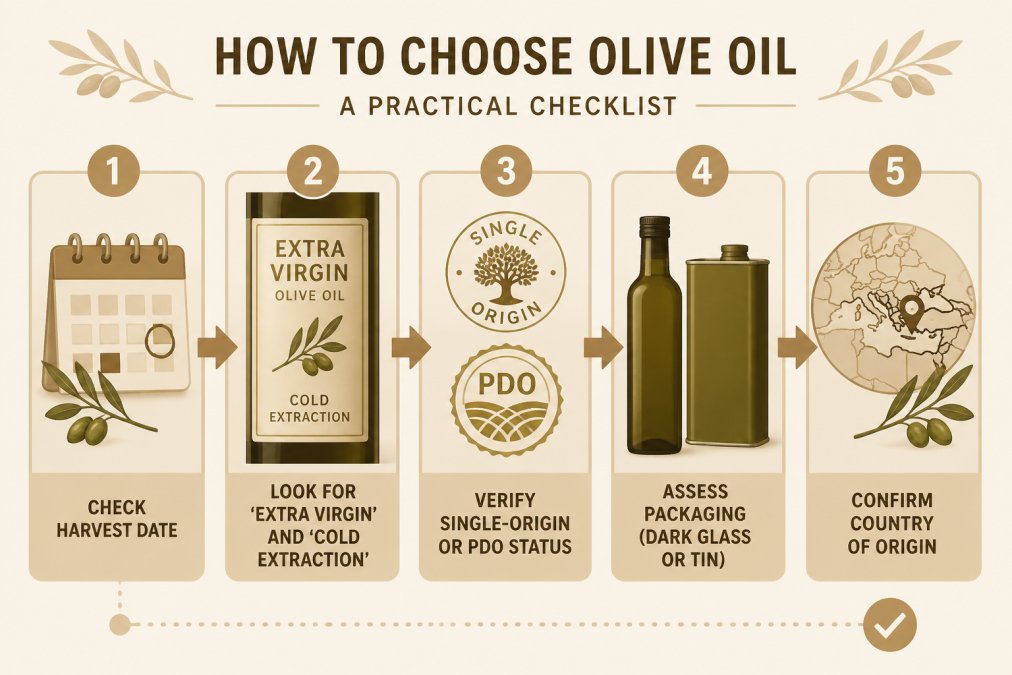
Choosing olive oil comes down to five checks you can run in under a minute at the shelf. The label tells you more than the price tag does.
- Check the harvest date. A harvest date, not just a best-by date, tells you how old the oil is. Fresher is better.
- Look for "extra virgin" and "cold extraction." These terms describe how the oil was graded and pressed.
- Verify single-origin or PDO status. One country or region of origin is easier to trace than a blend.
- Assess the packaging. Dark glass or tin protects oil from light, which speeds up oxidation.
- Confirm the country of origin. "Packed in" is not the same as "produced in."
The Case for Single-Origin Olive Oil Over Blends
Single-origin olive oil comes from one country or region, while blends combine oils from multiple sources. Single-origin oils are easier to trace, more consistent in flavor, and usually fresher because the producer controls the entire chain from grove to bottle.
Blends are not automatically bad. Large producers blend to hit a consistent flavor and price point year after year. The trade-off is that a blend can hide old or lower-grade oil behind a familiar brand name.
For anyone who actually wants to taste Greek olive oil, single-origin is the safer bet. You know what you are getting, and the flavor reflects a specific place rather than an average of many.
Olive Oil Freshness and Storage: Keeping Quality After Purchase
Freshness is the single biggest factor in how olive oil tastes, and storage decides how long it lasts. Heat, light, and air are the three enemies, and all three accelerate oxidation.
Keep your oil in a cool, dark cupboard, tightly capped, away from the stove. A dark glass or tin container slows light exposure. If you buy in bulk, decant a small amount for daily use and keep the rest sealed.
- Store away from heat and direct sunlight
- Cap tightly after every pour
- Use within a few months of opening for peak flavor
- Skip the decorative clear bottle on the windowsill
What Importing Changes Between Harvest and Your Table
Importing changes nearly everything between the grove and your kitchen, and the keyword is really about that gap. Olive oil is perishable: it loses aroma, bitterness, pungency, and polyphenols over time, and the rate of loss depends on how the oil is handled at each step. Two bottles with the same "extra virgin" label and the same country of origin can taste completely different because of what happened after milling.
The journey has five stages, and each one is a decision point:
- Milling. Greek oil is usually milled within hours of harvest, often at a cooperative mill near the grove. Time from tree to mill is the single biggest freshness variable, and it happens before the oil ever leaves the country.
- Bulk vs. bottled export. Oil can leave in stainless steel flexitanks, drums, or already-bottled. Bulk shipping is cheaper and common, but it means the oil is bottled later, sometimes by a third party, and the bottling date tells you nothing about the harvest date. Bottling at origin keeps the chain shorter and easier to trace.
- Ocean transit. A container crossing the Atlantic spends weeks in transit, and the temperature inside a shipping container can swing widely depending on route, season, and whether it sits on deck or below. Heat accelerates oxidation, so summer shipments and poorly ventilated containers are a real risk.
- Warehousing and distribution. Once it lands, oil may sit in a distributor's warehouse, then a retailer's back room, then on a lit shelf. Every month of sitting is a month of decline, and none of it shows up on the label.
- Retail shelf time. The bottle you pick up may have been harvested 18 months ago or 4 months ago. The label rarely tells you which.
The practical takeaway: importing does not automatically mean fresher or better. It means the oil traveled farther, which makes handling and time-to-shelf more important, not less. A well-run importer shortens each stage, bottling at origin, shipping in temperature-controlled containers, moving stock quickly, and printing a harvest date. A poorly run one adds months of warehouse time and calls it the same product.
This is why the same "Greek olive oil" label can taste completely different from one store to the next. The oil did not change. The handling did. For shoppers, that means the importer and retailer you trust matter as much as the country of origin.
How to Verify Origin and Avoid Misleading Labels
Verifying origin means reading the label carefully and knowing which claims carry legal weight versus which are marketing. The USDA Agricultural Marketing Service olive oil standards define quality grades for olive oil sold in the United States, which gives you a baseline for what "extra virgin" is supposed to mean.
The strongest signals, in rough order of reliability:
- A harvest date, not just a best-by date. A best-by date is typically set two years out and says almost nothing about freshness. A harvest date tells you the actual age of the oil.
- A Protected Designation of Origin (PDO) or Protected Geographical Indication (PGI) seal. These are EU-recognized origin protections tied to a defined region and production method. They are not a guarantee of quality on their own, but they are enforceable claims, not marketing copy.
- A specific region or estate name. "Kalamata," "Crete," "Lesvos," or a named grove is more verifiable than a country name alone.
- A lot code or batch number. This lets a producer trace the bottle back to a milling date and grove. If a producer cannot tell you the lot's harvest window, that is a signal.
- Bottled-at-origin language. "Bottled in Greece" is stronger than "packed for" or "distributed by," which can describe a third party that never touched the grove.
Watch for these common traps:
- "Packed in Greece" or "bottled in the EU" while the oil itself came from elsewhere
- No harvest date anywhere on the bottle
- "Light" or "pure" olive oil, which are lower grades than extra virgin
- "Mediterranean blend" or "product of multiple countries," which hides the actual origin
- A price that is far below what genuine early-harvest Greek oil typically costs to produce and ship
Independent testing is the backstop. Third-party labs and certification bodies test for sensory defects, free fatty acid levels, peroxide values, and adulteration with lower-grade or non-olive oils. Some retailers publish these results; most do not. When a producer or retailer can tell you the harvest date, the region, and the lot, and can point to a testing or certification program, you have something you can actually verify rather than trust.
When in doubt, buy from a producer or retailer who can answer those questions directly. Traceability is the whole point, and it is the one thing a misleading label cannot fake.
At Parthenon Greek Restaurant & Chevy Chase Lounge, we use imported Greek products and extra virgin olive oil in our kitchen, so the flavors you taste in our dishes reflect the same standards we would want you to look for at the store. If you would rather skip the label-reading and just enjoy the result, Experience Greece in DC makes it easy to book a table and taste the difference for yourself.
Frequently Asked Questions
Is Greek olive oil better than Italian olive oil?
Both produce high-quality extra virgin olive oil, but they differ in character. Greek olive oil, especially from the Koroneiki olive, tends to be more robust, grassy, and peppery with higher polyphenol levels. Italian oils vary widely by region, from delicate Ligurian oils to bold Tuscan ones. The best choice depends on your taste and how you plan to use the oil. For everyday cooking and finishing, single-origin Greek extra virgin olive oil offers consistent quality and a distinct flavor profile.
How can I tell if Greek olive oil is authentic?
Look for a specific harvest date rather than just a best-by date. Check for the country of origin on the label, ideally with a protected designation of origin (PDO) seal. Single-origin Greek olive oil will name the region, such as Kalamata or Crete. The packaging should be dark glass or tin to protect against light. If the label says 'blend of olive oils from multiple countries' but claims to be Greek, that is a red flag. Authentic Greek oil is almost always extra virgin because of how it is produced.
What does single-origin olive oil mean?
Single-origin olive oil comes from olives grown and pressed in one specific region, often one estate or cooperative. This contrasts with blended oils that mix olives from multiple countries or regions. Single-origin oils offer traceability, consistent flavor, and often higher quality because the producer controls every step from grove to bottle. For Greek olive oil, single-origin means the oil comes entirely from Greek olives, not a mix that includes cheaper oils from other countries. This matters for both taste and authenticity.
How should I store olive oil to keep it fresh?
Store olive oil in a cool, dark place away from heat and light. A cupboard away from the stove works well. Keep the bottle tightly sealed to limit oxygen exposure. If you buy in bulk, transfer a small amount to a dark glass cruet for daily use and keep the rest sealed in the original container. Olive oil does not improve with age; it starts to degrade after harvest. Use it within 12 to 18 months of the harvest date for the best flavor and highest antioxidant content.