 how-to
Authentic Greek Recipes for Family Dinners: 7 Easy Meals
Table of Contents
- Start with a Traditional Greek Table
- Traditional Greek Recipes: Moussaka, Souvlaki, and More
- Easy Greek Recipes for Busy Weeknights
- Greek Family Dinner Ideas: Plan a Full Menu
- Greek Side Dishes That Complete the Meal
- Substitutions, Dietary Swaps, and Sourcing
- Frequently Asked Questions
Last Updated: October 17, 2026
Start with a Traditional Greek Table
Authentic Greek recipes for family dinners start with a simple idea: a few good ingredients, shared without fuss. At Parthenon Greek Restaurant & Chevy Chase Lounge, we have served Greek food since 1989, and these are the dishes Greek families cook at home.
Greek cooking is not complicated: olive oil, lemon, oregano, garlic, and food cooked long enough to taste like itself.
The Building Blocks: Olive Oil, Lemon, and Oregano
Three ingredients carry most of the flavor in Greek recipes:
- Extra virgin olive oil for cooking, drizzling, and finishing
- Fresh lemon for brightness on meat, vegetables, and salads
- Dried oregano for the earthy note that reads as "Greek" before you take a bite
Add garlic, salt, pepper, and canned tomatoes, and you can cook most of this list.
A Sample Family Dinner Menu
Here is a full menu you can cook in one evening:
| Course | Dish | Why It Works |
|---|---|---|
| Main | Moussaka or lemon chicken | Hearty, feeds a crowd |
| Side | Roasted lemon potatoes | Uses the same oven |
| Side | Green beans in tomato sauce | Cooks on the stovetop |
| Fresh | Greek salad | Ten minutes, no cooking |
| Bread | Crusty loaf | For the sauce |
Traditional Greek Recipes: Moussaka, Souvlaki, and More
Traditional Greek recipes reward patience more than skill. These three anchor a family table and scale up easily.
Moussaka: The Layered Classic
Moussaka is a baked casserole of eggplant, seasoned ground meat, and a creamy top layer. Most recipes call for béchamel; a lighter yogurt-based topping works too.
- Slice two large eggplants, salt them, and let them sit for 20 minutes.
- Brown ground beef or lamb with onion and garlic.
- Add canned tomatoes, cinnamon, and oregano; simmer 20 minutes.
- Layer eggplant and meat sauce in a baking dish.
- Spread the topping over the top and bake at 375°F for 45 minutes.
- Rest for 15 minutes before slicing.
Expected Result: A firm, sliceable casserole that holds its shape on the plate.
Souvlaki: Grilled Skewers for a Crowd
Souvlaki is cubed meat marinated in olive oil, lemon, garlic, and oregano, then grilled on skewers. Pork and chicken both work; chicken suits picky eaters.
- Cut two pounds of meat into one-inch cubes.
- Marinate for at least 2 hours in olive oil, lemon juice, garlic, and oregano.
- Thread onto skewers, leaving small gaps.
- Grill over medium-high heat, turning every few minutes.
- Pull the skewers when the meat springs back to the touch.
Serve with warm pita, sliced tomato, red onion, and a spoon of Greek yogurt.
Dolmades: Stuffed Grape Leaves
Dolmades are grape leaves stuffed with rice and herbs, then simmered until tender. They take time to roll, so make them a weekend project and reheat during the week.
- Rinse jarred grape leaves and cut off the stems.
- Mix cooked rice with dill, mint, lemon juice, and olive oil.
- Place a spoon of filling on each leaf and roll tightly.
- Line a pot with spare leaves, pack the rolls in snugly.
- Add water and lemon, weight with a plate, and simmer 45 minutes.
Easy Greek Recipes for Busy Weeknights
Easy Greek recipes for a weeknight need one pan and a short ingredient list. These two deliver.
One-Pot Chicken with Lemon and Potatoes
Chicken thighs, potatoes, lemon, and oregano go into one pan and come out a complete dinner.
- Heat the oven to 400°F.
- Toss chicken thighs and quartered potatoes with olive oil, lemon juice, garlic, oregano, salt, and pepper.
- Arrange in a single layer in a roasting pan.
- Add a splash of water or stock to the bottom.
- Roast for 50 minutes, until the chicken skin crisps and the potatoes soften.
- Squeeze fresh lemon over everything before serving.
Expected Result: Crisp skin, tender potatoes, and a pan sauce worth spooning over bread.
Greek Salad in 10 Minutes
A Greek salad is chopped tomato, cucumber, red onion, and feta, dressed with olive oil, oregano, and a little red wine vinegar. Skip the lettuce; a traditional horiatiki does not use it.
- Cut three tomatoes into wedges.
- Slice one cucumber and half a red onion thin.
- Add a handful of kalamata olives.
- Top with a slab of feta.
- Drizzle with olive oil and dust with oregano.
Greek Family Dinner Ideas: Plan a Full Menu
Greek family dinner ideas work best as a coordinated plan, not a list of separate dishes. The goal is one oven, one stovetop, and no dish finishing 20 minutes early.
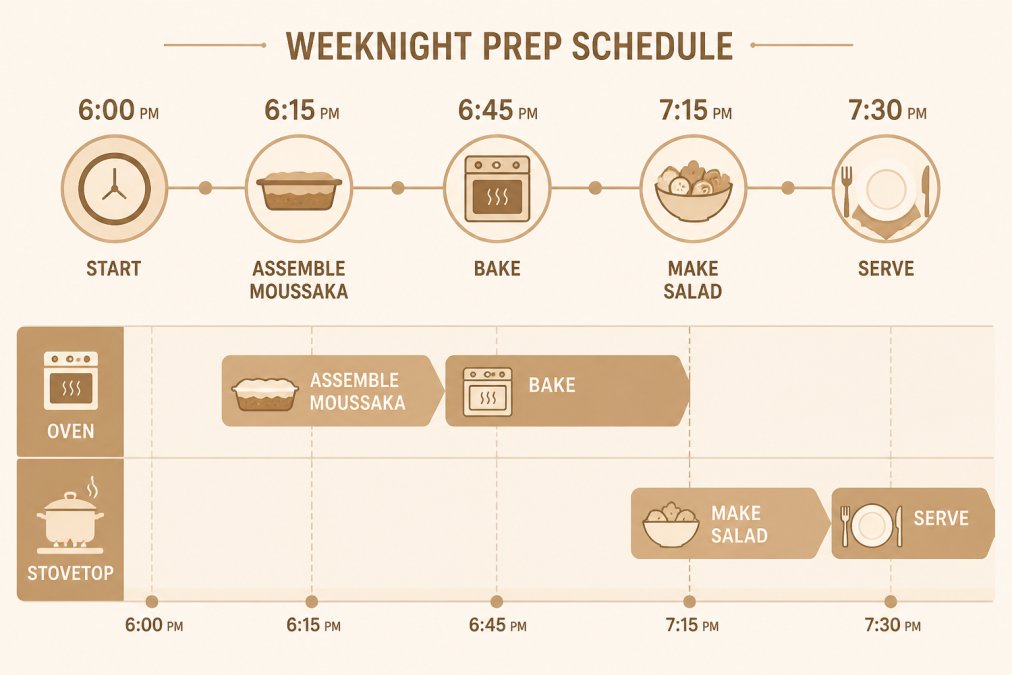
The Menu at a Glance
A balanced Greek family dinner has four jobs: one hearty main, one starch that uses the same oven, one stovetop vegetable, and one fresh dish assembled at the last minute. Dessert is optional, usually fruit, honey, and yogurt.
| Job | Dish | Oven or Stovetop | Hands-On Time |
|---|---|---|---|
| Main | Moussaka or one-pot lemon chicken | Oven | 25-30 min |
| Starch | Roasted lemon potatoes | Oven (same rack) | 10 min |
| Vegetable | Green beans in tomato sauce | Stovetop | 10 min |
| Fresh | Greek salad | Counter, no heat | 10 min |
| Bread | Crusty loaf, warmed | Oven, last 5 min | 1 min |
A Workable Sequence for a 7:30 Dinner
- 6:00 PM, Heat the oven to 400°F. Start the meat sauce for moussaka, or toss chicken and potatoes for the one-pot version.
- 6:15 PM, Assemble the moussaka, or slide the chicken-and-potato tray into the oven. If doing both, put potatoes on the lower rack and moussaka above.
- 6:45 PM, Everything is in the oven. Start the green beans now for soft beans; wait until 7:05 for a little bite.
The oven does the heavy lifting while the stovetop and counter handle fast jobs. Cook everything on the stovetop and you will run out of burners, and the moussaka will not rest before slicing.
Portion Scaling by Household Size
Cook for the number of people at the table plus two. Greek food reheats well, and the extra saves a second night. Numbers below assume adult portions with bread and salad.
| Household | Ground meat for moussaka | Chicken thighs (one-pot) | Eggplant | Tomatoes for salad |
|---|---|---|---|---|
| 2 people | 1 lb | 1.5 lb | 1 large | 2 |
| 4 people | 1.5-2 lb | 2-2.5 lb | 2 large | 3-4 |
| 6 people | 2.5-3 lb | 3.5-4 lb | 3 large | 5-6 |
| 8 people | 3.5-4 lb | 5 lb | 4 large | 7-8 |
A few rules of thumb:
- One pound of ground meat makes moussaka for four when layered with eggplant and topping.
- Two pounds of chicken thighs feeds four with leftovers for lunch.
- One eggplant per two people for moussaka; small eggplants are more bitter, so salt them longer.
Leftovers: What Keeps and What Does Not
Leftovers keep in the refrigerator for about three days. Cooked meat and casseroles should be reheated to 165°F and never left at room temperature for more than two hours.
- Moussaka, reheats best covered in a 350°F oven for 20-25 minutes. Microwaving works but the topping can separate.
- One-pot chicken and potatoes, reheat covered at 350°F; add a splash of stock so the potatoes do not dry out.
- Green beans in tomato sauce, actually better the next day; reheat on the stovetop over low heat.
Prep-Ahead and Weeknight Timing
Sunday prep cuts a weeknight dinner to about 30 minutes of hands-on work. Prep components, not finished dishes, a cooked meat sauce and roasted eggplant turn moussaka into an assembly job.
- Brown the meat sauce and refrigerate for up to three days, or freeze for up to three months.
- Roast eggplant slices and store covered in the refrigerator.
- Marinate chicken or pork for skewers; freeze in the marinade if you will not cook it within two days.
Greek Side Dishes That Complete the Meal
Greek side dishes do the quiet work on a family table. Both of these cook while the main dish rests.
Roasted Lemon Potatoes
Roasted lemon potatoes are the side we would pick if we could only pick one. Cut russet or Yukon potatoes into wedges, toss with olive oil, lemon juice, garlic, oregano, salt, and pepper, and roast at 400°F for 40 minutes, turning once. Add about half a cup of stock to the pan so the potatoes steam before they crisp, creamy center, browned edge.
Green Beans in Tomato Sauce
Green beans in tomato sauce is a stovetop dish that needs almost no attention. Sauté onion and garlic in olive oil, add a can of crushed tomatoes and a pinch of sugar, then stir in trimmed green beans. Simmer covered for 25 minutes, until the beans are soft and the sauce thickens.
Substitutions, Dietary Swaps, and Sourcing
Substitutions matter more than most guides admit. Greek recipes are forgiving, but a few swaps change the dish. Here is how to cook authentic-style Greek food with what is available.
Substitutions That Work and Substitutions That Change the Dish
Meat and dairy swaps:
- Ground lamb to ground beef is a clean swap in moussaka; the cinnamon and oregano carry the flavor. A plant-based crumble works but browns differently, so add a little extra olive oil.
- Chicken thighs to chicken breast is fine for souvlaki, but breast dries out faster, pull it 5-7 minutes earlier and marinate no longer than 2 hours, since lemon acid can make lean meat mushy.
- Feta to a firm goat cheese is a sharper salad; feta to ricotta salata is closer in texture but less salty. Do not substitute cream cheese or cottage cheese, the salad will turn watery.
Pantry swaps:
- Dried oregano to dried marjoram in a pinch; marjoram is milder, so use about a third more.
- Kalamata olives to any brine-cured black olive. Do not use canned black olives, they are bland and rubbery.
- Jarred grape leaves to fresh, blanched first. Fresh leaves need 2-3 minutes in boiling water and a rinse before rolling.
Swaps that change the dish:
- Skipping the béchamel in moussaka for a yogurt-egg topping is a real change, lighter, tangier, less rich. Good for a weeknight, but not the same dish.
- Replacing olive oil with butter or a neutral oil will mute the flavor that reads as Greek. If you must, use a mild olive oil rather than a strongly flavored one.
- Using dried dill instead of fresh in dolmades is acceptable; use about a third of the volume.
Sourcing Greek Ingredients
Look for olive oil and oregano that list Greece as the origin on the label, the single most useful sourcing rule. Beyond that:
- Olive oil, extra virgin for finishing and salads; a cheaper everyday olive oil is fine for roasting. Check the harvest date if the bottle has one; olive oil is not a wine and does not improve with age.
- Feta, look for a brine-packed block, not pre-crumbled. Pre-crumbled feta is drier and saltier. A protected designation of origin label is a reliable signal but not required for good feta.
- Oregano, dried Greek oregano is more aromatic than the generic jar. Rub a pinch between your fingers; if it smells like dust, it is old.
Ethnic aisles and Mediterranean grocers usually carry jarred grape leaves, kalamata olives, and good feta at lower prices than specialty shops. For guidance on how a Mediterranean eating pattern fits into everyday meals, the Mediterranean diet guidance from the Mayo Clinic is a useful, plain-language reference.
Allergen Notes and Dietary Adaptations
Most Greek dishes are easy to adapt, but a few ingredients hide in plain sight.
- Gluten, skip the béchamel in moussaka and use a yogurt-egg topping; serve souvlaki with rice instead of pita; check that spice blends are not bulked with wheat.
- Dairy, feta and yogurt appear in salads, toppings, and marinades, so check every component. Dairy-free yogurt works in marinades; use a plant-based feta alternative if needed.
- Nuts, traditional recipes rarely use them, but some stuffed vegetable fillings do. Check the filling before serving.
For food safety basics when cooking meat and reheating leftovers, the USDA FoodSafety.gov guidance covers safe internal temperatures and storage times in plain terms.
One more note on sourcing: if a label claim matters to you, the USDA organic standards explains what certification actually requires.
Frequently Asked Questions
What is the most authentic Greek dish to make for a family dinner?
Moussaka is often considered the most authentic Greek dish for a family dinner. It layers eggplant, ground meat, and a creamy béchamel sauce, and it feeds a crowd. Other classics include pastitsio, souvlaki, and spanakopita. For a true taste of Greece, use extra virgin olive oil, fresh oregano, and imported feta. Many families in Greece serve moussaka on Sundays or holidays, making it a hearty centerpiece for your own table.
Which Greek dishes are easiest to make for a family dinner?
Easy Greek recipes for family dinners include Greek salad, lemon roasted potatoes, and chicken souvlaki. These dishes require minimal prep and use familiar ingredients like olive oil, lemon, garlic, and oregano. A one-pot chicken with potatoes is another simple option: brown the chicken, add potatoes and broth, then bake until tender. For a faster meal, assemble a mezze platter with hummus, olives, feta, and pita. These easy Greek recipes keep weeknight cooking stress-free.
What should I serve with a traditional Greek main dish?
Traditional Greek side dishes include roasted lemon potatoes, green beans in tomato sauce, and a fresh Greek salad with tomatoes, cucumbers, red onion, and feta. Rice pilaf or orzo also works well. For dipping, serve tzatziki and warm pita. If you want a complete meal, add a vegetable like roasted eggplant or zucchini. These Greek side dishes balance the richness of main dishes like moussaka or grilled meats and add color to the table.
How do I plan a Greek dinner menu for the whole family?
Start with a protein like souvlaki or roasted chicken, then add two Greek side dishes such as lemon potatoes and a Greek salad. Include a vegetarian option like spanakopita or stuffed vegetables for variety. For dessert, serve Greek yogurt with honey and walnuts. Scale portions by counting 1/2 pound of meat per person and 1 cup of sides. Many components can be prepped ahead, making assembly quick on the night of your family dinner. Adjust for dietary needs by offering gluten-free pita and dairy-free tzatziki.
Cooking a full Greek dinner at home is rewarding, but some nights you want the table set for you. At Parthenon Greek Restaurant & Chevy Chase Lounge, we have served traditional family recipes since 1989, using imported Greek products and extra virgin olive oil. Join us on the outdoor patio, book the lounge for a group, or let our private catering team handle your next event. Book a table and let us bring the Greek table to you.