 how-to
How to Keep Catering Food Hot: A Step-by-Step Guide
Table of Contents
- What You'll Need Before You Start
- Step 1: Hold Every Dish at a Food-Safe Hot Holding Temperature
- Step 2: How Long Can Food Stay Hot in a Chafing Dish?
- Step 3: Choose the Best Food Warmers for Catering Your Menu
- Step 4: How to Transport Hot Food Safely to the Venue
- Step 5: Set Up the Buffet Line and Monitor Temperatures All Night
- Common Mistakes That Ruin Hot Catering Food
- Frequently Asked Questions
Last Updated: October 15, 2026
What You'll Need Before You Start
Keeping catering food hot comes down to three things: the right holding temperature, the right equipment, and a timeline you actually follow for catering food hot. This guide from Parthenon Greek Restaurant & Chevy Chase Lounge walks through each step, from the kitchen to the buffet line.
Here's what you need on hand before the first pan hits the warmer:
- A calibrated food thermometer (digital, probe-style)
- Chafing dishes with water pans, food pans, and lids
- Chafing fuel (Sterno or gel fuel) and matches
A common mistake is buying equipment before mapping the menu. A soup needs different holding gear than a roast. Match the tool to the dish, not the other way around.
Step 1: Hold Every Dish at a Food-Safe Hot Holding Temperature
The food-safe hot holding temperature for catering is 140°F or above. Below that, bacteria multiply fast. The FDA Food Code guidance on hot holding sets 140°F as the floor for holding hot food, and 165°F for reheating previously cooked food.
Use a probe thermometer to check the thickest part of each dish, not the surface. Surface readings lie.
The 2-Hour and 4-Hour Rules That Decide What You Can Still Serve
The 2-hour rule says perishable food left between 40°F and 140°F for more than two hours must be thrown out. The 4-hour rule applies to food held above 140°F: it can stay out for up to four hours total, then it's done. Track the clock from the moment the dish leaves the kitchen, not when guests arrive.
Step 2: How Long Can Food Stay Hot in a Chafing Dish?
The answer to how long can food stay hot in a chafing dish is simple: four hours maximum, and only if you keep the water pan filled and the fuel burning. After that, quality drops and safety risk climbs.
Chafing dishes hold heat well, but they aren't magic. A few practical rules:
- Fill the water pan two-thirds full before lighting fuel
- Use one fuel can per pan for the first two hours, then add a second
- Keep lids on between servings to trap moisture
Step 3: Choose the Best Food Warmers for Catering Your Menu
The best food warmers for catering depend on what you're holding, how many pans you're running, and what the venue will actually let you plug in or light. There is no single winner, only the right match. Most competitors stop at a list of warmer types. The comparison below adds the details that decide a real purchase: capacity, power or fuel draw, portability, and the site constraint that rules each option in or out.
| Warmer Type | Typical Capacity | Heat Source | Power / Fuel Draw | Portability | Best For | Site Constraint |
|---|---|---|---|---|---|---|
| Chafing dish (full-size) | One full-size pan, roughly 8-10 qt | Sterno or gel fuel | One 2-hour fuel can per pan, add a second at the 2-hour mark | High, nests and stacks | Buffets, roasts, pasta, casseroles | Open flame; needs airflow and a level, heat-safe surface |
| Insulated hot box (front-loading) | Several full-size pans or sheet pans | None, retains heat | None; preheat with hot water or a heat pack | Medium, bulky but wheeled models exist | Transport and large-batch holding | None, but must be preheated or it pulls heat from the food |
| Electric warming tray | One flat surface, appetizer to half-sheet size | Electric | Low wattage; standard household outlet | High, light and flat | Flat items, appetizers, passed bites | Needs a live outlet within cord reach |
| Warming cabinet | Multiple pans at once, often 4-8 | Electric | Higher draw; may need a dedicated circuit | Low, heavy, often on casters | Staging multiple dishes before service | Needs a dedicated outlet and clearance for airflow |
| Bain-Marie / water bath | One or two inset pans | Indirect water heat | Fuel or electric depending on unit | Medium | Sauces, soups, gravies | Slower to reach temperature; needs a steady water level |
A few trade-offs the table can't capture:
- Fuel quantity math. A full-size chafer burning one 2-hour can will typically hold temperature for the first service window, but a long reception or a windy patio burns fuel faster. Pack one spare can per pan and treat the second can as routine, not backup.
- Power reality. Electric trays and cabinets are the easiest hold, but only if the venue has outlets where you need them. Ask about circuit load before you commit, a warming cabinet plus a coffee urn on the same circuit is a common trip.
- Portability vs. capacity. Hot boxes win on transport and lose on presentation. Chafers win on presentation and lose on transport. Most catered events use both: hot boxes for the trip, chafers for the line.
Matching the Warmer to the Dish: Soups, Roasts, Rice, and Fried Items
Different foods need different holding methods, and the wrong warmer does more damage than a slightly cooler one.
- Soups, sauces, and gravies hold best in a Bain-Marie or water bath, where indirect heat is gentle enough to avoid scorching the bottom of the pot. Stir every 30 minutes to even out the temperature.
- Roasts and large cuts hold well in a covered chafing dish, but slice only what you need. A whole roast holds moisture better than a pan of pre-sliced meat, which dries at the edges.
- Rice and grains dry out fast in any open warmer. Keep them covered, add a splash of water before holding, and consider a covered hotel pan over a water bath rather than direct fuel heat.
- Fried and crisp items lose their crunch in any closed warmer because trapped steam softens the crust. Serve them first, or hold them in a low-temperature oven with the door cracked so moisture can escape.
The pattern is consistent: match the heat method to the food's tolerance for moisture and direct heat, not to whatever warmer is closest to hand.
Step 4: How to Transport Hot Food Safely to the Venue
Learning how to transport hot food safely starts before you load the vehicle. Preheat insulated carriers with hot water, then empty and dry them. Hot food goes into a hot box, never a cold cooler.
Follow these steps:
- Wrap each pan tightly with foil, then a lid
- Preheat the hot box for 15 minutes
- Load the heaviest items on the bottom
- Keep the box closed until you arrive
- Check temperatures within 15 minutes of setup
For a catered event across town, plan your route so the food is in transit for the shortest time possible. Traffic is the enemy of hot food.
Batching and Backup Trays: The Caterer's Insurance Policy
Never send all of one dish at once. Hold a backup tray in the kitchen or a warming cabinet. As the first pan empties, swap in the fresh one. This keeps the buffet line full and the food at temperature. For a 40-person event, two trays per main dish is a safe baseline.
Step 5: Set Up the Buffet Line and Monitor Temperatures All Night
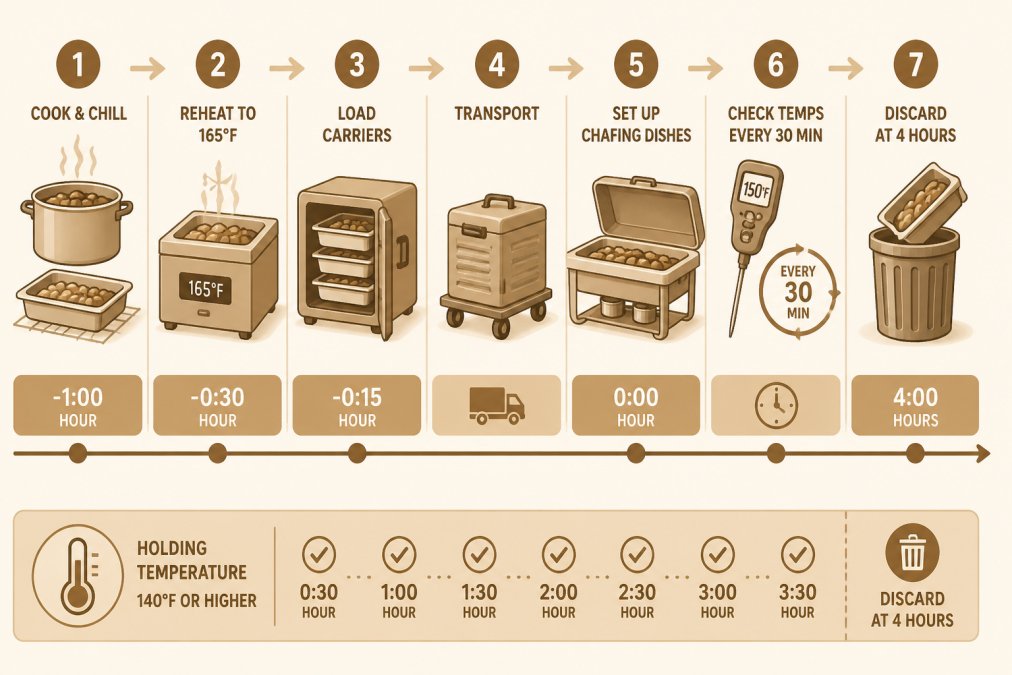
Setup and monitoring are where a hot-holding plan either holds together or falls apart. Most guides say "check the temperature" without saying when, how often, or what to do with the reading. This section gives you a working timeline, a simple log, and a batching workflow so the buffet stays full and safe from doors-open to last call.
The Setup Order
Set chafing dishes up in the order guests will serve themselves: cold items first, hot items last, so hot food spends less time exposed. Light fuel right before doors open, not an hour early, an early light burns fuel you'll want at hour three.
Before the first guest arrives:
- Confirm every hot dish is at 140°F or above with a probe thermometer.
- Fill water pans two-thirds full and light fuel.
- Put lids on every pan and keep them on between servings.
- Place serving utensils so guests don't have to reach across a hot pan.
- Set a timer for the first 30-minute check.
A Working Timeline
A practical pattern for a catered event, counting backward from doors-open:
- T-minus 60 minutes: Reheat previously cooked food to 165°F. Hold at 140°F or above.
- T-minus 45 minutes: Preheat insulated carriers with hot water; empty and dry.
- T-minus 30 minutes: Load carriers, wrap pans tightly with foil, then lids.
- T-minus 15 minutes: Depart for the venue. Keep carriers closed.
The Temperature Log
A log doesn't have to be fancy. A clipboard with columns for dish name, time, reading, and action taken is enough, and it's the single best defense if anyone asks how long a dish has been out.
Check every hot dish with a probe thermometer every 30 minutes. Read the thickest part of the dish, not the surface. Surface readings lie. Log the number.
Common Mistakes That Ruin Hot Catering Food
The biggest mistake is treating holding as an afterthought. Cook the food, then figure out how to keep it warm, and you've already lost.
Other frequent errors:
- Lighting fuel too early, which burns through it before guests arrive
- Stacking pans so heat can't circulate
- Skipping the thermometer because the food "feels hot"
- Using a cold cooler for hot food
Power, fuel, and ventilation are event-site constraints most guides ignore. A venue with no outlets rules out electric warming trays.
If all of this sounds like more logistics than you want to take on for your next event, it's worth knowing that some venues handle the hot-holding for you.
Frequently Asked Questions
What's the best way to keep food warm for a catered event?
Use a combination of methods rather than one: reheat each dish to 165F, move it into an insulated hot box or carrier, then transfer it to a chafing dish, warming tray, or low-temperature oven at the venue. Keep every dish covered with a lid or foil to trap moisture, and check the internal temperature with a food thermometer every 30 minutes. Holding above 140F is the target for the entire service window.
What is the 2-hour/4-hour rule for keeping hot food?
Hot food should stay at or above 140F. If it sits between 40F and 140F for more than 2 hours, it should be discarded. The 4-hour rule applies to food held properly above 140F: it can stay out for up to 4 hours total, after which it must be thrown away. If food has been in the temperature danger zone for more than 2 hours, reheating does not make it safe.
How long can food stay hot in a chafing dish?
A chafing dish with a full water pan and a fresh can of chafing fuel typically holds food at a safe temperature for about 2 to 4 hours. After 4 hours, discard whatever is left. Check the water level every 30 minutes and top it up with hot water, and replace the fuel when the flame dies down. Stir dishes like stews and rice so the bottom does not scorch.
Can I use a slow cooker to keep food warm at a buffet?
Yes, a slow cooker set to its warm setting works well for soups, dips, pulled meats, and saucy dishes. It holds a steady low heat without drying food out, and the lid keeps moisture in. For drier items like roasted vegetables or fried foods, a chafing dish or warming tray with a foil cover is usually a better fit because it avoids steaming them soft.
Catering a hot event is a logistics problem as much as a cooking one. If you'd rather leave the holding, transport, and timing to a team that has done it since 1989, Parthenon Greek Restaurant & Chevy Chase Lounge handles private catering with authentic Greek dishes, fresh seafood, and imported ingredients, plus a full setup that keeps every pan at temperature from kitchen to table. Get started with Parthenon Greek Restaurant & Chevy Chase Lounge and book your next catered event with confidence.