 how-to
How to Book Private Dining in DC: Step-by-Step
Table of Contents
- Private Dining DC: What You Need to Know Before You Book
- Step 1: Define Your Event Details and Guest Capacity
- Step 2: Compare Private Dining Rooms vs. Full Restaurant Buyout
- Step 3: Understand Private Dining Cost Per Person
- Step 4: How Far in Advance to Book a Private Dining Room
- Step 5: Send a Private Dining Inquiry Email Template
- Step 6: Questions to Ask When Booking a Private Dining Room
- Frequently Asked Questions
Last Updated: October 13, 2026
Private Dining DC: What You Need to Know Before You Book
Define your guest count, choose between a private room and a full buyout, confirm the food-and-beverage minimum, and send a written inquiry with your date, party size, and budget.
This guide from Parthenon Greek Restaurant & Chevy Chase Lounge walks through each step, from first email to signed contract.
Private dining is a reserved space within a restaurant, set aside for one group, with its own menu and service. A full restaurant buyout means your group takes over the entire venue for the evening.
That difference drives cost, capacity, and how far ahead you need to book.
Step 1: Define Your Event Details and Guest Capacity
Start with five details before you contact anyone:
- Date and backup date
- Start and end time
- Guest count (a firm number plus a realistic maximum)
- Event type: dinner, lunch, brunch, breakfast, work event, or celebration
- Budget range per person, all-in
Guest count matters most: a seated dinner needs roughly 10 to 15 square feet per guest, a standing reception about half that.
Private dining rooms often come in various sizes to accommodate different group needs.
Always ask about seated capacity and reception capacity separately. A room that seats 40 may hold 70 standing.
Step 2: Compare Private Dining Rooms vs. Full Restaurant Buyout
A private dining room is the better choice for most groups. A full buyout only makes sense when you need the entire space, bar, and patio to yourselves.
Here is how the two compare:
| Factor | Private Dining Room | Full Restaurant Buyout |
|---|---|---|
| Typical group size | 10-60 guests | 80+ guests |
| Minimum spend | Lower | Highest of any option |
| Menu flexibility | Set or bespoke menu | Full menu control |
| Privacy level | Semi-private to private | Complete |
| Best for | Team outings, celebrations | Large weddings, galas |
A semi-private space is a sectioned-off area, not a walled room; it may share sound and staff with the main floor. A private room typically has its own walls and door. A buyout closes the restaurant to the public.
Step 3: Understand Private Dining Cost Per Person
Private dining cost per person can vary depending on the room, staff, and menu. Here is how to build a real total and compare quotes without getting fooled by a low headline price.
Five numbers make up most quotes:
- Food-and-beverage minimum: the amount your group must spend on food and drink
- Room rental fee: a flat charge, sometimes waived when you hit the minimum
- Per-person menu price: a set figure for food, sometimes with drinks included
- Service charge: typically a percentage added to the food-and-beverage subtotal (commonly in the mid-teens to low twenties)
- Sales tax: applied on top of the subtotal and, in many jurisdictions, on the service charge as well
How to Build a Total-Cost Estimate
Do not compare per-person menu prices, compare estimated totals. The math, in order:
- Multiply your guest count by the per-person menu price to get the food-and-beverage subtotal.
- If the subtotal is below the food-and-beverage minimum, replace it with the minimum. You pay the minimum either way.
- Add the room rental fee, if any.
- Add the service charge (a percentage of the subtotal).
- Add sales tax on the subtotal plus service charge.
- Add any add-ons: cake-cutting fee, corkage fee, AV rental, extended-room-hour fee, coat check, or valet.
The result is your all-in estimate. Run the same six steps on every quote before comparing.
Deposits, Payment Schedules, and Cancellation Terms
Most venues ask for a deposit to hold the date, usually applied to your final bill.
Read the cancellation clause before you sign. Key terms to consider include the refund window, any sliding scale for refunds, and force majeure clauses.
Ask whether the deposit is refundable, transferable, or forfeited outright.
The Minimum-Spend Trap
The minimum spend is the amount your group must spend; if your group spends less, you typically pay the difference.
To manage a minimum spend, consider adding a hosted bar package or inquiring about weeknight availability, as some venues may offer lower minimums Monday through Thursday.
What to Get in Writing
Before you pay a deposit, ask the coordinator for a written summary listing the food-and-beverage minimum, room fee, service charge percentage, tax rate, deposit amount and refund terms, final-headcount deadline, and every add-on fee. A verbal promise about a waived fee is not a contract term.
Pricing depends on the date, the room, the menu, and the guest count. We do not publish flat rates, because no two events are the same. For current pricing on our private catering and event spaces, visit Parthenon DC reservations and private events.
Step 4: How Far in Advance to Book a Private Dining Room
Booking lead times can vary depending on the size and type of event, as well as the season. Peak seasons and holiday periods often require earlier reservations.
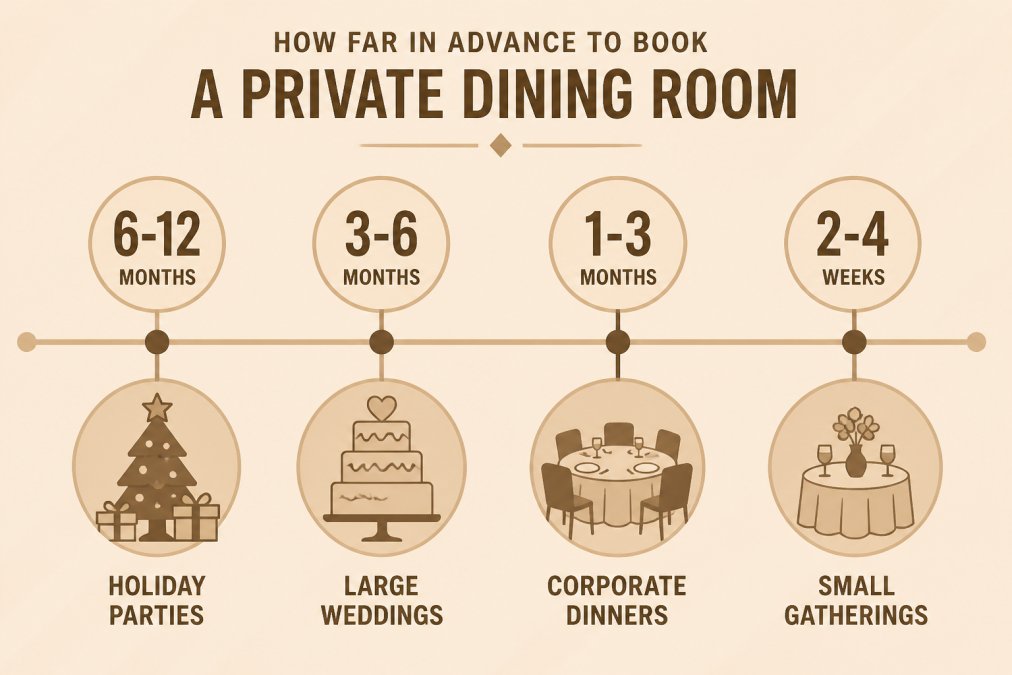
Consider booking well in advance for larger events or during peak seasons, and a few weeks out for smaller gatherings.
Weekends in spring and fall can be popular, so consider booking early for a fixed date. If your date is flexible, inquiring about weeknight availability may offer more options.
Step 5: Send a Private Dining Inquiry Email Template
Send a written inquiry, not just a phone call, a clear email gives the coordinator everything needed for a real proposal. Here is a template to copy and fill in:
Subject: Private Dining Inquiry - [Date] - [Guest Count] Guests
Hi [Name],
I would like to inquire about private dining for [event type] on [date], with a backup date of [backup date].
- Guest count: [number] guests, seated
- Time: [start] to [end]
- Event type: [corporate dinner / birthday / brunch]
- Budget: [range] per person, all-in
- Dietary needs: [vegetarian / gluten-free / other]
- AV needs: [microphone / screen / none]
Could you send a proposal with the room options, the food-and-beverage minimum, and any room fee? I am happy to tour the space if that helps.
Thank you, [Your name] [Phone] | [Email]
Keep your inquiry concise. Follow up after a few business days if you haven't heard back.
Step 6: Questions to Ask When Booking a Private Dining Room
Ask these questions before you sign anything, the answers change your total cost, timeline, and day-of stress.
About the Space
- What is the seated and reception capacity? Ask for both numbers, a room that seats 40 may hold 70 standing.
- Is the room fully private or semi-private? A semi-private space shares sound and staff with the main floor. If your event includes toasts, a keynote, or sensitive conversation, a walled room is worth the premium.
- Is there a lounge, patio, or outdoor space included? Confirm whether it is part of the rental or a separate, weather-dependent fee.
- What AV equipment is on site? Ask about microphones, screens, projectors, TVs, speakers, and Wi-Fi. If bringing your own AV, ask about setup time and any connection fee.
- Is the space accessible? Confirm step-free entry, elevator access, and accessible restrooms.
About the Money
- What is the food-and-beverage minimum? Ask whether it applies per event or per room, and whether it changes by day or season.
- Is there a separate room rental fee? Ask whether it is waived when you hit the minimum, and get that in writing.
- What is the service charge and tax rate? Ask whether tax applies to the service charge as well as the food-and-beverage subtotal. That single detail changes your total.
- What is the deposit and cancellation policy? Ask for the refund window, the sliding scale, and the force majeure clause in writing.
- What add-on fees exist? Cake-cutting, corkage, AV rental, extended-room hours, coat check, and valet are the common ones. Ask for the full list before you sign.
About the Menu
- Can we build a bespoke menu? Ask how many courses are included, whether the menu is set or selectable, and whether guests can choose entrees.
- How many entree choices can you offer a group? Many venues cap group menus at two or three entrees, confirm the cap before you commit.
- Can you handle dietary needs and menu customization? Ask about vegetarian, vegan, gluten-free, nut-free, and halal or kosher options, and whether the kitchen prepares them separately to avoid cross-contact.
- Is there a cake-cutting fee or a corkage fee? If you plan to bring a cake or wine, ask for these fees up front.
- Can we schedule a tasting? Many venues offer a tasting for a fee, sometimes credited toward the final bill.
About the Day
- How long do we have the room? Ask for start, end, and setup times, and whether the out-time is hard or soft. A soft out-time lets you extend if the room is free.
- Who is our on-site contact? Get a name, a phone number, and an email, not just a general inbox.
- When is the final headcount due? Most venues charge for the number you confirmed, not the number who show up. Mark the deadline on your calendar.
- What is the setup and teardown window? If bringing decor, a cake, or AV equipment, confirm when you can arrive and must clear out.
- What is the payment schedule? Ask when each payment is due and what forms of payment are accepted.
Get Every Answer in Writing
A verbal promise about a waived fee is not a contract term. Ask for a written summary listing the food-and-beverage minimum, room fee, service charge percentage, tax rate, deposit and refund terms, final-headcount deadline, and every add-on fee. Read it before paying the deposit.
For a smooth event, choosing a venue with dedicated event staff can be beneficial. If you would rather skip the venue hunt entirely, Experience Greece in DC offers private dining and event spaces, so you can check availability and reserve a room directly.
Frequently Asked Questions
How much does private dining cost per person?
Private dining cost per person depends on the venue, menu, and any food-and-beverage minimum. Most restaurants set a minimum spend rather than a flat per-person fee. Factors include the day of the week, time of year, and whether you choose a set menu or full restaurant buyout. Ask for a written estimate that lists the minimum spend, service charge, and tax. For current pricing, contact the restaurant directly.
How far in advance should I book a private dining room?
Booking lead times can vary significantly based on the event's size, type, and the time of year. For larger events or during peak seasons, it's advisable to book well in advance. Smaller gatherings may have more flexibility. Always confirm seasonal availability.
What questions should I ask before reserving a private dining room?
Ask about the food-and-beverage minimum, service charge, and tax. Confirm the room's seated and reception capacity, AV equipment, and whether there is a room rental fee. Ask about cancellation and deposit terms, menu customization for dietary needs, and parking or transportation options. Also check if you can bring a cake or decor, and what time you can access the space for setup.
Can I book private dining for a small group?
Yes, many restaurants offer private or semi-private spaces for groups as small as 10 to 15 people. For smaller groups, a private room or a section of the main dining area may work. If you need a dedicated space, ask about minimum spends, which may apply even for small groups. Some venues also offer a lounge or patio for casual gatherings.