 How-to
Planning a Sustainable Office Lunch in Washington DC
Last Updated: November 17, 2026
Quick Summary
Planning a sustainable office lunch in Washington DC starts with setting two or three clear goals before choosing a menu or caterer. Then pick a vendor who limits waste, favors local and seasonal food, and uses responsible packaging. Confirm attendance 48 hours out and order to your real headcount to cut food waste.
- Ask every caterer what happens to leftover food after an event before you book.
- Local and seasonal food carries a lower carbon footprint because it travels less and needs less storage.
- Compostable packaging only helps if your building has a compost pickup, so confirm that first.
- Start your planning countdown four weeks out and work backward to the event day.
- Track four metrics after each lunch: food wasted, packaging avoided, plant-based share, and local sourcing share.
Table of Contents
- Planning a Sustainable Office Lunch in Washington DC: What Changes First
- Sustainable Office Catering: How to Pick a Vendor That Matches Your Goals
- Sourcing Local and Seasonal Food for a Lower Carbon Footprint
- Building a Zero-Waste Office Lunch with Reusable and Compostable Materials
- How to Reduce Food Waste at Office Events: Portions, Headcount, and Leftovers
- Your Sustainable Event Planning Checklist and Timeline
- Measuring Lunch Impact and Balancing Cost and Procurement Trade-Offs
- Booking Your Sustainable Office Lunch with a Local Greek Kitchen
- Frequently Asked Questions
Planning a Sustainable Office Lunch in Washington DC: What Changes First
Planning a sustainable office lunch in Washington DC starts with one shift: decide what you want to change before you decide what to serve.
This guide from Parthenon Greek Restaurant & Chevy Chase Lounge walks you through the whole process, from goal-setting to booking.
Here is the good news: a sustainable office lunch is not harder to run. It just needs a plan.
Set Your Goals Before You Set the Menu
Pick two or three goals, not ten. Common choices include cutting food waste, reducing packaging, adding plant-based options, and supporting local vendors. Write them down.
Vague goals produce vague results. "Be greener" gives your caterer nothing to work with.
Your goals also shape your budget. Local and seasonal food can cost more per head than bulk frozen food. Deciding early stops surprises later.
Sustainable Office Catering: How to Pick a Vendor That Matches Your Goals
Sustainable office catering is catering that limits waste, favors local and seasonal food, and uses responsible packaging. The right vendor already does this work. You should not have to teach them.
Start with a simple test. Ask what happens to leftover food after an event. A vendor with a real answer has thought about waste. A vendor who shrugs has not.
We welcome these questions.
Questions to Ask Any Caterer Before You Book
Bring this list to every call:
- Where does your food come from, and what is in season right now?
- Can you offer plant-based dishes that are not an afterthought?
- What packaging do you use, and is it reusable or compostable?
Watch out: a caterer who cannot name a single local supplier is probably not sourcing locally. Ask for specifics, not adjectives.
For a deeper walkthrough of vetting caterers for office events, read our guide to Greek restaurant catering for office events. If you want to see what a full Greek spread looks like for a team, explore Greek hospitality, wherever you gather.
Sourcing Local and Seasonal Food for a Lower Carbon Footprint
Local and seasonal food carries a lower carbon footprint because it travels less and needs less storage. That is the core idea, and it is easy to act on.
Seasonal eating means building the menu around what is ripe now, not what ships well year-round. In spring, that means greens, herbs, asparagus, peas, and radishes. In summer, tomatoes, peppers, corn, zucchini, and berries take over.
Where to Source Local and Seasonal Food in the Region
You do not need a farm contract to source locally. Most offices use a mix of these channels:
- Farmers markets. Ask local markets about bulk quantities and delivery before you assume they only sell retail.
- Community-supported agriculture (CSA) shares. A workplace CSA share delivers a weekly box of seasonal produce to the office. It works best for teams that cook on-site or run a weekly lunch program, not for one-off catered events.
- Food hubs and regional distributors. Aggregators pool produce from multiple nearby farms and sell to businesses, which solves the problem of a single farm not having enough volume for a 60-person lunch.
Seasonal Menu Examples for an Office Lunch
A seasonal menu does not have to be complicated. Build it as a base plus swaps:
- Spring: mixed greens with herbs, pea and feta salad, roasted asparagus, grilled chicken or chickpeas, lemon-olive oil dressing.
- Summer: tomato and cucumber salad, grilled peppers and zucchini, corn and bean salad, grilled fish or halloumi, oregano and olive oil.
- Fall: roasted squash and farro, beet and yogurt salad, braised greens, roasted pork or lentils, thyme and olive oil.
The Trade-Offs to Plan For
Local and seasonal sourcing has real constraints. Variety narrows in winter, and some items cost more per head than bulk frozen alternatives. Volume can also be a problem: a small farm may not be able to supply a 100-person lunch on short notice.
Watch out: a caterer who cannot name a single local supplier is probably not sourcing locally. Ask for specifics, not adjectives, and ask what is in season right now.
Building a Zero-Waste Office Lunch with Reusable and Compostable Materials
A zero-waste office lunch means designing waste out from the start, not recycling harder at the end. The order of preference is simple: reuse first, compost second, recycle last.
Apply the same logic to your lunch:
- Use real plates, cutlery, and glasses when you have a kitchen or dishwasher.
- Choose compostable packaging only when you have a compost stream to send it to.
- Skip individually wrapped condiments and bottled water.
Watch out: compostable forks thrown in a landfill trash can do not break down. Compostable packaging only helps if your building has a compost pickup. Check that first.
How to Reduce Food Waste at Office Events: Portions, Headcount, and Leftovers
You reduce food waste at office events by ordering to your real headcount and controlling portions. Most waste comes from over-ordering, not from guests eating too much.
Confirm attendance 48 hours out. Expect a small drop-off, and order for the confirmed number plus a small buffer.
For buffet-style catering trays, ask the caterer for guidance on quantity per person. They know their own food best.
Then plan the end of the event:
- Offer take-home containers for leftovers.
- Arrange food donation where local rules allow it.
- Track what was left over so next time's order is sharper.
Your Sustainable Event Planning Checklist and Timeline
A sustainable event planning checklist works best on a countdown. Start four weeks out and work backward. This timeline keeps decisions from piling up in the final week.
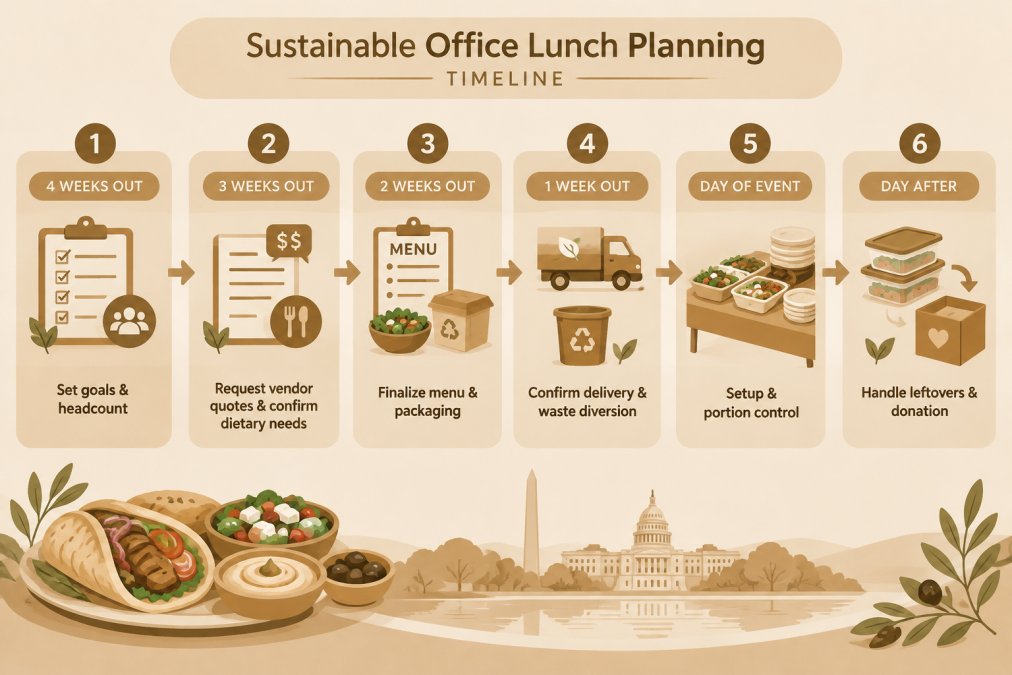
Use this checklist at each stage:
- Four weeks out: set goals, confirm budget, estimate headcount
- Three weeks out: request quotes, ask the vendor questions above, collect dietary needs
- Two weeks out: finalize the menu, confirm packaging and bins
For the broader logistics picture, our corporate catering services guide for Washington DC covers vendor options and delivery planning in more detail.
Here is the countdown the article recommends, working backward from four weeks out.
| When | What to do |
|---|---|
| Four weeks out | Set goals, confirm budget, estimate headcount |
| Three weeks out | Request quotes, ask vendor questions, collect dietary needs |
| Two weeks out | Finalize the menu, confirm packaging and bins |
| One week out | Confirm delivery time, temperature plan, waste pickup |
| Day of event | Set up bins, label food, control portions |
| Day after | Distribute leftovers, log what was wasted |
Measuring Lunch Impact and Balancing Cost and Procurement Trade-Offs
Most sustainability advice stops at "measure your impact." This section turns that into a simple system you can run after every lunch, plus the cost and procurement trade-offs that decide whether the system survives a budget review. The unique angle here is that measurement and procurement are the same conversation: what you track is what you can defend to whoever approves the spend.
Four Metrics That Take Ten Minutes to Collect
Measure four things after each lunch. You do not need fancy tools. A shared spreadsheet and a kitchen scale are enough.
- Food wasted. Weigh leftovers before disposal, or estimate by tray. Record pounds and the share of food ordered that went uneaten. A common pattern is that buffet-style service wastes more than plated or boxed service.
- Packaging avoided. Count the disposable items you did not use: plates, cutlery, cups, condiment packets, bottled water. Compare against a baseline lunch that used all disposables.
- Plant-based share. Note how many dishes were plant-based and what share of the menu they represented. This is the easiest metric to move and the easiest to explain to leadership.
Log the four numbers the day after the event. Repeat next month and compare. Two or three data points turn a claim into a trend, and a trend is what gets a sustainable lunch program renewed.
How to Frame Cost Per Person
Cost is the honest trade-off, and the useful unit is cost per person, not total spend. Local and seasonal food often costs more per head than bulk options. Reusable serviceware costs more upfront but pays back over many lunches.
A practical way to compare options is to price three versions of the same lunch: a baseline, a sustainable version, and a stretch version. The gap between baseline and sustainable is the number you defend. The gap between sustainable and stretch is the number you phase in later.
Procurement Trade-Offs by Volume
Pick your trade-off based on how often you run the lunch:
- One-time lunch: compostable serviceware and a menu built around seasonal produce. Reusables rarely pay back in a single event.
- Weekly team lunch: reusable plates, cutlery, and glasses if the building has a dishwasher or a shared kitchen. The upfront cost amortizes quickly.
- Monthly event with a fixed budget: fewer, better dishes over a long, cheap menu. A shorter menu reduces waste and makes local sourcing easier to afford.
Watch out: compostable packaging only helps if your building has a compost stream. Confirm pickup before you pay a premium for it, or the money buys nothing.
Booking Your Sustainable Office Lunch with a Local Greek Kitchen
Booking is the easy part once the plan is set. At Parthenon Greek Restaurant & Chevy Chase Lounge, we provide private catering services.
If you want a seated group dinner instead of a delivered lunch, our private dining in Washington, DC page covers group arrangements. You can also come see us to talk through your event in person, or book a table through Experience Greece in DC to sample the menu before you commit.
Contact us for current pricing and to discuss your event.
A sustainable office lunch does not require a big budget or a committee. It requires a clear goal, a vendor who already cares, and a plan you follow.
Frequently Asked Questions
How do you plan a sustainable office lunch?
Start with a headcount and a short list of goals: less food waste, less packaging, and more local or plant-based food. Ask caterers how they source ingredients, what packaging they use, and whether they can adjust portions. Confirm dietary needs early, plan for leftovers, and set up recycling and composting before the lunch. A sustainable office lunch works best when the plan is written down and shared with whoever places the order and whoever cleans up.
What should you look for in sustainable office catering?
Ask about sourcing, packaging, and portion flexibility. A good sustainable office catering partner can tell you where produce comes from, whether seasonal items are on the menu, and what containers the food arrives in. Ask if they offer reusable trays or compostable packaging, whether they can scale portions to your headcount, and how they handle delivery within the city. Clear answers on those points matter more than a sustainability logo on a website.
How should an office handle leftover catered food?
Plan for leftovers before the event. Ask the caterer to leave labeled containers, keep hot food hot and cold food cold during service, and refrigerate what is safe within two hours. Offer staff a take-home option with containers on hand, and check whether a local food recovery organization can accept unserved, properly handled food. Track how much comes back so the next order is sized more accurately. Leftover planning is one of the simplest ways to reduce food waste at office events.
How do you estimate food quantities for an office lunch?
Use your RSVP count, not your invite list, and add a small buffer of about 10 percent. Ask the caterer for per-person guidance on proteins, sides, and bread, since portions vary by menu. Build in plant-based options that appeal to everyone rather than a separate small tray. If your office regularly over-orders, compare the leftover volume across two or three lunches and adjust the headcount you give the caterer. Accurate numbers are the fastest route to a zero-waste office lunch.