 How-to
How to Plan a Festive Holiday Dinner Party for Groups
Quick Summary
To plan a festive holiday dinner party for a group, start six to eight weeks out by setting the date with a short survey, fixing a per-person budget, and writing a planning template. Choose a menu that scales to your guest count, then build a cooking timeline so the oven never runs out of space.
- Send a short survey with three to five date options and a firm RSVP deadline about two weeks before the party.
- Divide your total budget by guest count, and reserve about 10 percent for supplies like plates and napkins.
- Plan about 6 to 8 ounces of cooked protein and 1 cup of starches and sides per guest.
- Ask about dietary needs in your survey, and label every dish clearly with its major allergens.
- Cook dishes that reheat well two days ahead, so the oven is free on party day.
Table of Contents
- Using a Short Survey to Lock In the Date
- Build a Holiday Dinner Party Planning Template
- Choose a Holiday Dinner Party Menu That Scales to Your Guest Count
- Christmas Party Food Ideas for a Buffet That Moves Guests Smoothly
- Plan Your Cooking Schedule, Oven Space, and Serving Setup
- Book Your Holiday Dinner Party Catering or Private Room
- Frequently Asked Questions
Set the Date, Budget, and Guest List Six to Eight Weeks Out
A holiday dinner party for a group is easier to pull off when you start early. Six to eight weeks out is the sweet spot for most hosts, because it gives you time to lock in a date, set a budget, and send invitations before everyone's calendar fills up.
Start by deciding who you want to invite and roughly how many people will come. Write the list down. This number drives almost every other decision, from the size of your space to how much food you need.
Using a Short Survey to Lock In the Date
Choosing a date is often the hardest part of group planning. A quick survey solves this problem fast. Send a short form to your guest list with three to five date options and ask people to mark which ones work for them.
Here is what your survey should cover:
- The date and time options you can host
- Whether guests prefer an evening dinner or a lunch gathering
- Any dietary needs or allergies you should know about
- A firm RSVP deadline, usually about two weeks before the party
Once the most popular date wins, send a save-the-date right away. That way, the people who must be there plan around it.
Setting a Per-Person Budget
Before you shop or book anything, set a total budget and divide it by the number of guests. This per-person number tells you what you can spend on each plate, drink, and decoration.
Keep the math simple:
- Total budget divided by guest count equals your per-person cost
- Reserve about 10 percent for supplies like plates, napkins, and serving dishes
- Leave a small buffer for surprises, such as an extra guest or a spilled drink
A potluck-style split can help lower costs. Assign each guest a dish category, such as appetizers, sides, or desserts, and cover the main course yourself or with a caterer.
Build a Holiday Dinner Party Planning Template
A written planning template keeps you from forgetting small details. Think of it as a single page that tracks every task from the first invitation to the last dish washed.
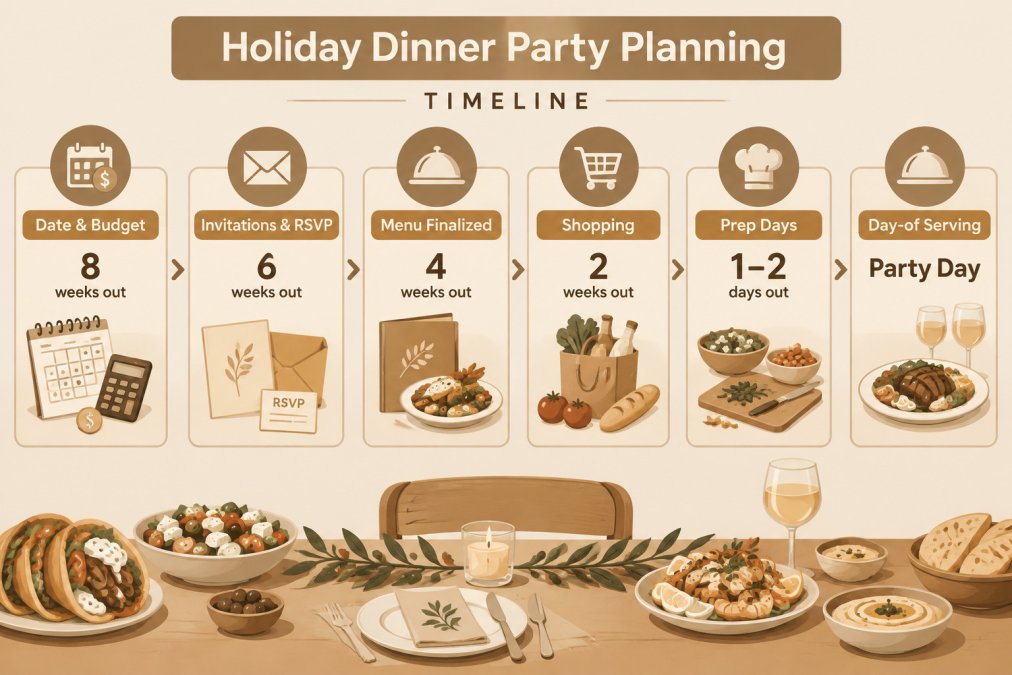
Your template can be a simple spreadsheet or a printed checklist. Include these sections:
- Date and time: Confirmed date, start time, and end time
- Guest list: Names, RSVP status, and dietary notes
- Budget: Total spend, per-person cost, and what you have paid so far
- Menu: Each dish, who is bringing it, and how many servings you need
- Shopping list: Items to buy, with quantities and store
- Prep schedule: What to make ahead, and what to make on the day
- Setup: Table layout, serving dishes, and seating plan
Fill in the template with dates working backward from the party. For example, send invitations at six weeks out, finalize the menu at four weeks, and shop two days before. Seeing the whole plan on one page makes a large event feel manageable.
Choose a Holiday Dinner Party Menu That Scales to Your Guest Count
The best holiday menus are ones you can cook for a crowd without spending the whole party in the kitchen. Pick a main dish that feeds many people with little hands-on time, such as a sliced roast, a baked pasta, or a large casserole. Then add a few appetizers, two or three sides, and one or two desserts.
Keep the menu balanced. Include at least one lighter dish, like a salad or roasted vegetables, so guests have choices that feel fresh next to the heavier foods.
Working Out Portion Sizes and Quantities
Running out of food is one of the most common complaints after a group dinner. A simple rule helps prevent it.
As a starting point, plan for these amounts per guest:
- Main protein: About 6 to 8 ounces cooked
- Starches and sides: About 1 cup per person
- Appetizers: About 6 to 8 small bites per person before dinner
- Desserts: Plan one small serving per person
When you scale a recipe, multiply each ingredient by the ratio of your guest count to the recipe's original yield. Round up, not down. It is better to have a little leftover food than to run short in front of your guests.
Accommodating Dietary Restrictions and Allergies
Ask about dietary needs in your survey, not at the door. Common needs include vegetarian, vegan, gluten-free, and nut allergies.
Label every dish clearly. A small card that names the food and lists major allergens helps guests make safe choices. Make sure at least one vegetarian main and one allergy-safe dessert are on the table. Serve these dishes separately to avoid cross-contact, and use different serving spoons for each one.
Christmas Party Food Ideas for a Buffet That Moves Guests Smoothly
A buffet works well for a big group because people can serve themselves and move around the room. To pick crowd-pleasing dishes, you can explore the Greek restaurant menu for meze, salads, grilled seafood, lamb and desserts. The key is to arrange the food so the line flows without a bottleneck.
Set up the buffet in this order: plates first, then mains, sides, and finally desserts and drinks. Put utensils at the end of the food line so guests do not have to juggle a full plate and a fork at the same time.
Good crowd-pleasing options include:
- Appetizers: Stuffed mushrooms, spinach dip with bread, and a cheese and fruit board
- Mains: Sliced roast turkey or ham, baked lasagna, and a vegetarian pasta bake
- Sides: Mashed potatoes, green beans, and a fresh salad
- Desserts: Sliced pies, cookies, and a platter of mini pastries
Serve hot foods in warm dishes and cold foods over ice to help keep them at safe temperatures.
Plan Your Cooking Schedule, Oven Space, and Serving Setup
Most home kitchens have one oven and a few burners, which becomes a real limit for a big dinner. Plan which dishes need the oven and when, so nothing competes for space at the same time.
Build a cooking timeline that works backward from serving time. Dishes that reheat well, such as casseroles and sliced meats, can be made one or two days ahead and stored in the refrigerator. Desserts and cold salads often hold well overnight too.
Plan your oven like this:
- Two days before: Bake desserts and make casseroles that reheat well
- Day before: Prepare cold salads, chop vegetables, and set up serving dishes
- Party day, morning: Make dips and any dish that needs chilling
- Party day, 60 minutes before: Start reheating mains and sides in staggered batches
Set up serving dishes and utensils the day before. Label each one with its dish name. Keep leftovers moving into the fridge within two hours of serving to stay safe.
The timeline below shows which dishes to prepare on each day, so the oven and burners never compete at the same time.
| When | Task | Note |
|---|---|---|
| Two days before | Bake desserts and make casseroles | Dishes that reheat well |
| Day before | Prepare cold salads and chop vegetables | Set up serving dishes |
| Party day, morning | Make dips and dishes that need chilling | Keep cold until serving |
| Party day, 60 minutes before | Start reheating mains and sides | Stagger in batches |
Book Your Holiday Dinner Party Catering or Private Room
If cooking for a large group feels like too much work, outside help can take the pressure off the kitchen and let you focus on your guests. For a group dinner, you can browse private dining options in Washington, DC to compare room sizes and set-ups. You have three common routes: a full-service caterer who sets up and serves, a drop-off caterer who delivers hot or cold trays, or a private dining room at a restaurant. If you prefer to outsource the food, you can order Greek catering for your group and see how delivery and setup work. Each one trades cost for control over the menu and the timing.
Before you contact anyone, know your guest count range, your budget per person, whether you need a space or only food, and whether you have a kitchen to reheat in. Holiday dates can fill quickly, so booking ahead gives you more choice.
When you request quotes, ask these questions in writing:
- Is there a minimum guest count or minimum spend for private dining?
- What is included in the per-person price, such as plates, utensils, servers, and setup?
- Are taxes and service charges added on top of the quoted price?
- How many dishes can I choose from, and can I mix in vegetarian or allergy-safe options?
- What is the cancellation policy, and how much notice do you need to change headcount?
- For drop-off orders, what are the reheating instructions and the holding time before food must be consumed?
Compare quotes on the same basis. A low per-person price can rise quickly once service fees, delivery, and rental items are added, so write down the total for your exact guest count before you decide.
If you want a restaurant space, tour the private room in person and confirm how many tables and chairs it holds. Check whether you can bring in a cake or a shared dessert, and confirm the end time so you are not rushed out.
For private dining and catering options, visit Experience Greece in DC to check availability and request a quote for your event. Pricing depends on quantity, dates, and delivery.
Frequently Asked Questions
How far in advance should you plan a holiday dinner party?
Start six to eight weeks out for a large group. Set the date and budget first, then send invitations with a firm RSVP deadline about two to three weeks before the event. Finalize the menu and place any catering or venue orders by the end of the third week before the party. Use the final two weeks for shopping, make-ahead dishes, and confirming headcount. Holiday calendars fill quickly, so booking early also protects your preferred date and venue.
How much food do you need for a holiday dinner party for a crowd?
A common planning range is about one pound of total food per guest when you serve a full buffet with several mains, sides, and desserts. Plan roughly four to six ounces of cooked protein per person and count on at least two side dishes per guest. Adjust upward if the party is long, if guests are mostly adults with big appetites, or if you have few desserts. Scale each recipe by multiplying the ingredient amounts by your guest count divided by the recipe's yield, then add a small buffer for seconds.
What should you serve at a holiday dinner party for a large group?
Choose one or two crowd-friendly mains, such as a baked ham, roast turkey breast, or a large pan of lasagna, and pair them with make-ahead sides like mashed potatoes, green salads, and roasted vegetables. Add a vegetarian main so every guest has a substantial option. For appetizers, pick items that hold well at room temperature, such as dips, crostini, and cheese boards. Finish with two or three desserts and a festive drink such as spiced cider or eggnog.
How do you accommodate dietary restrictions at a group holiday dinner?
Send a single invitation that asks about dietary restrictions and allergies alongside the RSVP. Label every dish clearly with its main ingredients and common allergens such as nuts, dairy, gluten, and shellfish. Include at least one vegetarian and one gluten-free option in the main course, and set aside a separate serving spoon for each dish to prevent cross-contact. Keep allergy-sensitive items on a separate part of the buffet table whenever possible.