 How-to
7 Signs of Authentic Greek Food in DC to Spot
Last Updated: November 15, 2026
Quick Summary
To identify authentic greek food in DC, read the menu before you order: a traditional kitchen names its olive oil and feta, lists a full meze category with six or more items, and uses regional dish names like kleftiko, stifado, or horta. Dishes should taste bright and clean, with olive oil and lemon rather than heavy cream or sugar.
- A real meze section usually lists six or more items, including a legume dish and a seafood or offal dish.
- Dishes like taramasalata, fava, horta, grilled octopus, and lamb kleftiko signal a kitchen that cooks Greek food.
- Gyros and souvlaki should arrive with char and taste of charcoal and oregano, not just salt.
- Ask which olive oil and feta a restaurant uses and whether the tzatziki is made in house.
- Read reviews for dish names like horta or grilled octopus, not just star ratings.
Table of Contents
- Start With the Menu: Authenticity Cues You Can Read Before You Order
- Authentic Greek Dishes to Order and What They Should Taste Like
- Traditional Greek Ingredients and Preparation Cues to Look For
- Reading a Greek Restaurant Menu: Regional Dishes and What They Reveal
- How to Evaluate a Greek Restaurant Before You Visit
- Finding Greek Food Near Me in DC: Neighborhoods and Dining Styles
- Book a Table and Test the Signs for Yourself
- Frequently Asked Questions
Start With the Menu: Authenticity Cues You Can Read Before You Order
Learning how to identify authentic greek food in dc starts before the first bite arrives. The menu itself is your best evidence, and at Parthenon Greek Restaurant & Chevy Chase Lounge we have watched diners scan ours for clues since 1989. You can explore Parthenon's Greek restaurant menu, from meze and salads to grilled seafood, lamb, desserts and online ordering.
Dishes That Signal a Traditional Kitchen
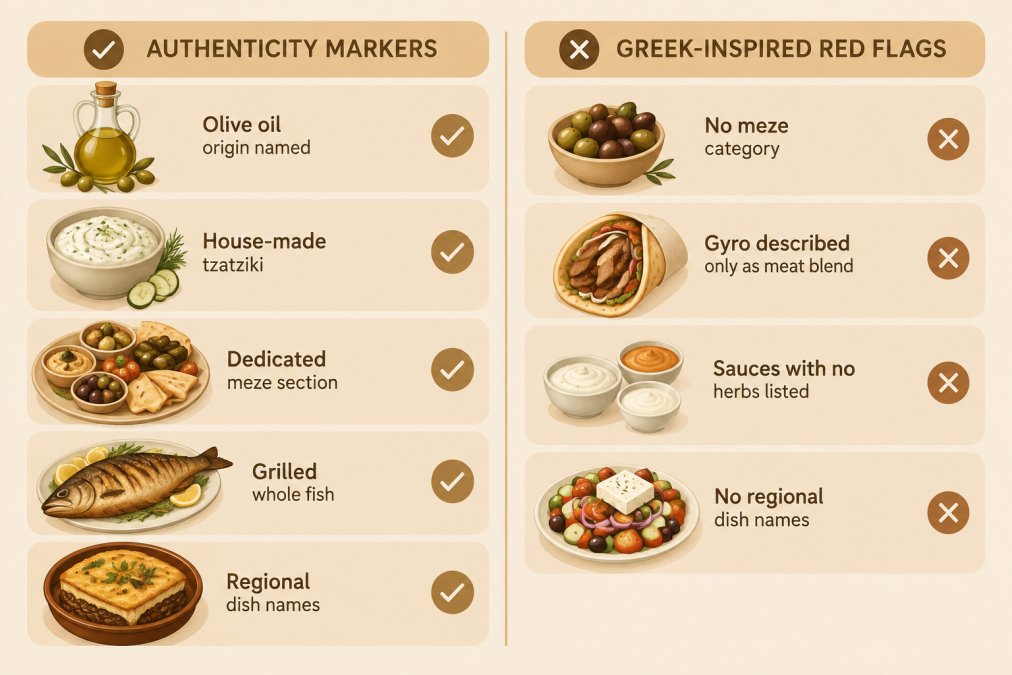
Certain dishes rarely appear on a menu unless someone in the kitchen actually cooks Greek food. Look for taramasalata, fava, horta, grilled octopus, and lamb kleftiko. These take time, technique, and ingredients that a shortcut kitchen will not bother sourcing. A menu that lists them alongside a clear meze section is telling you something real.
Red Flags on a Greek-Inspired Menu
The word "Greek-inspired" is doing a lot of work on some menus. Watch for a gyro described only as a "meat blend," sauces with no herbs named, and a menu with no meze category at all. Those are signs of a kitchen borrowing flavors rather than cooking a tradition.
Authentic Greek Dishes to Order and What They Should Taste Like
Authentic Greek dishes should taste bright, clean, and distinct: olive oil rather than heavy cream, lemon rather than sugar, oregano and thyme rather than a generic seasoning blend. That contrast is the simplest test you can run at the table. If you want a deeper walk through the classics, our guide to traditional Greek dishes covers each one from village salad to spanakopita.
Meze and Shared Plates
Meze is the heart of the meal, not an appetizer afterthought. Order tzatziki, tirokafteri, dolmades, and grilled halloumi and share them. A kitchen that makes its own dips will show it in the texture: thick yogurt, visible cucumber, real garlic.
Gyros, Souvlaki, and the Main Course Test
Gyros and souvlaki should arrive with char, not steam. Grilled meat that tastes of charcoal and oregano is the goal; meat that tastes only of salt is a shortcut. First-timers building an order from dips to mains can follow our first-timer's ordering guide.
Traditional Greek Ingredients and Preparation Cues to Look For
Traditional Greek ingredients announce themselves on the plate. Extra virgin olive oil should taste peppery, feta should be salty and crumbly rather than rubbery, and herbs should be dried oregano and thyme rather than a mixed blend.
Watch out: a menu that promises "imported ingredients" but cannot tell you which ones should leave you asking questions. Ask your server where the olive oil comes from.
Reading a Greek Restaurant Menu: Regional Dishes and What They Reveal
Greek food is not one uniform cuisine, and the dish names on a menu are a map of where the kitchen's tradition comes from. Treating "Greek" as a single style is the most common mistake diners make, and the easiest one to correct. Once you know a few regional markers, a menu tells you far more than the word "authentic" ever will.
Island Cooking: Seafood, Lemon, and Herbs
The Aegean islands built their cooking around what the sea and the dry hills provided: grilled whole fish, octopus dried in the sun and then grilled, sardines, and simple vegetable dishes dressed with olive oil and lemon. Island menus tend to be lighter and more herb-forward, with oregano, thyme, and wild greens (horta) doing much of the work.
Mainland and Northern Cooking: Braises, Paprika, and Phyllo
Northern and mainland kitchens lean toward slow-cooked meats, layered phyllo pies, and warming spices. Dishes like kleftiko (lamb slow-roasted in parchment), stifado (braised meat with pearl onions), and gemista (vegetables stuffed with rice and herbs) point to a mainland tradition. Paprika and pepper appear more often in the north, reflecting influences from the Balkans and the interior. A menu with several braises and phyllo pies is telling you the kitchen cooks beyond the grill.
Crete and the Peloponnese: Greens, Cheeses, and Olive Oil
Crete is known for wild greens, distinct cheeses, and a heavy reliance on olive oil, while the Peloponnese contributes its own olives, oranges, and hearty vegetable dishes. Menus that list unusual greens, local cheeses, or olive-oil-forward vegetable plates are often drawing on these traditions. These are the dishes that rarely survive on a shortcut menu because the ingredients are hard to source and the preparations take time.
What a Menu's Regional Balance Reveals
A menu that names regions, or that clusters dishes by style, is usually written by someone who cooks them. A menu of generic "Greek salad, gyro, baklava" tells you less, not because those dishes are inauthentic but because they are the lowest common denominator across every regional tradition.
Watch out: a menu that lists regional names but describes every dish with the same two or three ingredients is borrowing vocabulary rather than cooking a tradition. Ask your server which region a dish comes from; a specific answer is a good sign, and a blank look tells you the names are decoration.
Using Regional Knowledge to Order
Regional awareness also improves your order. If you want a light, seafood-forward meal, look for island markers. If you want a hearty shared dinner, look for braises and phyllo pies. If you want to test the kitchen's depth, order one dish from each regional cluster and see whether the preparations actually differ.
How to Evaluate a Greek Restaurant Before You Visit
Most diners decide where to eat in under two minutes, then spend the meal wondering whether the food was the real thing. A short pre-visit evaluation fixes that. The goal is not to certify a restaurant as authentic, no single test does that, but to gather enough evidence to predict whether the kitchen is cooking a tradition or assembling a theme.
Step 1: Read the Menu as a Document, Not a Sales Pitch
Open the menu online and read it the way an editor would. Count the meze items. A kitchen that treats meze as a real course usually lists six or more, including at least one made with legumes (fava, gigantes) and one with offal or seafood (grilled octopus, sardines).
Watch out: a menu that uses "authentic" three times but cannot name a single cheese, olive oil, or herb is marketing, not evidence.
Step 2: Trace the Sourcing Claims
Sourcing is where menus separate. Greek kitchens often lean on a small set of high-impact imports, such as extra virgin olive oil, feta, and oregano. A confident menu names at least one. If the menu says "imported ingredients" with no detail, that is a warning sign, not a neutral statement.
Step 3: Read Reviews for Dishes, Not Stars
Star ratings tell you about service and noise as much as food. Read reviews for dish names. Reviewers who mention taramasalata, horta, or grilled octopus are describing a menu with depth; reviewers who only mention gyro platters and fries are describing a different kind of restaurant. Look for patterns across at least a dozen reviews rather than one enthusiastic post. , from shared-plate menus to seafood-forward kitchens (Eater's guide to the area's newest Greek restaurants).
Step 4: Check Ownership and Culinary Background
Family-owned Greek-American restaurants are a legitimate and important part of the landscape, and many cook traditional recipes alongside American adaptations. The useful question is not whether the owner is Greek but whether someone in the kitchen has a culinary background in Greek cooking, a family taverna, a culinary program, years in a Greek kitchen. Restaurant websites and local press profiles often mention this.
Step 5: Ask Two Questions Before You Book
Call or check the reservation page and ask two specific questions: Which olive oil and feta do you use, and is the tzatziki made in house? A confident, specific answer is a good sign. A vague answer is not disqualifying, busy staff may not know, but it tells you to look for other evidence on the menu.
| What to Check | Good Sign | Warning Sign |
|---|---|---|
| Menu structure | Dedicated meze section with six or more items | No shared-plate category |
| Ingredients | Olive oil and feta named, ideally with origin | "Imported" with no detail |
| Grilled dishes | Whole fish, char described, cut named | Fried or steamed only |
| Dish names | Regional or traditional (kleftiko, horta) | Generic and vague |
| Dips | Made in house, texture and herbs visible | Uniform texture, no herbs |
| Reviews | Dish names mentioned repeatedly | Only gyro and fries mentioned |
| Ownership | Culinary background in Greek cooking | No information at all |
Step 6: Match the Restaurant to the Occasion
A carryout counter with a short menu of gyros and souvlaki can be excellent at what it does; a white-tablecloth room with a long meze list serves a different purpose. Evaluate each against its own format. The question is whether the kitchen is cooking or assembling, and a small menu executed well often beats a long menu executed poorly.
Finding Greek Food Near Me in DC: Neighborhoods and Dining Styles
Searching for Greek food near me in DC turns up everything from carryout counters to white-tablecloth rooms, and the setting shapes the experience. For a shortlist of options, our local's guide to authentic Greek food is a good place to start.
Casual carryout and full-service dining are both legitimate. The question is whether the kitchen is cooking or assembling.
Book a Table and Test the Signs for Yourself
Reading a menu only takes you so far. Bring your checklist and see how the food holds up, you can Experience Greece in DC by reserving a table and putting every sign on this list to the test.
Ready to put these signs to the test? Reserve a table at Parthenon Greek Restaurant & Chevy Chase Lounge and order a spread of meze, grilled seafood, and something from the lounge.
Frequently Asked Questions
How can you tell if a Greek restaurant is authentic?
Read the menu before you sit down. A traditional kitchen lists meze as its own section, names regional dishes like moussaka or horiatiki, and describes how food is cooked (grilled, roasted, braised). Ask where the olive oil and feta come from. Authentic Greek food relies on a short list of fresh ingredients: olive oil, lemon, oregano, garlic, tomatoes, and fish. If the menu leans on generic 'Mediterranean' language and heavy cream sauces, it is likely Greek-inspired rather than traditional.
What dishes should you try at a Greek restaurant?
Order across the menu to test the kitchen. Start with meze: tzatziki, taramosalata, dolmades, and grilled octopus. Follow with a horiatiki salad (tomatoes, cucumber, olives, feta, oregano, olive oil, no lettuce), then a grilled fish or lamb dish. A gyro should include pita, sliced meat, tomato, onion, and tzatziki. If the kitchen handles these simple dishes well, the rest of the Greek restaurant menu usually follows.
What ingredients are common in traditional Greek cooking?
Traditional Greek ingredients are few and seasonal: extra virgin olive oil, lemons, oregano, garlic, tomatoes, cucumbers, olives, feta, yogurt, legumes, and fresh fish. Meat appears in smaller portions, often grilled or braised. Restaurants that source imported Greek products, including olive oil and cheese, tend to produce food closer to what you would eat in Greece. Ask your server which items are imported and which are made in-house.
What is the difference between Greek and Mediterranean food?
Mediterranean is a broad label covering Greek, Italian, Lebanese, Turkish, and other cuisines. Greek food is more specific: it uses olive oil rather than butter, oregano and lemon rather than cream sauces, and dishes like moussaka, souvlaki, and horiatiki. A menu that lists Greek and Italian dishes side by side is usually Mediterranean, not traditional Greek. Look for a focused menu with regional Greek names and preparation methods spelled out.