 listicle
7 Keys to Choosing Outdoor Catering for Community Events
Last Updated: October 25, 2026
Quick Summary
Outdoor catering community events require managing weather, power sources, water access, and guest comfort while keeping food at safe temperatures and protecting it from contamination. The best outdoor caterers bring insulated containers, warming trays, and ice baths designed for outdoor use, plus experience with logistics like permits, site access, and weather contingencies that indoor catering doesn't demand.
- Hot food must stay above 140°F and cold food below 40°F; perishable items shouldn't sit out longer than two hours, or one hour if temperature exceeds 90°F.
- Request itemized quotes breaking down food, staffing, delivery, rentals, service charge, gratuity, and tax separately to compare true total costs, not just per-person rates.
- Walk the site with your caterer before booking to identify permit requirements, power and water access, vehicle access, and weather contingencies.
- Greek cuisine naturally suits outdoor catering because grilled proteins, cold salads, and meze platters maintain flavor across temperature swings and don't require constant reheating.
- Check references from past clients and ask whether food arrived hot, the caterer was responsive to changes, and whether they would hire them again.
Table of Contents
- What Makes Outdoor Catering for Community Events Different
- Outdoor Catering Menu Ideas That Work for Groups
- Keeping Food Safe at Outdoor Events
- Finding Affordable Event Catering Without Sacrificing Quality
- Event Catering Checklist for Outdoor Community Gatherings
- Logistics That Make or Break an Outdoor Event
- Booking Your Community Event Catering
- Frequently Asked Questions
What Makes Outdoor Catering for Community Events Different
Outdoor catering community events require a fundamentally different approach than indoor restaurant service. Weather, power sources, water access, and guest comfort create constraints that indoor venues simply don't face.
When you're hosting people outside, food stays hot or cold only as long as your equipment allows. Guests sit in direct sun or wind. Bugs become a real concern. Restroom facilities may be limited.
Indoor catering lets you rely on a kitchen, climate control, and established infrastructure.
This guide covers the seven keys to selecting outdoor catering that actually works. We'll walk through menu planning, food safety in outdoor settings, realistic pricing, logistics that hold up under pressure, and the checklist you need before booking.
Outdoor Catering Menu Ideas That Work for Groups
The best outdoor catering menus prioritize foods that hold temperature well and taste good whether they're served hot or slightly cooled.
Greek cuisine is built for outdoor entertaining. Grilled lamb, chicken souvlaki, and seafood maintain their flavor across temperature swings.
Consider these menu categories when planning outdoor catering: Learn more about catering menus for groups.
- Grilled proteins: lamb, chicken, seafood that guests remember
- Cold salads: Greek salad, pasta salad, grain-based options that hold well
- Meze and appetizers: cheese, olives, bread, vegetables that don't spoil quickly
- Bread and sides: flatbreads, rice, roasted vegetables
- Desserts: baklava, fruit, items that don't melt in outdoor heat
Avoid heavy cream sauces, delicate items that wilt easily, and foods that require precise temperature control.
When you explore Parthenon's Greek restaurant menu, you'll see how traditional Greek dishes naturally suit group catering.
Keeping Food Safe at Outdoor Events
Food safety outdoors depends on temperature control, time limits, and protecting food from contamination.
Many community event organizers don't realize that outdoor catering requires active temperature management. You can't just set food on a table and hope.
The second safety layer is preventing contamination. Flies, dust, and direct sunlight all pose risks. Covered serving stations, food shields, and careful handwashing reduce these hazards.
A reliable outdoor catering service will discuss food safety protocols before your event.
Finding Affordable Event Catering Without Sacrificing Quality
Most caterers quote a per-person food price, but the number that matters for a community event is the all-in total. Organizers who compare only per-person rates routinely get surprised by minimums, delivery zones, staffing charges, rental fees, and service charges. Build your budget around the total, then work backward to a per-person figure you can defend to your board or committee.
The line items that make up a real quote
Ask every caterer to break the estimate into these categories so quotes are comparable side by side:
- Food and beverage per person, the headline number, but usually the smallest variable.
- Staffing, servers, cooks, and event captains are often billed hourly with a minimum shift (commonly four to six hours) plus setup and breakdown time.
- Delivery and setup, distance-based delivery fees, plus charges for tent, table, and serving-station setup.
- Rentals, chafing dishes, warming trays, ice baths, linens, plates, and utensils are frequently separate from the food price.
- Service charge and gratuity, a service charge (often in the 15-22% range) and gratuity may both appear; confirm whether they are additive.
- Sales tax, applies to taxable food and service items and varies by jurisdiction; ask for the tax line explicitly.
- Minimums, food-and-beverage minimums, guest-count minimums, and weekend or peak-season surcharges.
A simple total-cost comparison method
For each quote, calculate: (food + beverage) + staffing + delivery/setup + rentals + service charge + gratuity + tax = total event cost. Then divide by your confirmed guest count to get a true per-person figure.
A common pattern is that the lowest per-person quote is not the lowest total, because it excludes rentals and staffing. A caterer who includes plates, utensils, warming equipment, and cleanup in one number is easier to budget against even if the food line looks higher.
Where community events can legitimately save
- Simplify the menu. Fewer proteins and one or two strong sides reduce labor and equipment needs more than cutting ingredient quality does.
- Choose service style deliberately. Buffet and family-style service generally cost less in staffing than plated service; food stations can reduce server counts while keeping variety.
- Shorten the service window. A tighter serving period can reduce hourly staffing charges.
- Pick up instead of delivered setup where your venue and volunteer capacity allow it, but confirm food-safety holding requirements first.
- Ask about off-peak dates and weekday pricing, which some caterers discount.
Questions that expose hidden costs
- What is the food-and-beverage minimum, and does my guest count meet it?
- Is there a minimum staff shift, and does setup/breakdown count toward it?
- Are rentals included, or billed separately, and at what markup?
- Is delivery included within my venue's zone, and what is the fee outside it?
- Are service charge and gratuity both applied, and are they calculated before or after tax?
- What is the cancellation and weather-postponement policy, and are deposits refundable?
Quality caterers can work within tight community budgets by adjusting menu complexity and service style rather than cutting ingredient quality or food-safety practices. The goal is a total you can plan around, not a per-person number that grows after you sign.
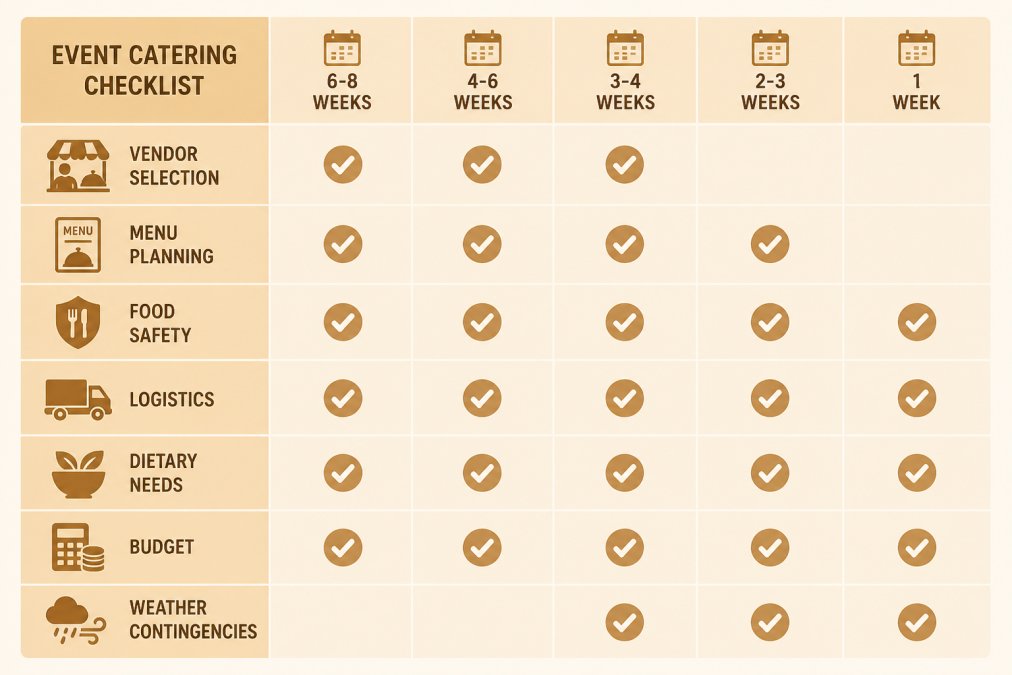
Event Catering Checklist for Outdoor Community Gatherings
Before booking, use this checklist to evaluate caterers and plan your event:
| Planning Category | Key Consideration | Timeline |
|---|---|---|
| Vendor Selection | Request quotes from 3+ caterers; check references | 6-8 weeks before |
| Menu Planning | Confirm final headcount and dietary needs | 4-6 weeks before |
| Food Safety | Discuss temperature management and protocols | 4 weeks before |
| Logistics | Confirm delivery, setup, breakdown, rentals | 3-4 weeks before |
| Dietary Needs | Collect dietary restrictions and allergies | 3 weeks before |
| Budget Approval | Finalize pricing and payment terms | 3 weeks before |
| Weather Plan | Discuss contingencies and backup plans | 2 weeks before |
| Final Confirmation | Reconfirm headcount, timing, and details | 1 week before |
Before you book, confirm that your caterer has handled events similar in size and type to yours. A caterer experienced with 50-person corporate picnics may struggle with a 200-person community festival. Experience matters because outdoor events expose gaps in planning faster than indoor ones do.
Logistics That Make or Break an Outdoor Event
Outdoor community events fail on logistics more often than on food. The caterer's job is to cook and serve; the organizer's job is to make sure the site can support them. Treat the items below as a joint checklist you walk through with your caterer before signing.
Permits and public-space requirements
If your event is in a park, plaza, street, or other public space, confirm early what the jurisdiction requires. Common requirements include:
- Special-event or park-use permits, often filed with the parks department or special-events office, sometimes weeks in advance.
- Temporary food-service permits, many health departments require a permit for food prepared or served at a temporary event, even when the caterer is licensed.
- Fire and safety review, open-flame cooking, propane, and generators may require approval or restrictions.
- Insurance certificates, venues and permitting agencies frequently require the caterer to provide a certificate of insurance naming the organizer or venue as additional insured, with general liability coverage.
- Alcohol licensing, if alcohol is served, confirm who holds the license and whether the site allows it.
Power, water, and site access
- Power, confirm whether the site has accessible outlets and what amperage they support. Warming equipment, refrigeration, and lighting may require a generator; ask who supplies it and who fuels it.
- Water, handwashing stations and cleaning water are required for food service. Confirm whether the site provides potable water or the caterer brings it.
- Access and setup space, measure the serving area and confirm vehicle access for delivery, plus a load-in path that doesn't cross guest traffic.
- Surface and slope, uneven ground affects tables, chafing dishes, and guest flow; note it in the site walkthrough.
- Trash and grease, confirm who removes waste and whether the site requires haul-away.
Weather contingencies
Ask for the caterer's written weather plan. A workable plan typically covers: a tent or canopy decision point and rental contact; wind protection for serving stations; a rain date or postponement policy; and a heat plan (shade, ice, and shortened holding times when temperatures exceed 90°F). The best caterers will tell you the trigger conditions for each decision rather than promising nothing will go wrong.
Staffing and cleanup expectations
Confirm how many servers and kitchen staff the caterer brings, whether they manage cleanup and trash removal, and who is responsible for rentals at the end of the night. Clear written expectations prevent the most common day-of disputes.
Booking Your Community Event Catering
When you're ready to book outdoor catering community events, start with caterers who understand your vision.
Ask about their experience with outdoor events specifically. Have they catered in parks, on patios, or at other outdoor venues?
Check references.
When you book a table or catering service, Parthenon Greek Restaurant & Chevy Chase Lounge brings decades of experience serving community events.
Review frequently asked questions about catering and private events to understand how we approach outdoor gatherings, what to expect during the planning process, and how we ensure food safety and guest satisfaction.
Choosing the right outdoor catering for community events requires balancing quality, logistics, and realistic planning.
Frequently Asked Questions
What should an outdoor event catering checklist include?
A complete checklist covers vendor selection and contracts, menu and dietary requirements, food safety and temperature control, delivery and setup logistics, staffing and service style, weather contingencies, permits and insurance (if required by your venue), guest count confirmation, and final payment terms. Review your checklist 2-3 weeks before the event, then again 1 week out to catch any missed details.
How do you keep catered food safe at an outdoor event?
Maintain cold foods at 41°F or below and hot foods at 135°F or above using insulated containers and ice packs or warming equipment. Keep raw and cooked foods separate to prevent cross-contamination. Use single-use utensils and serving tools. Cover all food when not actively serving. Limit food sitting out to 2 hours maximum (1 hour if the temperature exceeds 90°F). Ensure your caterer follows local health codes and has proper food handling certification.
What are affordable event catering options for a community event?
Affordable options include buffet-style service (lower labor costs than plated meals), seasonal menus that use available ingredients, box lunches for smaller groups, and food stations that let guests serve themselves. Barbecue, pizza, and Mediterranean fare like Greek cuisine offer good value per person. Ask caterers about package deals, off-peak pricing, or simplified setups. Confirm what's included: delivery, setup, staffing, and cleanup. Request itemized quotes to compare actual costs.
How far in advance should you book an event caterer?
Book 4-6 weeks ahead for community events of 50-100 people to secure your preferred date and menu customization. Larger events (150+ guests) benefit from 8-12 weeks advance notice. For smaller gatherings (under 30 people), 2-3 weeks may be sufficient. Confirm your caterer's availability early and get the agreement in writing with menu details, guest count, delivery time, and total cost.