 comparison
Is Greek Food Better Than Italian? A 2026 Comparison
Table of Contents
- Greek vs Italian Food Differences: What Actually Sets Them Apart
- Popular Greek Dishes for Beginners to Try First
- Essential Mediterranean Dishes for First-Time Diners
- Greek Food Health Benefits: What the Evidence Shows
- Dish-by-Dish Comparison: Greek Food vs Italian Food
- Dietary Needs and Practical Meal Choices for Every Diner
- Which Cuisine Wins? A Verdict Tailored to Your Preferences
- Frequently Asked Questions
Last Updated: October 12, 2026
Greek vs Italian Food Differences: What Actually Sets Them Apart
Is Greek food better than Italian? It depends on what you value: Greek food leans on lemon, olive oil, oregano, and grilled proteins, while Italian food builds layered flavor from tomato, basil, butter, and slow-simmered sauces.
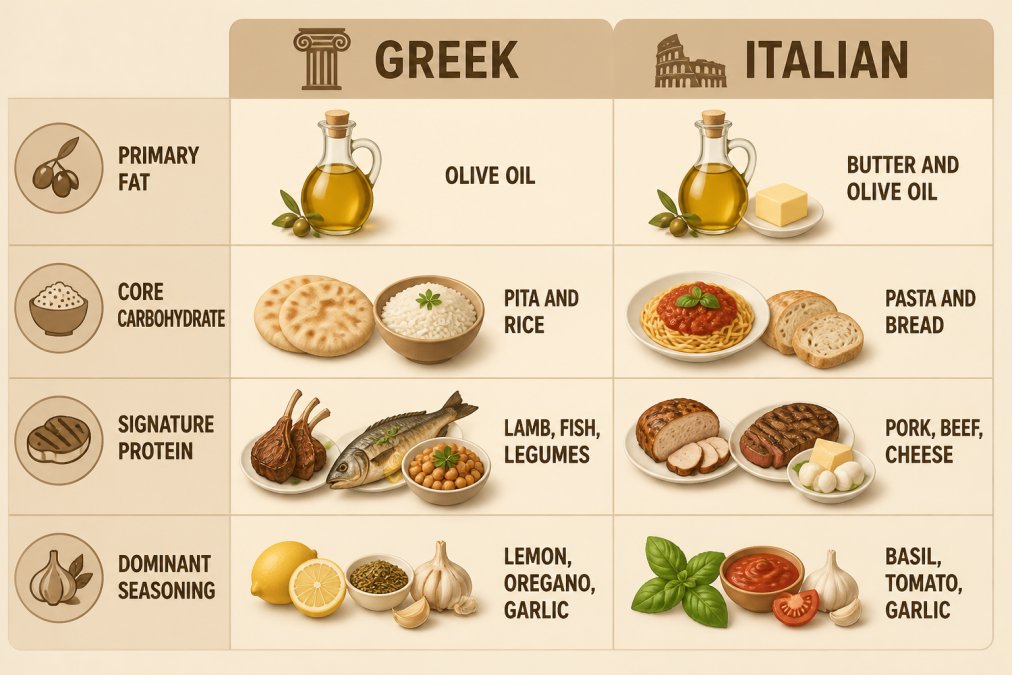
Both belong to Mediterranean cuisine and prize fresh ingredients. The difference is how each seasons, cooks, and plates.
The cuisines differ most in fat and acid: Greek cooking finishes with lemon and extra virgin olive oil, while Italian cooking starts with butter, pancetta, or long-cooked tomato.
Core Ingredients and Cooking Methods
Greek cooking favors high heat and open flame: souvlaki and whole fish on the grill, vegetables roasted with oil and oregano, lemon squeezed on at the end. Italian cooking leans on slow heat and layers, as in a ragù simmered for hours or risotto stirred to order.
Regional Diversity Within Each Cuisine
Both cuisines are far more regional than menus suggest. Greek cooking changes between the mainland, the Peloponnese, and the islands, where seafood and wild greens dominate. Italian food splits into northern cooking (butter, rice, polenta) and southern cooking (tomato, olive oil, dried pasta).
That regional spread is why "which is better" resists a single answer: you are comparing dozens of local traditions, not two monoliths.
Popular Greek Dishes for Beginners to Try First
Start with grilled meat, then branch into seafood and vegetable plates. These are the most approachable entry points for anyone new to Greek food.
Meat and Grilled Dishes
Gyros and souvlaki are the gateway dishes: seasoned meat, warm pita, tomato, onion, and tzatziki. Lamb, roasted or grilled, is the most traditional. Keftedes, seasoned meatballs, suit anyone wanting familiar textures with Greek seasoning.
Fish, Seafood, and Vegetable Options
Grilled fish with lemon and olive oil is the island standard, and octopus, shrimp, and calamari appear simply grilled. If seafood is not your thing, Greek food still delivers: moussaka layers eggplant, potato, and béchamel; spanakopita wraps spinach and feta in phyllo; and horiatiki, the village salad, pairs tomato, cucumber, olives, and feta with oil and oregano.
Essential Mediterranean Dishes for First-Time Diners
A first visit to either cuisine goes best family style: two or three small plates per person, shared, letting the table fill up. That is how both are eaten at home.
For Greek food, build a table from tzatziki, taramasalata, grilled halloumi, dolmades, and olives, then add one grilled meat and one seafood dish.
| Dish | Cuisine | Main Ingredients | Best For |
|---|---|---|---|
| Moussaka | Greek | Eggplant, potato, béchamel | Vegetarian-leaning diners |
| Souvlaki | Greek | Pork or chicken, pita, tzatziki | First-time Greek diners |
| Parmigiana | Italian | Eggplant, tomato, mozzarella | Comfort-food seekers |
| Grilled octopus | Greek | Octopus, lemon, olive oil | Adventurous seafood fans |
| Risotto | Italian | Rice, broth, butter, cheese | Creamy-texture lovers |
Greek Food Health Benefits: What the Evidence Shows
Greek food fits the Mediterranean diet pattern closely, and that pattern is one of the most studied ways of eating in the world.
The caveat: both cuisines can be heavy. Greek food brings fried items and phyllo pastries; Italian food brings cream sauces and large pasta portions. Healthfulness depends on what you order, not the flag on the menu.
Nutrition Comparisons With Italian Favorites
Greek plates often carry more vegetables and legumes by default: fasolada, a white bean soup, and gigantes, giant beans baked in tomato, are everyday dishes.
Where Italian food tends to run higher: refined carbohydrates from white pasta and bread, plus cured meats like pancetta and prosciutto. Where Greek food tends to run higher: sodium from feta and olives, and fat from fried appetizers.
How the Two Cuisines Compare Plate by Plate
Broad health claims fall apart once you compare equivalent meals. Here is how representative plates stack up.
- Everyday protein plate: A Greek plate of grilled fish or souvlaki with horiatiki and gigantes lands heavy on vegetables, legumes, and olive oil. An Italian plate of sausage and peppers with bread lands heavier on cured pork and refined carbohydrate. Greek usually wins on fiber and vegetable volume; Italian can win on satiety if the portion is smaller.
- Pasta night vs meze night: Spaghetti with tomato sauce is mostly refined carbohydrate with modest vegetable contribution. A meze spread of tzatziki, dolmades, grilled halloumi, and olives spreads the same calories across more fiber and fat, slowing eating and blunting blood-sugar spikes. The trade-off is sodium: feta, olives, and taramasalata are all salty.
- Dessert: Baklava is honey, nuts, and phyllo, high in sugar and fat but with some nut protein and fiber. Tiramisu is mascarpone, sugar, and coffee-soaked ladyfingers, higher in saturated fat and refined carbohydrate. Neither is health food; both are occasional.
What Most People Get Wrong
A common mistake is assuming Greek food is automatically lighter because it uses olive oil and lemon. Olive oil is still calorie-dense, and fried kefalograviera or phyllo-heavy spanakopita can carry more fat than simple pasta with tomato.
The practical takeaway: judge the plate, not the cuisine. Ask how the protein is cooked (grilled vs fried), whether a vegetable or legume is the base or garnish, and how much cheese and cured meat is on top.
Dish-by-Dish Comparison: Greek Food vs Italian Food
Comparing fairly means using the same criteria per dish: dominant fat, acid source, cooking method, texture, and fit on a shared table. Broad claims like 'Greek is brighter' or 'Italian is richer' collapse once you line up equivalent dishes. Here is how the signature plates stack up.
Eggplant, Layered and Baked
Moussaka vs parmigiana. Both layer eggplant and sauce, but the mechanisms diverge. Moussaka roasts or fries eggplant, then layers it with spiced lamb or beef and béchamel, so fat comes from olive oil, meat, and dairy. Parmigiana skips the meat, uses tomato as the only sauce, and relies on mozzarella and parmesan.
Skewers and Sausage
Souvlaki vs Italian sausage. Greek skewers are leaner cuts, pork shoulder, chicken thigh, or lamb, marinated in lemon, olive oil, and oregano, then grilled hot and fast. Italian sausage is ground pork with fennel seed, salt, and fat, often braised with peppers or grilled on a roll. Souvlaki finishes with acid; sausage with fat and spice.
Seafood, Two Ways
Grilled whole fish vs seafood pasta. Greek preparation lets the fish speak: whole fish, olive oil, lemon, salt, maybe oregano. Italian preparation builds a sauce, tomato, garlic, white wine, chili, carried by pasta. The Greek version rewards freshness and technique; the Italian version is more forgiving and filling. Diners who love fish order Greek; diners who love sauce order Italian.
Tomato-and-Cheese Salads
Horiatiki vs caprese. Both are tomato-and-cheese salads, but horiatiki skips lettuce and adds cucumber, red onion, Kalamata olives, and a slab of feta, dressed with olive oil, oregano, and maybe red wine vinegar. Caprese is tomato, mozzarella, basil, olive oil, and salt. Horiatiki is saltier and more acidic; caprese is creamier and more delicate.
Desserts
Baklava vs tiramisu. Baklava is layered phyllo, chopped nuts, and honey or sugar syrup, crisp, sticky, very sweet. Tiramisu is mascarpone, espresso-soaked ladyfingers, and cocoa, soft, creamy, bittersweet. Baklava travels and shares well; tiramisu needs to stay cold and is best the day it is made.
What the Pattern Actually Shows
Across the menu, the same trade-off repeats. Greek cooking finishes with acid (lemon, vinegar) and relies on high, dry heat (grill, roast, fry). Italian cooking builds with fat (butter, pancetta, cheese) and relies on moist, slow heat (simmer, braise, bake). Neither is better; they produce different textures and cravings. For char, brightness, and a lighter finish, Greek food usually wins.
Regional Nuance Matters More Than the Flag
A Greece-versus-Italy framing flattens real regional variation. Greek cooking changes between the mainland, the Peloponnese, and the islands, island cooking leans on seafood, wild greens, and capers; mainland cooking on lamb, beans, and phyllo. Italian cooking splits between the north (butter, rice, polenta, cream) and the south (olive oil, tomato, dried pasta, chili).
Dietary Needs and Practical Meal Choices for Every Diner
Both cuisines accommodate most dietary needs, but Greek food has a slight edge for vegetarians and anyone avoiding gluten, since its menus lean on legumes, vegetables, and grilled proteins that need no modification.
- Vegetarian: Greek gives you moussaka, spanakopita, gigantes, and mezze spreads. Italian gives you parmigiana, caprese, and vegetable risotto.
- Gluten-free: Greek food centers on grilled meat, fish, rice, and salads. Italian food centers on pasta and bread, so you will rely more on substitutions.
- Low-carb: Greek food wins comfortably, with grilled proteins and salads as the default.
Which Cuisine Wins? A Verdict Tailored to Your Preferences
There is no universal winner. Greek food wins on freshness, simplicity, and lighter everyday eating. Italian food wins on comfort, richness, and the variety of pasta and bread.
For bright, clean flavors and grilled seafood, choose Greek. For slow-cooked depth and a pasta course, choose Italian. For both in one evening, that is what sharing plates are for.
At Parthenon Greek Restaurant & Chevy Chase Lounge, we have served traditional Greek cuisine since 1989, using imported Greek products and extra virgin olive oil in family recipes. Our Chevy Chase Lounge pours handcrafted cocktails, our patio handles a long dinner, and our private catering covers office lunches and larger celebrations. Book a table and judge Greek food against Italian food yourself, Experience Greece in DC and taste the difference firsthand.
Frequently Asked Questions
Which cuisine is healthier, Greek or Italian?
Both can be healthy, but traditional Greek food often has an edge due to higher use of olive oil, legumes, and vegetables. Greek cuisine features more fish and pulses, while Italian food relies more on refined carbohydrates like pasta and white bread. However, Italian cuisine also includes plenty of healthy ingredients like tomatoes, garlic, and olive oil. The healthiest choice depends on preparation methods and portion sizes in either case.
What are the main differences between Greek and Italian food?
Greek vs Italian food differences come down to core ingredients and cooking methods. Greek cuisine emphasizes lemon, wild herbs, olive oil, lamb, fish, and feta cheese with grilling and roasting as primary techniques. Italian food centers on tomatoes, basil, pasta, pizza, and regional cheeses with boiling, baking, and slow-simmering. Greek food tends to be simpler in seasoning, while Italian cuisine often layers more complex flavors through sauces and reductions.
Which cuisine is better for vegetarians, Greek or Italian food?
Italian food offers more vegetarian pasta and pizza options, but Greek cuisine provides excellent vegetable-forward dishes like briam, fasolada, and horiatiki salad. Greek food health benefits include more legume-based meals that satisfy without meat. Italian cuisine has caponata, parmigiana, and risotto primavera. Both work well for vegetarians, though Greek food often includes more pulses and fresh vegetables as main courses rather than sides.
Is Greek food similar to Italian food?
Greek and Italian cuisines share Mediterranean roots, including olive oil, fresh ingredients, and shared meals as cultural cornerstones. Both use tomatoes, garlic, and herbs. However, Greek food features more lemon, oregano, and feta, while Italian cuisine relies on basil, parmesan, and pasta. The cooking methods differ too: Greek food leans toward grilling and roasting, while Italian cooking includes more boiling, baking, and slow-simmering techniques.
Choosing between two great cuisines is a good problem to have, and the only real test is the table in front of you. Parthenon Greek Restaurant & Chevy Chase Lounge brings the flavors of Greece to Washington with imported ingredients, extra virgin olive oil, a full lounge, and private catering for groups of any size. Reserve your table and taste the difference for yourself.