 how-to
How to Spot Real Imported Olive Oil Before You Buy It
Last Updated: November 5, 2026
Quick Summary
To identify real imported olive oil, check the label for a harvest date, a named country or region where the olives were grown, a clear single-origin or blend statement, a named producer, and a lot code. Verify any certification seal against the certifying body's published list, and treat the refrigerator test as a freshness hint only.
- A UC Davis study found most imported oils tested did not match their extra-virgin claims.
- A bottle can list three different places: where olives were grown, where oil was produced, and where it was bottled.
- The refrigerator test cannot prove authenticity because blended or refined oils can cloud too.
- The North American Olive Oil Association publishes a certified oils list updated for 2024.
- Score bottles on seven label points; five or more gives you something to work with.
Table of Contents
- How to Tell if Extra Virgin Olive Oil Is Real or Fake
- Label Clues That Separate Real Imported Olive Oil From Marketing Claims
- How to Tell if Olive Oil Is Real Refrigerator Test and Its Limits
- Taste and Smell Tests That Reveal Fresh, Grassy, or Peppery Oil
- How to Verify Certifications and Traceability for Imported Oil
- Real Olive Oil Brands and How to Evaluate Them
- How to Identify Real Imported Olive Oil for Cooking
- Tasting Real Imported Olive Oil at a Greek Table
- Frequently Asked Questions
How to Tell if Extra Virgin Olive Oil Is Real or Fake
Most people shopping for how to identify real imported olive oil start with the same instinct: taste it and trust their gut. That instinct is half right.
Below, we walk through what the grade actually requires, which label clues matter, what a refrigerator test can and cannot prove, and how to check a certification before you spend money on a bottle.
What the Extra-Virgin Grade Actually Requires
The USDA olive oil grades and standards describe free fatty acidity limits, peroxide values, and a required sensory assessment for defects and fruitiness.
A single informal test at home cannot confirm any of this. That is the honest limit, and it is the first thing most buying guides skip.
Why Adulteration Happens in the First Place
Extra-virgin oil commands a higher price than refined oil or seed oil, which gives some producers a reason to blend in cheaper oil and label it extra-virgin.
Detection methods have advanced. A 2024 review of olive oil adulteration detection describes close-range standoff Raman techniques used to detect grape-seed and canola-oil impurities in extra-virgin oil.
For a buyer, the lesson is this: fraud is real, but your defense is the label, the certification, and the traceability chain, not a trick you saw online.
Label Clues That Separate Real Imported Olive Oil From Marketing Claims
The label is where a real imported olive oil either proves itself or falls apart, but most guides stop at "look for a harvest date." For imported oil, the harder question is what the origin language actually means, because three different places can appear on one bottle and they are not the same thing.
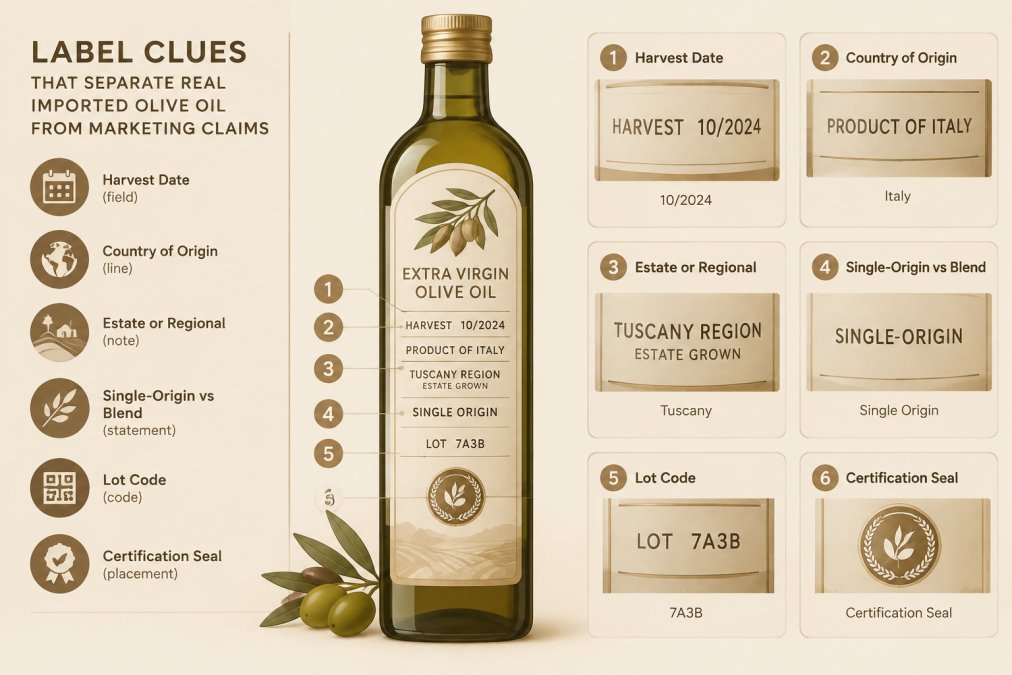
Separate the three places on the label
A bottle can tell you where the olives were grown, where the oil was extracted and produced, and where it was bottled. Those can be three different locations, and a label that says only "imported" or "packed in" is telling you the least useful of the three.
- Where the olives were grown is the origin that matters most for character and for regional claims. Look for a named country or region, not a continent.
- Where the oil was produced is where pressing and extraction happened. An oil can be grown in one place and produced in another.
- Where it was bottled is often the least meaningful line. "Bottled in" a country does not mean the oil came from there.
A common pattern is a bottle that leads with a romantic origin story but, in the fine print, says the oil was blended from several countries and bottled somewhere else.
Read blended-origin statements precisely
Blended oil is not automatically bad. Many consistent, well-made oils are blends. What matters is that the label says so plainly and does not bury it.
- "Blend of" or "mixture of" followed by countries means exactly that. Treat the first-listed country as the largest share only if the label says so; otherwise assume no ranking.
- "Packed in" or "bottled in" describes the packaging location, not the source of the olives.
- A single named country with no blend language is the clearest origin claim, and it is the one you can most easily check against a certification or producer record.
Watch out: a label that says "imported from" a country but lists a different country under "packed in" or "produced in" is not necessarily misleading, but it is telling you the oil is not single-origin from the headline country.
The label fields worth checking, in order
- Harvest date, not just a best-by date. A harvest date tells you the oil's age. A best-by date alone tells you almost nothing.
- Country or region of origin, stated as grown, not just imported. "Imported" is not an origin.
- Single-origin or blend, stated clearly. Both can be legitimate; the label should say which one you are buying.
A bottle that hides its harvest date or its true origin behind vague language is telling you something. Believe it.
How to Tell if Olive Oil Is Real Refrigerator Test and Its Limits
The refrigerator test is the most repeated advice online, and it deserves a straight answer. The test says real olive oil turns cloudy or solid in the fridge while fake oil stays liquid.
That test cannot prove authenticity. Oils solidify at different temperatures based on their fatty acid makeup, and a blended or refined oil can cloud too.
Use the fridge test as a freshness hint, not a verdict:
- Cloudiness suggests the oil contains natural waxes, which real oils do
- Staying liquid does not prove an oil is fake
- Any result still needs a harvest date and a real origin to mean anything
If you want proof, look for lab-tested certification, not a cold spoon.
Taste and Smell Tests That Reveal Fresh, Grassy, or Peppery Oil
Your senses are a real tool, just not a lab. A fresh extra-virgin oil smells grassy, green, and fruity.
Watch for these signals:
- Grassy or herbal aroma points to fresh, early-harvest oil
- Fruity notes like green apple or tomato leaf suggest good fruit
- A peppery finish is a positive sign, not a flaw
A common mistake is judging oil by color. Dark green does not mean better. Many excellent oils are golden, and color tells you nothing about freshness or grade.
The honest limit: your nose can spot a stale or defective oil. It cannot confirm that a bottle meets the full extra-virgin standard.
How to Verify Certifications and Traceability for Imported Oil
A certification seal is only useful if you can check it, and for imported oil the check is the whole point. The North American Olive Oil Association certified oils list publishes a list of oils it describes as certified authentic, updated for 2024. That is a real, checkable list, and it is the model for how you should treat any seal.
A practical verification process
- Note the certifying body named on the seal. A seal without a named organization behind it is decoration.
- Find that body's published list or database. Most credible certifiers publish a searchable list or a downloadable roster.
- Confirm the producer and the specific product appear there. A producer being listed does not automatically cover every bottle it sells.
- Check the lot code against the producer's traceability page. The lot code is the batch identifier; it should resolve to a harvest and bottling record.
- Confirm the harvest date matches the season on the label. A harvest date that does not line up with the stated season is a red flag.
A seal you cannot verify is decoration. A seal you can verify is a paper trail.
What a verified seal does and does not prove
A verified certification tells you the oil met a defined standard at the time it was tested, and that the producer is accountable to a named body. It does not prove the bottle in your hand is fresh, and it does not guarantee the oil has not degraded in storage or transit. Treat certification as one strong link in the chain, not the whole chain.
Traceability beyond the seal
- Lot codes are the most useful tool most buyers ignore. A lot code that the producer can resolve to a harvest and bottling date is worth more than a seal alone.
- Producer records matter for estate oils. A named estate that publishes harvest dates and lot information is easier to trust than an anonymous bottler.
- Importer details on the back label give you a party to contact if a lot code does not check out.
Watch out: a seal that appears only as an image with no organization name, no registry, and no lot-code link is the easiest thing in the world to print. Verify the body before you trust the badge.
Checking a seal means following it back to a named body and a specific batch.
| Step | What to do |
|---|---|
| 1 | Note the certifying body named on the seal |
| 2 | Find that body's published list or database |
| 3 | Confirm the producer and specific product appear there |
| 4 | Check the lot code against the producer's traceability page |
| 5 | Confirm the harvest date matches the season on the label |
Real Olive Oil Brands and How to Evaluate Them
No brand name guarantees authenticity on its own. What separates a trustworthy olive oil from a weak one is how much it tells you and how easily you can check it.
Use this quick scoring checklist on any bottle:
- Harvest date printed, not just a best-by date
- Named country or region of origin
- Single-origin or blend stated clearly
Score a bottle on those seven points. A brand that clears five or more is giving you something to work with. A brand that clears two is asking for your trust without earning it.
Storage matters too. Light and heat break oil down fast, so dark glass and tin containers protect freshness better than clear bottles on a warm shelf.
How to Identify Real Imported Olive Oil for Cooking
For cooking, freshness beats prestige. A recent harvest date and a verified origin will do more for your food than a fancy label ever will.
- Everyday cooking: a fresh, verified extra-virgin oil for sautéing, roasting, and dressings
- Finishing: your best peppery oil drizzled raw over finished dishes
- Storage: keep bottles dark, cool, and capped tight
If you want to taste what well-chosen olive oil does to a dish, you can explore Parthenon's Greek restaurant menu and see it at work in meze, salads, and grilled seafood.
Tasting Real Imported Olive Oil at a Greek Table
When you taste it in a dish, notice the peppery finish and the green aroma. If you would rather learn by tasting than by reading labels, Experience Greece in DC at our table and let the oil speak for itself.
If you want the deeper story behind the dishes, read what makes Greek food authentic. Then reserve a table and taste the difference for yourself, or go deeper with our guide to traditional Greek dishes.
Frequently Asked Questions
How can you tell if extra-virgin olive oil is real or fake?
Start with the label: look for a harvest date, a named estate or region, and whether the oil is single-origin or a blend. Check for third-party certification from a named body. Then taste it. Real extra-virgin olive oil should taste fresh and grassy with a peppery finish, not flat or greasy. Label and certification checks matter more than any single at-home trick.
Does the refrigerator test prove olive oil is real?
No. Chilling olive oil can make it cloudy or thicken because of its fat composition, but that reaction depends on the oil's fatty acid profile and storage temperature, not on authenticity. A refined or adulterated oil can also cloud in the cold, and a genuine oil stored in a warm kitchen may not. Use the refrigerator test as a curiosity, not a verdict.
What should you look for on an imported olive oil label?
Look for a harvest date rather than only a best-by date, a specific country or region of origin, and a clear statement of whether the oil is single-origin or a blend. A lot code and producer name add traceability. Certification seals from a named body give you a claim you can check. A country-of-origin label alone does not prove authenticity, since it shows where the oil came from, not how it was produced or whether it meets the extra-virgin standard.
How should you store imported olive oil after opening?
Keep it in a dark glass bottle or tin, sealed, away from light and heat, and use it within a few months of opening for the best flavor. Light exposure and warm storage speed up rancidity, which shows up as a stale, waxy, or crayon-like smell. Buy in sizes you will finish rather than a large tin that sits open for a year. Freshness, not just authenticity, decides whether the oil tastes the way it should.
Real olive oil rewards a careful buyer. Check the harvest date, confirm the origin, verify the certification, and taste before you trust. Parthenon Greek Restaurant & Chevy Chase Lounge has served Greek food built on real imported ingredients since 1989, with a lounge for handcrafted cocktails, patio dining, and private catering. Get started with Parthenon Greek Restaurant & Chevy Chase Lounge and taste what authentic Greek cooking actually means.