 how-to
7 Steps to Choose a Mediterranean Restaurant for Business Meetings
Last Updated: October 29, 2026
Quick Summary
To choose a mediterranean restaurant business meetings call for, start with your meeting goal and guest list, then score each candidate on noise, menu fit for every diet, privacy, and service reliability. Visit at off-peak hours, ask about a private room early, and confirm dietary details with a manager before you book.
- Write down the meeting purpose, guest count, and per-person budget before searching.
- Use a weighted scorecard, with noise and conversation weighted at 25 percent.
- Visit or call before committing and ask to see the table you would be assigned.
- Request a private room at least one to two weeks ahead and confirm any fees.
- Verify dietary details with a manager, since online menus are often out of date.
Table of Contents
- Start With Your Meeting Goal and Guest List
- Business Lunch Restaurant Checklist
- Finding Quiet Restaurants for Client Meetings
- Private Dining for Business Meetings: When and How to Ask
- Restaurant Reservation Questions for a Business Lunch
- Checking Menu Options and Dietary Needs
- Booking Your Next Mediterranean Business Meeting
- Frequently Asked Questions
Choosing the right Mediterranean restaurant for business meetings takes more thought than picking the place with the best reviews. The room has to suit the conversation, the menu has to work for every guest, and the booking has to go smoothly. This guide walks through seven steps to help you choose a Mediterranean restaurant for business meetings with confidence.
Start With Your Meeting Goal and Guest List
Every good restaurant choice starts with one question: what is this meeting for? A first meeting with a prospective client calls for a calm room where people can talk. A team celebration can handle more noise and energy.
Write down three things before you search:
- The purpose: Pitch, check-in, celebration, or interview
- The guest count: Include yourself and anyone who might join late
- The budget per person: Set a range so you do not waste time on places you cannot afford
Also note any guests with dietary needs. You will use this list again later when you check menus.
Business Lunch Restaurant Checklist
Most restaurant guides give you a flat list of yes-or-no questions. That is not enough when you are comparing three Mediterranean spots for a client lunch and need to justify the choice to your team. Use a weighted scorecard instead: assign each factor a weight based on what matters most for your meeting, then score each candidate from 1 to 5. The restaurant with the highest weighted total wins, and you have a defensible record of why you picked it.
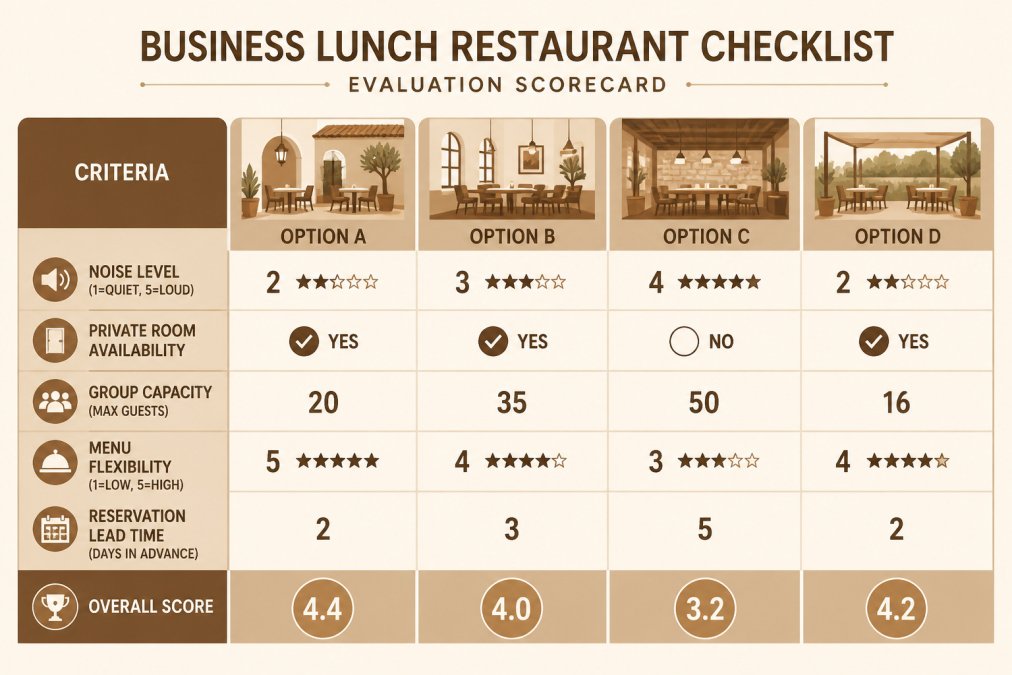
Here is a practical weighting scheme you can adapt. The weights below assume a typical client meeting where conversation and reliability matter most.
| Factor | Suggested Weight | What a 5 Looks Like | What a 1 Looks Like |
|---|---|---|---|
| Noise and conversation | 25% | Quiet room, soft surfaces, tables spaced apart | Loud open floor, bar crowd, echoing walls |
| Menu fit for all diets | 20% | Vegetarian, vegan, gluten-free, and halal options clearly marked; kitchen accommodates swaps | One or two token salads; no accommodation |
| Privacy and seating | 15% | Private room or quiet corner available for your group size | Only communal tables or high-traffic areas |
| Service speed and reliability | 15% | Prix fixe lunch menu, staff experienced with business groups, single invoice | Slow kitchen, confused about split checks |
| Location and access | 10% | Walkable from offices, parking or transit nearby | Difficult parking, long commute for guests |
| Cost predictability | 10% | Per-person prix fixe, clear minimums, no surprise fees | A la carte only, unclear service charges |
| Technology and logistics | 5% | Wi-Fi, outlets, screen or projector available | No connectivity, no presentation support |
How to use the scorecard in practice:
- Set your weights first. If your meeting is a confidential negotiation, raise privacy to 25% and drop technology to 0%. If it is a working session with slides, raise technology and lower atmosphere.
- Score each candidate independently. Do not compare restaurants against each other while scoring; score each one against the 1-to-5 anchors, then compare totals.
- Visit or call before you commit. A 10-minute walk-through at lunch service tells you more about noise and table spacing than any review. Ask to see the table you would be assigned.
- Keep the scorecard on file. If a partner asks why you chose one restaurant over another, you have a one-page answer.
Mediterranean-specific items to add to the scorecard:
- Meze pacing: Does the kitchen course out small plates so the table is not overwhelmed at once? Shared-plate service can either fuel conversation or stall it depending on pacing.
- Bread and oil service: A simple signal of whether the kitchen treats the table as a guest or a transaction.
- Prix fixe availability: Many Mediterranean restaurants offer a fixed lunch menu that simplifies ordering and controls cost. Ask whether it is available for groups and whether it can be customized.
- Alcohol policy: Confirm whether the restaurant serves alcohol, whether you can bring your own, and whether there is a corkage fee. Some guests may not drink, and some may expect wine with a Mediterranean meal.
A restaurant that scores well on noise, menu fit, and privacy is usually a safe choice. A place that scores high on atmosphere but low on menu flexibility will create problems the moment a guest mentions a dietary restriction.
Finding Quiet Restaurants for Client Meetings
Noise is the most common complaint at business meals. Many restaurants fill up at lunch and dinner, and loud rooms make it hard to hear details.
Here is how to find a quieter space:
- Visit at off-peak hours. Mid-afternoon or early evening is usually calmer.
- Ask for a corner or back table. These spots often sit away from the kitchen and bar.
- Check the layout. Smaller dining rooms with soft surfaces tend to absorb sound better.
- Avoid happy hour crowds if your meeting needs focus.
A quieter room often makes it easier to hold a productive conversation. If you are planning a client dinner, call ahead and ask which tables are the calmest.
Private Dining for Business Meetings: When and How to Ask
A private room can make a big difference when you need privacy for sensitive talks or a larger group. Not every restaurant offers one, so ask early.
When to request a private space:
- The meeting involves confidential business
- Your group is larger than a standard table can handle
- You want to present slides or share a screen
How to ask:
- Call or email the restaurant at least one to two weeks ahead
- Share your guest count, date, and time
- Ask about minimum spending requirements or room fees
- Confirm whether the room has a television, projector, or Wi-Fi
Clear details up front help the staff plan well and keep your meeting on track.
Restaurant Reservation Questions for a Business Lunch
Before you book, ask a few questions to avoid surprises. This is also a good time to see how responsive the staff is.
- Can you hold a table for my group size and time?
- How far in advance should I reserve for a group of this size?
- Is there a cancellation or no-show policy?
- Can I request a quiet table or private area?
- Do you offer a separate check or a single invoice?
- What is the best time to arrive so we can start on schedule?
Write down the answers and the name of the person you spoke with. That record helps if plans change on the day.
Checking Menu Options and Dietary Needs
Mediterranean menus look flexible on paper, but the details matter when you are hosting a group with mixed dietary needs. Guests with mixed dietary needs require more than a salad option. Here is how to verify each category before you book.
Vegetarian and vegan depth
Ask the restaurant to send you the full menu, not just the online summary, and count the vegetarian dishes that are not sides or salads. Ask whether the kitchen can adapt dishes for vegan guests.
Gluten-free and cross-contact
Ask the restaurant directly how it handles gluten-free requests, including whether items are marked on the menu and how shared cooking surfaces are managed.
If the staff cannot answer these questions confidently, assume the risk is high and consider a different venue for a guest with celiac disease.
Halal and kosher considerations
If you have guests who keep halal or kosher practices, ask the restaurant directly about its sourcing and preparation before you book.
Allergies: nuts, dairy, and sesame
Ask the kitchen which dishes contain nuts, dairy or sesame, and whether any dish can be prepared without them for guests with allergies.
Using prix fixe menus to simplify group ordering
Ask whether the restaurant offers a fixed-price menu for groups, and whether it can be adjusted for dietary needs and what it includes.
Shareable plates and pacing
Ask whether the kitchen can time courses so dishes arrive together, and whether the group can order a set number of dishes per person rather than a la carte.
A quick script for the call
When you call, describe your group's dietary needs and ask which dishes can accommodate them.
Booking Your Next Mediterranean Business Meeting
Once you have a shortlist, it is time to book. Reserve early for weekday lunches and group dinners, since these fill up fast.
Use this final checklist before you confirm:
- Date, time, and guest count confirmed in writing
- Private room or quiet table requested, if needed
- Dietary needs shared with the restaurant
- Billing arrangement agreed upon
- Arrival time shared with all guests
Parthenon Greek Restaurant & Chevy Chase Lounge can help you plan a lunch, dinner, or group gathering. You can book a table online and share your guest details in advance. A little planning up front lets you focus on the conversation, which is the whole point of the meeting.
Frequently Asked Questions
What should you look for in a restaurant for a business meeting?
Look for a quiet dining room where you can hold a conversation without raising your voice, reliable table service, and enough space between tables for private discussion. Check whether the restaurant can seat your full group comfortably and whether it offers a private dining area for longer meetings. Confirm that the menu includes lighter lunch options and dishes suited to different dietary needs. Finally, ask about reservation policies so your guests are not left waiting at the door.
How far in advance should you book a restaurant for a business meeting?
For a standard business lunch with a small group, booking three to five days ahead is usually enough. For a larger group, a private dining room, or a meeting on a busy weekday, reserve at least one to two weeks in advance. Early booking also gives you time to confirm the seating arrangement and any special requests. Call or use the restaurant's online reservation system, and note the name and time on the booking so there is no confusion on the day.
Is a Mediterranean restaurant a good choice for a business meeting?
Yes, when the restaurant offers a calm setting and a flexible menu. Mediterranean menus usually include shared appetizers, grilled meats, fish, salads, and vegetable dishes, which suit both lighter lunches and longer dinners. Shared plates can also encourage conversation. Choose a place with reliable service and a quiet dining room, and review the menu ahead of time to make sure there are options for guests who eat fish, vegetarian, or other dietary-restricted meals.
How do you choose a restaurant that accommodates dietary restrictions?
Review the menu online before booking and look for clearly labeled vegetarian, gluten-free, or seafood-based dishes. When you make the reservation, tell the host about any allergies or dietary needs for your guests. Ask whether the kitchen can adjust dishes, such as removing dairy or substituting a side. Confirming these details in advance avoids delays and keeps everyone at the table comfortable during the meeting.