 how-to
How to Identify Authentic Greek Ingredients
Table of Contents
- Why Authentic Greek Ingredients Matter
- Understanding Traditional Greek Ingredients
- How to Verify Authentic Greek Olive Oil
- Identifying Genuine Greek Feta Cheese
- Selecting Authentic Greek Herbs and Spices
- Spotting Counterfeit and Misleading Claims
- Your Shopping Checklist for Authentic Greek Products
- Frequently Asked Questions
Last Updated: October 11, 2026
Why Authentic Greek Ingredients Matter
Cooking with authentic Greek ingredients connects you to centuries of Mediterranean tradition. At Parthenon Greek Restaurant & Chevy Chase Lounge, we've built our reputation since 1989 on using genuine imported products and extra virgin olive oil that make every dish taste authentic.
The difference between authentic and mass-produced is real. Real feta tastes tangy and crumbly. Real olive oil has depth and complexity. Real oregano carries an aroma you can't get from a dusty jar that's been sitting in a warehouse for two years.
Identifying authentic Greek ingredients requires knowing what to look for on labels, understanding certifications, and spotting red flags.
Understanding Traditional Greek Ingredients
Authentic Greek cooking relies on core staples that have defined the cuisine for generations. The key skill is verifying that what you're buying is genuinely Greek and produced to traditional standards, not a mass-market imitation.
Extra-virgin olive oil is the foundation, appearing in nearly every dish. Look for harvest dates (current year is fresher), single-origin claims (not "Mediterranean blend"), and PDO or PGI certification marks that guarantee regional production standards.
Olives are essential. Kalamata olives are most famous, but varieties like Koroneiki, Halkidiki, and Throumba each have distinct profiles.
Feta cheese is iconic: brined, crumbly, and tangy. Real feta must contain at least 70% sheep's milk and be made and aged in Greece.
Fresh herbs like oregano, thyme, dill, mint, and rosemary define traditional Greek food. Dried Greek oregano should have a strong, peppery aroma. Check the label for "Product of Greece" and a recent packaging date; herbs lose potency over time.
Honey sweetens Greek desserts and sauces. Look for single-origin honey (not blended) with a clear country-of-origin statement. Thyme honey and pine honey are traditional varieties.
Grains and bread round out the foundation. Authentic Greek bread should list "Product of Greece" or be labeled as imported from a specific Greek bakery or region.
How to Verify Authentic Greek Olive Oil
Olive oil is where counterfeit and misleading claims run rampant. Many bottles say "Greek" or "Mediterranean" without actually coming from Greece.
Reading the Label
Look for "Product of Greece" or "Made in Greece." These phrases guarantee Greek origin. "Mediterranean blend" or "Greek-style" are red flags.
Check the harvest date if listed. Oil from the current year is preferable.
Real extra-virgin olive oil has one ingredient: olives.
Look for "cold-pressed" or "first cold-pressed," which means extraction without heat.
Checking for PDO Certification
PDO (Protected Designation of Origin) is an official certification guaranteeing the product comes from a specific region and follows strict production rules. Greek PDO olive oils come from regions like Koroni, Sitia, Kolymvari, and Gialias. The bottle should display the PDO logo clearly; if it's hard to find, that's a warning sign.
Identifying Genuine Greek Feta Cheese
Feta is the most counterfeited Greek cheese. Many products labeled "feta" come from other countries, Denmark, Bulgaria, Romania, and the United States, and don't meet Greek standards. Real Greek feta has specific legal and sensory characteristics you can verify before and after purchase.
Label Verification: The First Line of Defense
Look for PDO or PGI certification. Feta PDO comes from seven specific Greek regions and must be made from Greek milk, produced in Greece, and aged in Greece. The label should display the official PDO logo or clearly state the region name.
Examine the milk-type statement. Real Greek feta must contain at least 70% sheep's milk. If the label says "cow's milk feta" or does not specify the milk type, it is not authentic Greek feta.
Read the ingredient list carefully. Authentic feta contains only milk, salt, and milk cultures. Long chemical ingredient lists with cellulose, gums, preservatives, or anti-caking agents indicate a mass-produced imitation.
Check the packaging type. Traditional Greek feta is stored in brine in a rigid container. If feta is vacuum-sealed in plastic film without brine, it is almost certainly an imitation. Real feta should be visibly submerged in liquid.
Verify the best-by date. Look for a date at least several months away; feta keeps well in brine for many months.
Sensory Verification: What to Expect When You Open It
Once you bring feta home and open the container, several sensory checks confirm authenticity.
Texture and crumble. Real Greek feta crumbles easily with a fork and should not be smooth, creamy, or rubbery. You should feel distinct crystals breaking apart on your tongue.
Taste profile. Authentic feta has a sharp, tangy, distinctly salty flavor with a clean, briny finish. Mild, creamy, or bland feta is usually an imitation.
Color. Real feta is bright white or off-white, never yellowish or gray. Discoloration can indicate age, contamination, or improper storage. The color should be uniform throughout the block or crumbles.
Aroma. When you open the container, you should smell the brine, a salty, pungent, slightly tangy aroma. This is the smell of authentic feta. If the container smells musty, sour, or has no distinctive smell, the feta may be old, improperly stored, or not authentic.
Brine appearance and consistency. The brine should be clear or slightly cloudy (cloudiness is normal and does not indicate spoilage). It should smell salty and briny, not off or rancid. If the brine is discolored, has visible particles, or smells bad, do not consume the feta.
Common Imitation Red Flags
When shopping, watch for these warning signs that signal feta-style cheese rather than authentic Greek feta:
- "Feta-style" or "feta cheese product" on the label
- No country-of-origin statement or origin listed as a country other than Greece
- Cow's milk listed as the primary or only milk type
- Vacuum-sealed packaging without brine
- Suspiciously low price, authentic Greek feta costs more because it is imported and produced to strict standards
- Long ingredient lists with additives, preservatives, or anti-caking agents
- No PDO or PGI certification and no clear regional origin claim
- Soft, creamy, or uniform texture that does not crumble
- Mild or bland taste with minimal saltiness or tanginess
Where to Buy Authentic Feta
Authentic Greek feta is most reliably found at specialty Greek or Mediterranean markets, international grocery stores, and online retailers that specialize in imported foods. Mainstream supermarkets often stock both authentic and imitation feta; read the label carefully. When in doubt, ask the store staff about the origin and production method, or choose a brand with clear PDO certification and Greek origin labeling.
Selecting Authentic Greek Herbs and Spices
Greek herbs define the flavor profile of the cuisine. Oregano is the most important, but thyme, dill, mint, and rosemary all play crucial roles.
Fresh herbs are always better than dried when available. But dried herbs from Greece are far superior to generic dried herbs from anywhere else.
Look for "Product of Greece" on dried herb containers. The label should show the country of origin clearly.
Oregano is the signature herb. Greek oregano has a strong, peppery aroma. It grows wild in Greece and carries intense flavor. When you open a jar of real Greek oregano, the smell should be powerful and unmistakable.
Thyme from Greece is delicate and floral. It's used in many traditional dishes and pairs well with olive oil and lemon.
Dill is fresh and bright. Greek dill is used in fish dishes and vegetable preparations.
Mint and rosemary round out the herb collection. Both should smell vibrant and fresh, not dusty or stale.
Buy herbs in smaller quantities and replace them regularly. Dried herbs lose potency over time. Fresh flavor matters more than stockpiling old jars.
Spotting Counterfeit and Misleading Claims
Marketing language can be deceptive. Learning to spot fake claims protects your wallet and your table.
"Greek-style" doesn't mean Greek. It means the product mimics Greek characteristics but comes from somewhere else. Skip it.
"Mediterranean" is too vague. It could mean anything from Spain to Turkey to Italy. Real Greek products say Greece.
"Imported" sounds good but doesn't guarantee quality or origin. Many products are imported from other countries and repackaged.
"All natural" is marketing speak. It doesn't mean authentic or traditional. Real Greek products don't need to advertise naturalness. It's assumed.
"Artisanal" and "small-batch" sound authentic but mean nothing legally. Anyone can use these terms.
Watch for missing origin information. If the label doesn't clearly state where the product came from, there's usually a reason.
Suspiciously low prices are a red flag. Authentic Greek products cost more because they're imported and produced to strict standards. If the price seems too good to be true, it probably is.
Vague certifications or logos that don't match official standards are warning signs. PDO, PGI, and other certifications have specific logos and formats. Fake certifications look similar but aren't quite right.
Your Shopping Checklist for Authentic Greek Products
Use this checklist every time you shop for Greek ingredients. It takes 30 seconds and ensures you're getting the real thing.
| Item to Check | Olive Oil | Feta Cheese | Herbs & Spices |
|---|---|---|---|
| Origin statement | "Product of Greece" or "Made in Greece" | "Feta from Greece" or "Greek Feta" | "Product of Greece" |
| PDO certification | Look for PDO logo and region name | Look for PDO logo | Not always present but preferred |
| Ingredient list | Olives only | Milk, salt, cultures | Single herb, no fillers |
| Harvest/production date | Current year preferred | Check packaging date | Recent, not dusty or faded |
| Packaging | Dark glass bottle | Brine in container, not vacuum-sealed | Sealed jar with strong aroma |
| Red flags | "Mediterranean blend," no harvest date | "Feta-style," plastic vacuum-sealed | "Greek-style," weak smell, stale appearance |
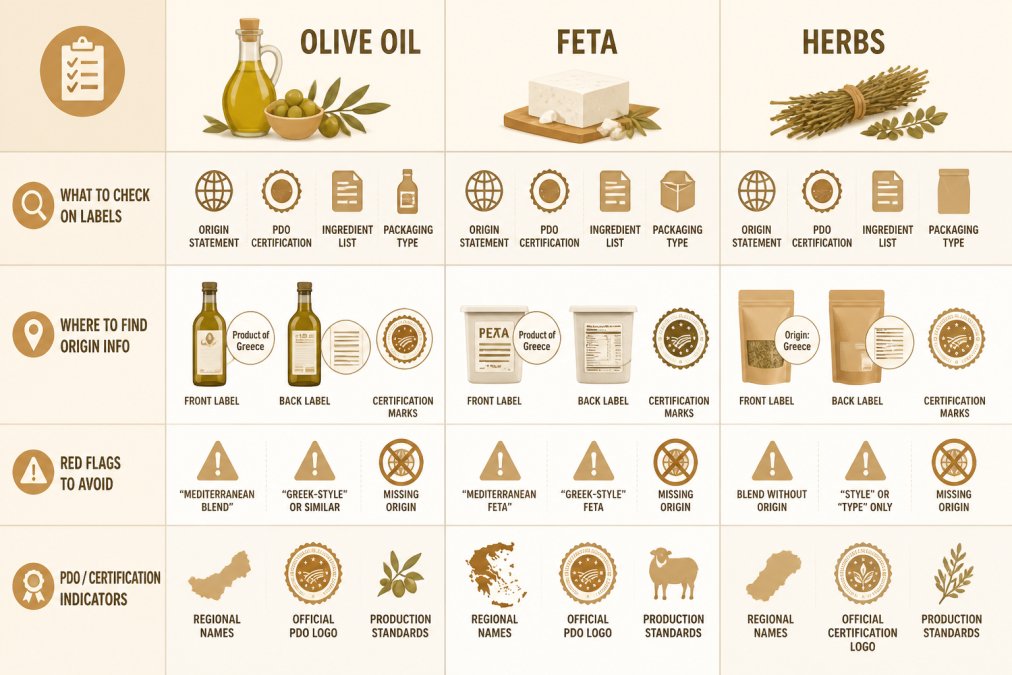
Before you buy:
- Read the label completely
- Check the origin statement
- Look for PDO or certification marks
- Examine the ingredient list
- Notice the packaging type
- Trust your instincts about price
At home:
- Taste the product
- Check the aroma
- Evaluate the texture
- Compare to previous purchases
- Note what you liked or didn't like
Building a collection of authentic Greek ingredients takes time. Start with olive oil and feta. Add herbs and spices as you cook more Greek food. Each purchase teaches you something about quality and authenticity.
When you're ready to experience authentic Greek flavors prepared by people who understand the tradition, Parthenon Greek Restaurant & Chevy Chase Lounge brings that expertise to every plate. We've sourced genuine imported ingredients and used extra virgin olive oil since 1989 because we know the difference quality makes. You can also Experience Greece in DC by joining us for a meal that showcases what happens when tradition meets fresh, authentic ingredients, let our team show you the real taste of Greece.
Frequently Asked Questions
How can you tell if feta is authentic Greek feta?
Authentic Greek feta must be made in Greece from sheep's milk (or a blend with up to 30% goat's milk) and carry a Protected Designation of Origin (PDO) label. Check the packaging for 'Feta PDO' or 'Protected Designation of Origin.' The texture should be crumbly, not rubbery. Genuine feta has a tangy, salty flavor. If the label lists cow's milk or lacks origin information, it's not authentic Greek feta.
What should you look for when buying Greek olive oil?
Look for 'extra-virgin' on the label, which indicates the highest quality with minimal processing. Check that the bottle states the country of origin as Greece. PDO certification (such as from specific Greek regions) guarantees authenticity and meets strict production standards. The oil should be in a dark bottle to protect it from light. Avoid bottles listing blended oils or unclear sourcing. Purchase from reputable retailers or directly from producers when possible.
Which ingredients are essential to traditional Greek cooking?
Traditional Greek ingredients include extra-virgin olive oil (the foundation of Greek cuisine), olives (especially Kalamata varieties), feta and other Greek cheeses, fresh herbs like oregano, thyme, rosemary, and dill, honey, grains and bread, and seasonal produce. These ingredients reflect the Mediterranean diet and regional specialties across Greek islands and mainland areas. Authentic Greek cooking emphasizes minimal processing, freshness, and purity of ingredients, with flavor and aroma developed through quality sourcing rather than heavy seasoning.
How can you tell whether a Greek restaurant uses authentic ingredients?
Ask the restaurant directly about their sourcing and whether they import ingredients from Greece. Check if they list origin information on the menu or website. Authentic Greek restaurants typically feature PDO-certified products and can explain their supplier relationships. Look for menus that showcase seasonal produce and regional specialties rather than generic 'Greek-style' dishes. Restaurants committed to culinary heritage will highlight their ingredient sourcing and be transparent about what makes their food authentic.