 how-to
How to Find Quiet Bars for Conversation in DC
Table of Contents
- Assess Noise Levels Before You Visit
- Best Time to Visit a Bar for a Quiet Conversation
- How to Request a Quiet Table at a Bar
- Neighborhood Spots Known for Quieter Atmospheres
- What Makes a Bar Conversation-Friendly
- Common Mistakes When Choosing a Quiet Bar
- Frequently Asked Questions
Last Updated: October 9, 2026
Assess Noise Levels Before You Visit
Learning how to find quiet bars for conversation in dc starts before you walk in the door. Research the venue's atmosphere using reviews, phone calls, and local recommendations to ensure conversation is actually possible.
At Parthenon Greek Restaurant & Chevy Chase Lounge, we understand that ambiance matters. A lively happy hour suits some occasions, but when you need a space built for talking, you need to know what you're getting into.
Check Customer Reviews for Atmosphere Details
Read reviews with a specific focus: look for mentions of noise, crowd size, and whether people could hear each other. Search for words like "quiet," "peaceful," "conversation-friendly," or "loud."
Pay attention to the details reviewers mention:
- Whether background music was noticeable
- How crowded the bar felt on different days
- If seating was comfortable and spaced out
Reviews that say "perfect for a quiet drink" are good signs. Avoid places where reviewers mention shouting to be heard.
Call Ahead to Ask About Ambient Noise
A quick phone call reveals what you need to know. Ask staff directly about noise levels at different times.
Specific questions to ask:
- What time of day is quietest?
- How loud is the background music?
- Do you have quieter seating areas away from the bar?
If staff hesitate or say "it gets pretty lively," that's valuable information.
Best Time to Visit a Bar for a Quiet Conversation
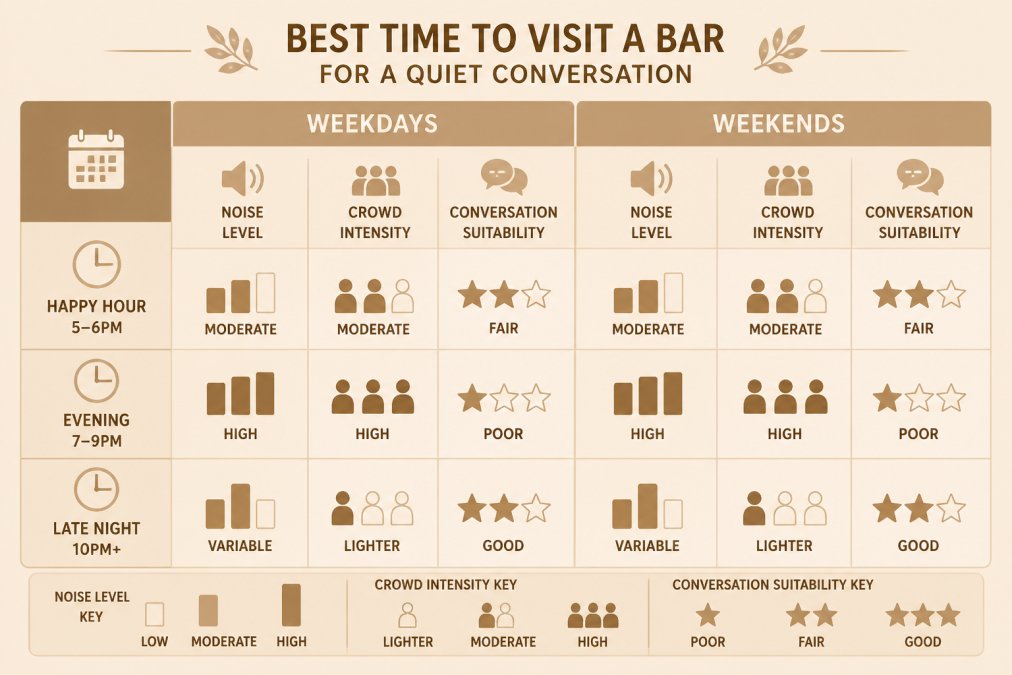
Timing is everything, but "go on a weeknight" is a guess. The same bar feels completely different at 6 p.m. Tuesday versus 9 p.m. Friday, and the only way to know which version you're walking into is to check before you go.
A Repeatable Method for Checking Noise Before You Visit
Here is a four-step check you can run in about five minutes:
- Search reviews for noise keywords, not just star ratings. On Google Maps and Yelp, search within reviews for "loud," "quiet," "can't hear," "shouting," and "conversation." Sort by newest first, a three-year-old review describes a different bar.
- Check the venue's social media for recent crowd photos. Friday-night photos show actual room density better than any description.
- Call during the hours you plan to visit. Ask: "How loud is it right now?" and "What time does the music get turned up?" Staff answer honestly about the current moment.
- Check the event calendar. Trivia nights, live music, DJ sets, and game-day specials are the biggest cause of unexpected noise.
Weeknight Visits vs. Weekend Crowds
Weeknights are your best bet for quiet bars. Monday through Thursday, most venues have fewer customers and a relaxed vibe.
Weekends bring larger crowds, louder music, and more energy. If quiet conversation is your goal, avoid peak weekend hours. Sunday is the underrated exception: many bars stay calm, with a crowd that skews local.
Peak Hours and Off-Peak Timing
Happy hour (typically 5 to 7 p.m.) draws crowds, so avoid this window for a quiet experience. The exception is a bar in a neighborhood without a large office population, where happy hour may be barely noticeable.
Better times for conversation:
- Weekday early evenings after 8 p.m. (post-happy hour, pre-late night)
- Weekday afternoons before 5 p.m.
- Weekday late nights after 10 p.m. (fewer people, calmer atmosphere)
Late-night visits work well: crowds thin, noise drops, and remaining customers tend to be there for conversation.
Matching Timing to the Occasion
- First date: weekday 7-9 p.m., enough energy to feel alive, not so much that you cannot hear each other.
- Catching up with an old friend: Sunday afternoon or weekday before 5 p.m., the bar is nearly empty and you can linger.
- Small group (4-6 people): weekday after 8 p.m., post-happy-hour calm with enough seating to spread out.
How to Request a Quiet Table at a Bar
When you arrive, communicate your needs. Staff can place you in the best spot for conversation if you ask.
Communicate Your Needs When Booking
If you're making a reservation, mention that you're looking for a quiet, conversation-friendly table: "We'd like a spot where we can hear each other comfortably." Most venues will note this and seat you accordingly, especially for groups.
For walk-ins, ask the host or server directly: "Do you have a quieter seating area?" Staff want you to have a good experience.
Seating Locations That Support Conversation
Not all seats are equal. Corner booths and tables away from the main bar counter are quieter; avoid high-traffic areas near the entrance or restrooms.
Best seating for conversation:
- Corner booths or banquettes (enclosed spaces reduce ambient noise)
- Tables away from the bar counter (less drink-making noise)
- Seats facing away from the main room
Ask your server if quieter seating is available. Most bars have at least one or two spots designed for talking.
Neighborhood Spots Known for Quieter Atmospheres
Washington, DC rewards people who think in neighborhoods. Conversation-friendly bars cluster in walkable, residential-adjacent corridors rather than high-volume entertainment districts. Below is a framework organized by neighborhood character and transit access.
Chevy Chase and Upper Northwest
Chevy Chase, Friendship Heights, and Tenleytown sit along the Red Line and skew toward an older, residential crowd. Bars here tend to be attached to restaurants or neighborhood taverns rather than standalone nightlife venues, which keeps volume down. If you're seeking an authentic Greek experience in a welcoming lounge setting, Experience Greece in DC offers a dedicated space designed for conversation and connection.
Dupont Circle and Kalorama
Dupont Circle (Red Line) has a split personality. The 17th Street strip gets loud on weekends, but side streets toward Kalorama and blocks along P Street hold wine bars and small cocktail rooms with softer acoustics. Walk two blocks off the main strip and the noise profile changes completely.
Adams Morgan and Mount Pleasant
Adams Morgan (walkable from Woodley Park and Columbia Heights stations) is known for loud bars, but quieter options sit on the edges, Mount Pleasant Street, the southern end of 18th Street, and side streets off Columbia Road. Look for small wine bars and neighborhood restaurants with bar seating.
Capitol Hill and Barracks Row
Capitol Hill (Eastern Market and Capitol South stations) is one of the most reliable neighborhoods for conversation. The crowd is largely local, happy hour ends earlier than downtown, and many bars are in converted rowhouses with small, separated rooms that contain sound. Barracks Row along 8th Street SE offers taverns and restaurant bars; the further from the Marine Barracks at 8th and I, the calmer it tends to be.
Shaw and Bloomingdale
Shaw (Green/Yellow Line) has become a cocktail destination, so noise levels vary block to block. The quieter bets are wine bars and restaurant bars along the residential edges rather than the busiest stretches of 9th Street. Bloomingdale, just north, is almost entirely neighborhood spots and worth the short walk.
Georgetown and Foggy Bottom
Georgetown has no Metro station, which keeps the crowd more local and less transit-driven. Quieter bars sit off M Street on side streets like Wisconsin Avenue north of the intersection and along residential blocks toward the university. Foggy Bottom (Orange, Silver, and Blue lines) offers hotel and restaurant bars near the Kennedy Center with controlled, conversation-friendly ambiances.
How to Pick a Neighborhood for Your Night
- For a first date: Dupont Circle side streets or Capitol Hill, walkable, low-pressure, easy to leave if the vibe is wrong.
- For an after-work drink: Foggy Bottom or Capitol Hill, where happy hour winds down earlier and the crowd thins by 8 p.m.
- For a group that wants to actually talk: Chevy Chase or Bloomingdale, where booths and separated rooms are common.
What Makes a Bar Conversation-Friendly
Certain design features and operational choices create spaces where people can actually hear each other.
Background Music and Acoustic Design
Background music should enhance the atmosphere, not dominate it. In conversation-friendly bars, you hear the music without it interfering with talking.
Look for:
- Lower volume levels (you can hear your companion without raising your voice)
- Pleasant, non-aggressive music (jazz, acoustic, soft rock over heavy bass or loud pop)
- Acoustic treatments (soft furnishings, carpeting, curtains that absorb sound)
- Spaces designed to contain noise (booths, separate rooms, outdoor areas)
Bars with hard surfaces everywhere (concrete, tile, glass) amplify noise; softer materials and thoughtful layout reduce it.
Crowd Size and Seating Comfort
A venue with seating spread across the space feels less crowded than one packed with tables. If chairs are close together, conversations blend and noise builds.
Good conversation bars have:
- Enough tables that people aren't squeezed in
- Booths or banquettes that create semi-private spaces
- At least a few feet between tables
- Comfortable seating that encourages lingering
Crowding creates noise; space allows for conversation.
Common Mistakes When Choosing a Quiet Bar
Most people make predictable errors when searching for quiet bars. Avoid these pitfalls.
Assuming popular equals good. Trendy, well-known bars are often loud and crowded.
Visiting during peak hours. Happy hour and weekend nights are loud by design.
Not communicating your needs. Staff can't help if they don't know what you want.
Frequently Asked Questions
How can I tell if a bar will be quiet before I go?
Check recent customer reviews on Google Maps and Yelp, specifically looking for comments about noise level and atmosphere. Call the bar directly and ask staff about their typical crowd size and ambient noise at your preferred time. Visit their social media pages to see photos of the space and get a sense of the environment. Ask if they have a quieter section away from the main bar area. These steps help you assess whether a quiet bar will meet your needs before you commit to a visit.
What is the best time to visit a bar for a quiet conversation?
Weeknights (Monday through Thursday) are generally quieter than weekends. Visit between 5-6 p.m. for early happy hour or after 9 p.m. when the initial crowd has thinned. Avoid peak hours around 6-8 p.m. on Friday and Saturday. If you want the quietest experience, aim for Tuesday or Wednesday between 4-5 p.m., before the after-work rush. Early afternoon visits on weekdays also tend to be peaceful, though not all bars have full service at that time.
How do I ask a bar for a quiet table at a bar?
When making a reservation or arriving, let staff know your purpose: 'We're here for a business conversation' or 'We'd like a quiet spot for a date.' Request seating away from the main bar, kitchen, or entry door. Ask if they have a quieter section or corner booth. If you're calling ahead, mention your preference when booking so they can hold the right table. Most bars will accommodate this request, especially if you book in advance and visit during off-peak hours.
What should I look for in reviews when choosing a quiet bar?
Search reviews specifically for words like 'quiet,' 'conversation-friendly,' 'calm atmosphere,' or 'peaceful.' Note comments about background music volume and crowd noise. Look for mentions of specific seating areas that reviewers praise for being quieter. Check the date of recent reviews to ensure descriptions are current. Pay attention to reviews from people visiting on weeknights, as their experience will better reflect quiet-bar conditions than weekend visitors. Ratings alone don't tell you about atmosphere, so read the detailed comments.