 Ultimate guide
Is Greek Food Heart Healthy for Daily Eating?
Last Updated: November 21, 2026
Quick Summary
Greek food is heart healthy for daily eating because it follows the Mediterranean pattern: vegetables, fruits, whole grains, legumes, fish, nuts, and olive oil as the main fat, with limited saturated fat and added sugar. That makes greek food heart healthy as a steady pattern rather than a single meal.
- A Mediterranean diet supplemented with olive oil or nuts cut heart event risk by roughly 30% versus a low-fat diet.
- Aim for fish twice a week and legumes two to three times a week as core protein choices.
- Use about two to three tablespoons of olive oil daily as your main added fat.
- Fill half your plate with vegetables, a quarter with whole grains or legumes, and a quarter with fish or lean meat.
- Limit feta, olives, cured meats, and fried dishes, which push sodium and saturated fat too high.
Table of Contents
- What Makes Greek Food Heart Healthy
- The Evidence: What Studies Say About Greek Food and Heart Healthy Eating
- Heart-Healthy Greek Diet Staples to Eat Often
- Greek Foods to Limit for Heart Health
- Daily Portions and Realistic Serving Sizes
- Mediterranean Diet 7-Day Meal Plan
- How to Order Greek Food for Heart Health
- Book a Table and Eat Greek Tonight
- Frequently Asked Questions
What Makes Greek Food Heart Healthy
Greek food is heart healthy for daily eating because it is built on the Mediterranean pattern: vegetables, fruits, whole grains, legumes, fish, nuts, and olive oil as the main fat, with limited saturated fat and added sugar, which is why greek food heart healthy eating is so easy to follow. The American Heart Association's 2026 dietary guidance names whole or minimally processed vegetables and fruits as core components of heart-healthy eating patterns consistently linked to cardiovascular health.
The Mediterranean Pattern Behind Greek Cooking
Greek cooking is a regional expression of the Mediterranean diet, which a review by Widmer and colleagues calls one of the best-studied diets for cardiovascular health. Its defining components are fish, olive-oil monounsaturated fats, and fruits. The pattern works by replacing saturated fat with unsaturated fats and building meals around plants.
That is the theory behind why Greek food is heart healthy. The practical question is how often, and how much, you actually eat it.
The Evidence: What Studies Say About Greek Food and Heart Healthy Eating
The strongest evidence comes from Mediterranean-diet research. A CardioSmart summary of a randomized trial, published in 2018, found that a Mediterranean diet supplemented with olive oil or nuts reduced the risk of heart events by roughly 30% compared with a low-fat diet. A 2017 review by Tosti and colleagues reported a 70% reduction in all-cause mortality among participants in a Mediterranean-diet group, attributed to a 73% reduction in coronary heart disease mortality.
Those are big numbers, and they come with caveats: the research looks at overall dietary patterns over years, not single meals. One dinner will not change your risk factors. A steady pattern of Greek-style eating can.
Heart-Healthy Greek Diet Staples to Eat Often
The staples to eat most often are olive oil, vegetables, legumes, fish, whole grains, nuts, and fruit. These are the nutrient-dense, plant-based foods that define the pattern. If you want to see them in context, explore our Greek restaurant menu, from meze and salads to grilled seafood and lamb.
Olive Oil, Nuts, and Other Healthy Fats
Olive oil is the primary fat in Greek cooking, and it is a monounsaturated fat that replaces butter and other saturated fats. A handful of nuts most days adds healthy fats, fiber, and protein. Both appear in the trial evidence above as the supplements that produced the heart benefit. Watch out: "drizzled with olive oil" and "drowning in it" are different meals, and olive oil is still calorie-dense.
Fish, Seafood, and Legumes
Fish and seafood supply protein and unsaturated fats, and legumes such as lentils, chickpeas, and white beans deliver protein and fiber with almost no saturated fat. Aim for fish twice a week and legumes two to three times a week. If you are pairing seafood with wine, our guide to which Greek white wine pairs best with seafood covers the match.
Greek Foods to Limit for Heart Health
Limit the salty, cured, and fried parts of the Greek table: olives and feta in large amounts, cured meats, salty cheeses, and fried dishes. These are the foods most likely to push sodium and saturated fat past what a heart-healthy pattern allows. None of them is off-limits; they are the accents, not the base of the plate.
Sodium and Saturated Fat in Common Greek Dishes
Feta, olives, and cured meats are the main sodium sources in a Greek meal, and lamb and heavy cheese dishes carry the most saturated fat. UT Southwestern Medical Center notes that the Mediterranean pattern lowers cardiovascular risk in part by limiting saturated fat and sugar. In practice, this means choosing grilled fish over fried, a small portion of feta over a slab, and olive oil over butter.
| Dish type | Main concern | Simple swap |
|---|---|---|
| Fried seafood or vegetables | Added oil, saturated fat | Grilled or baked version |
| Cured meats and salty cheeses | Sodium | Smaller portion, more vegetables |
| Heavy lamb and cheese dishes | Saturated fat | Grilled fish or legumes as the main |
Daily Portions and Realistic Serving Sizes
Most Greek-food advice stops at "eat more vegetables and olive oil." The harder question, and the one that decides whether Greek food works for daily eating, is how much, how often, and what a realistic plate looks like on an ordinary Tuesday. The ranges below reflect common Mediterranean-pattern guidance; they are a starting framework, not a prescription, and needs vary by age, activity level, medications, and medical conditions.
A Repeatable Daily Pattern
A workable Greek-inspired day tends to follow the same rhythm rather than a strict menu:
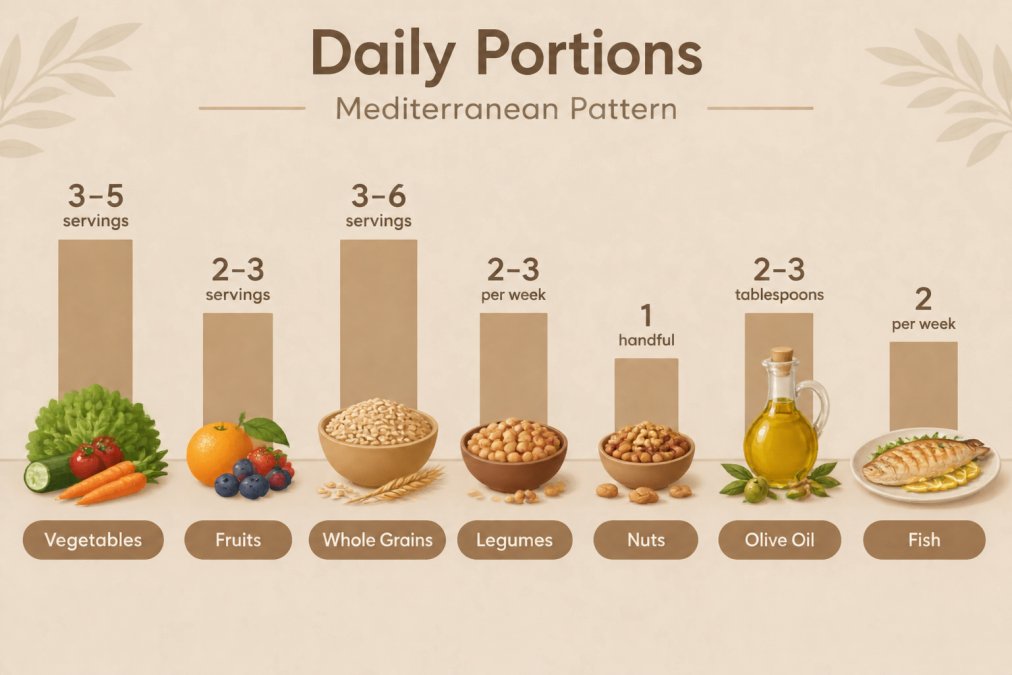
- Vegetables: three to five servings, where a serving is about one cup of cooked vegetables or two cups of raw leafy greens. This is the largest volume on the plate.
- Fruit: two to three servings, where a serving is one medium piece or about a cup of cut fruit.
- Whole grains: three to six servings, where a serving is about one slice of whole-grain bread, half a cup of cooked rice or bulgur, or half a cup of cooked pasta.
- Legumes: two to three times per week, where a serving is about half a cup to one cup of cooked lentils, chickpeas, or white beans.
- Fish and seafood: twice per week, where a serving is about three to four ounces cooked.
- Nuts: about one handful (roughly one ounce) most days.
- Olive oil: about two to three tablespoons per day as the main added fat, used for cooking, dressing, and finishing.
- Cheese, olives, and cured meats: small portions and not every day, an accent, not a base.
What That Looks Like on a Plate
At a meal, the visual rule is simpler than the numbers: half the plate vegetables, a quarter whole grains or legumes, a quarter fish, poultry, or a small portion of meat, with olive oil used to cook and finish rather than poured on top. For more ideas, see this guide to Greek side dishes and how to build a balanced plate.
Watch out: portion drift usually happens with the calorie-dense items, olive oil, nuts, feta, and olives, not with vegetables. A few extra tablespoons of olive oil or a second handful of nuts can quietly turn a heart-healthy plate into a calorie-heavy one, so measure those rather than free-pour.
Adjusting for Individual Needs
These ranges are a general framework, not a personal prescription. People managing hypertension may need to watch sodium from feta, olives, and cured meats more closely. People with diabetes should discuss carbohydrate distribution from bread, grains, and fruit with their care team. People with heart disease or on medications that interact with diet should treat this as a starting point for a conversation with a clinician or registered dietitian, not a substitute for one. The pattern is flexible enough to adapt, but the right amounts depend on the person eating them.
Mediterranean Diet 7-Day Meal Plan
A Mediterranean diet 7-day meal plan for Greek eating repeats a simple rhythm rather than demanding new recipes daily. Build each day around vegetables, a whole grain, a legume or fish, olive oil, and fruit, then rotate the dishes.
- Day 1: Greek salad, lentil soup, whole-grain bread, olive oil
- Day 2: Grilled fish, roasted vegetables, one handful of nuts
- Day 3: Chickpea stew, greens, fruit
- Day 4: Grilled chicken or lamb in a small portion, salad, yogurt
- Day 5: Sardines or other oily fish, lemon potatoes, vegetables
- Day 6: Bean salad, feta in a small portion, olives in moderation, fruit
- Day 7: Meze-style spread: dips, vegetables, grilled seafood, olive oil
The pattern, not the exact menu, is what matters. Swap dishes freely as long as vegetables, legumes, fish, and olive oil stay at the center.
How to Order Greek Food for Heart Health
Order for heart health by leading with grilled fish, legumes, salads, and vegetables, asking for olive oil on the side, and treating fried items, cured meats, and heavy cheese as occasional. That single ordering habit does more than any individual dish choice. If it is your first time, our first-timer's guide to ordering at a Greek restaurant walks through dips, salads, grilled mains, and a sweet finish.
A few swaps we recommend:
- Grilled octopus or fish instead of fried calamari
- A large Greek salad instead of a cheese-heavy appetizer
- Lentil or bean dish as the main, with a small meat plate alongside
- Olive oil and lemon instead of creamy sauces
If you are not a seafood person, plenty of Greek food is built on legumes, vegetables, and grilled meats, so you will not run out of options.
Book a Table and Eat Greek Tonight
The challenge with heart-healthy eating is that it has to taste good enough to repeat. That is the part we take seriously: traditional family recipes, imported Greek products, and extra virgin olive oil.
Visit Parthenon Greek Restaurant & Chevy Chase Lounge to enjoy Mediterranean flavors. Reserve a table for lunch, dinner, weekend brunch, or a celebration, and see how good heart-healthy Greek food can be.
The gap between knowing Greek food is good for you and actually eating it daily comes down to one thing: making it the easy choice. That is what a table at Parthenon is for.
Frequently Asked Questions
Can you eat Greek food every day and still follow a heart-healthy diet?
Yes, if you build your plate around the right dishes. A 2026 American Heart Association scientific statement names whole or minimally processed vegetables and fruits as core parts of a heart-healthy dietary pattern, and Greek cooking puts those at the center. The catch is what you choose daily: grilled fish, beans, vegetables, and olive oil can anchor everyday eating, while fried items, heavy pastry, and salty cheeses are occasional treats. Portion size matters as much as the dish itself.
Is Greek food good for your heart?
The Mediterranean eating pattern that Greek cooking follows is one of the best-studied diets for cardiovascular health. A study summarized by CardioSmart found that a Mediterranean diet supplemented with olive oil or nuts reduced heart-event risk compared with a low-fat diet. Greek food heart healthy eating depends on preparation, so grilled and baked dishes beat fried ones.
Which Greek foods should you limit for heart health?
Watch fried dishes like french fries and fried calamari, salty cheeses such as feta in large amounts, processed meats, and desserts heavy in honey and butter. Sodium and saturated fat add up fast in these items. The American Heart Association recommends limiting saturated fat and added sugar, and UT Southwestern Medical Center notes the Mediterranean pattern lowers cardiovascular risk partly by cutting both. You do not need to avoid these foods entirely, just keep portions small and frequency low.
What is the healthiest Greek food to eat?
Grilled fish, lentil or bean dishes, horiatiki salad (tomato, cucumber, onion, olives, olive oil), horta (boiled greens), and grilled chicken or lamb with lemon are strong choices. Olive oil replaces butter as the primary fat, and nuts work as a snack. These dishes deliver fiber, healthy fats, and nutrient-dense plant foods without heavy sodium. A Mediterranean diet 7-day meal plan built on these staples keeps saturated fat low and keeps you full.
Can Greek food help with weight loss?
It can support weight management because the pattern emphasizes vegetables, legumes, whole grains, and olive oil instead of processed foods and added sugar. The American Heart Association lists healthy body weight through balanced energy intake as part of a heart-healthy pattern. Portion control still decides the outcome: olive oil is calorie-dense, and large servings of pita and dips add up. Pairing Greek food with regular activity gives the best results.