 blog
Corporate Catering Menu Ideas for Dietary Restrictions
Last Updated: November 5, 2026
Quick Summary
A corporate catering menu for dietary restrictions makes safe dishes the default, not the exception, so guests with allergies, religious rules, or lifestyle diets eat a full meal. Build the base menu around naturally gluten-free dishes like grilled chicken, salmon, and roasted vegetables, and verify allergens at four points: ingredients, preparation surfaces, utensils, and packaging.
- Boxed lunches for corporate events average $15 to $25 per person; plated meals run $50 to $100 or more.
- If 40 people attend and 8 are vegetarian, plan for 10 to 12 vegetarian portions.
- Ask for a written ingredient list per dish, not a verbal confirmation.
- Set a primary deadline a week or more before the event and a secondary cutoff for late RSVPs.
- Set up the buffet so restricted dishes come first, with separate serving spoons for each tray.
Table of Contents
- Building a Corporate Catering Menu That Works for Every Dietary Restriction
- Office Catering for Dietary Restrictions: The Most Common Needs to Plan For
- Gluten-Free Catering Options That Don't Feel Like an Afterthought
- Allergy-Friendly Catering Ideas: Cross-Contact Procedures and Verification
- Catering Menu Ideas for Large Groups: Portions, Stations, and Variety
- How to Collect Dietary Requirements Before the Event
- Labeling, Buffet Layout, and Inclusive Service on the Day
- Planning Your Next Corporate Catering Order
- Frequently Asked Questions
Building a Corporate Catering Menu That Works for Every Dietary Restriction
Boxed lunches for corporate events average $15 to $25 per person, while full-service plated meals run $50 to $100 or more, according to Eat Breadless corporate catering pricing guide. That gap matters, because the wrong menu wastes money and leaves half your guests hungry. This guide from Parthenon Greek Restaurant & Chevy Chase Lounge breaks down corporate catering menu ideas for dietary restrictions that actually satisfy a mixed room.
A corporate catering menu for dietary restrictions is a food plan built so guests with allergies, religious rules, or lifestyle diets can eat a full meal, not a side plate. The best menus make safe dishes the default, not the exception.
Below, we'll show you how to plan portions, collect requirements, and lay out a buffet that works for everyone. But first, here's what most guides get wrong: they treat restricted diets as special orders instead of the base menu.
Office Catering for Dietary Restrictions: The Most Common Needs to Plan For
Office catering for dietary restrictions starts with knowing the requests you'll actually get. Most groups mix vegetarians, gluten-free guests, dairy-free guests, and people with nut allergies.
Plan for these first:
- Vegetarian and vegan requests
- Gluten-free and celiac needs
- Dairy-free diets
- Nut and shellfish allergies
- Religious and cultural rules
For a deeper look at logistics, see our guide to Greek restaurant catering for office events.
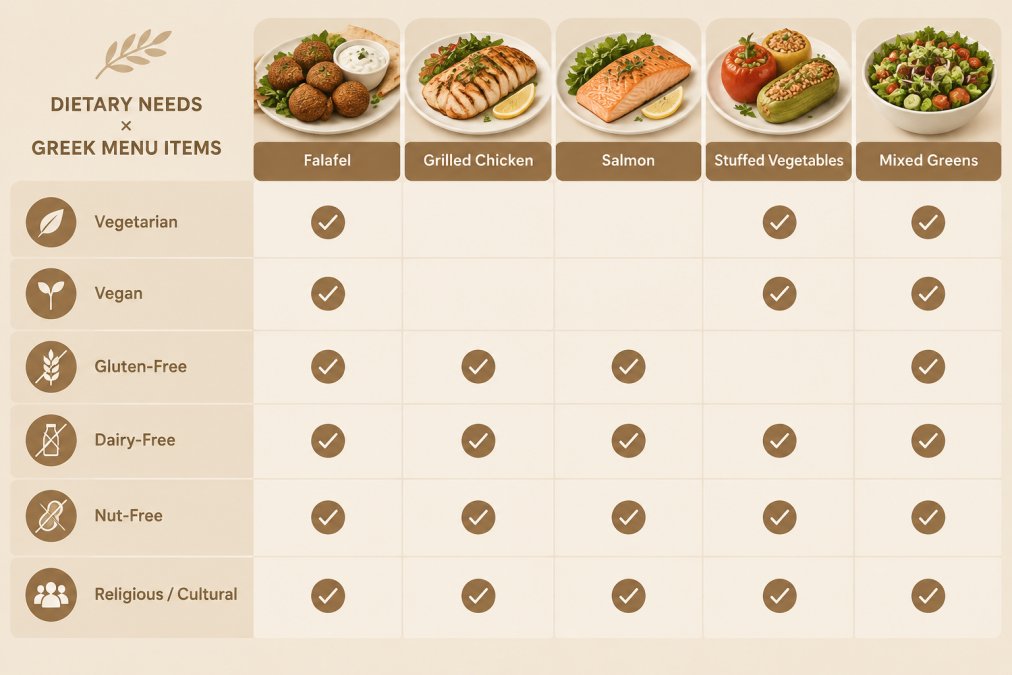
Vegetarian, Vegan, and Plant-Forward Requests
Plant-forward menus are a 2026 industry focus for corporate catering, per Eat Breadless. Build in dishes that stand on their own.
Vegetarian and vegan guests can be served with dishes such as falafel, stuffed vegetables, and roasted vegetables, with hummus, olives, and mixed greens for variety.
Gluten-Free, Dairy-Free, and Nut-Free Needs
Label every dish clearly. Keep sauces and dressings on the side so guests control what touches their plate.
Grilled chicken, salmon, and roasted vegetables are naturally gluten-free.
Gluten-Free Catering Options That Don't Feel Like an Afterthought
Gluten-free catering options work best when the base menu is already gluten-free. Don't rely on a separate "special plate" that shows up cold.
Greek food has a head start here, since many traditional dishes do not rely on wheat.
Our Greek restaurant menu covers meze, salads, and grilled mains that adapt well for gluten-free guests. Ask about ingredient substitutions when you order.
Allergy-Friendly Catering Ideas: Cross-Contact Procedures and Verification
Allergy-friendly catering ideas only work if the kitchen controls cross-contact. Cross-contact is when an allergen touches a safe dish through shared tools, surfaces, oil, or packaging. A menu label is a claim; verification is the evidence behind it.
Most top-ranking guides stop at "ask about allergens." The stronger approach is to verify at four points: ingredients, preparation surfaces, utensils and equipment, and packaging and service. Run each dish through all four before the event day.
1. Verify ingredients in writing. Ask the caterer for a written ingredient list per dish, not a verbal confirmation. For packaged components, dressings, sauces, breads, desserts, request the manufacturer's allergen statement or label. Ingredient lists change; confirm the version used for your event date. A common pattern is for a sauce that was gluten-free last quarter to pick up a wheat-based thickener in a reformulation.
2. Verify preparation surfaces and equipment. Ask specifically about shared fryers, grills, griddles, cutting boards, and mixers. A fryer that cooked breaded items earlier in the day is not safe for a gluten-free guest, even if the oil was changed.
3. Verify utensils and service tools. Separate serving spoons per tray are the minimum. For nut and shellfish allergies, confirm that tongs, scoops, and knives used on allergen-containing dishes are not reused on safe dishes. Ask whether staff will change gloves between trays.
4. Verify packaging and transport. For boxed or individually packaged meals, confirm that allergen-aware boxes are sealed, labeled, and stored apart from other boxes. Cross-contact in transit is common when trays stack and lids leak.
Ask your caterer these questions:
- Are fryers and grills shared with allergens, and can a dedicated pan or surface be used?
- Are utensils kept separate for each dish, and will staff change gloves between trays?
- Can you provide a written ingredient list and manufacturer allergen statement for every packaged component?
- How are allergen-aware dishes packaged and kept separate during transport?
- Who on site can confirm ingredients on the event day if a guest asks?
MDPI research on sustainable collective catering shows that clear food information supports safer, better-planned meals. Get allergy details confirmed before the event day, not during setup.
Watch out: a caterer who says "it should be fine" without a written ingredient list has not verified anything.
Our catering FAQ answers common questions about special requests and how we handle them.
Catering Menu Ideas for Large Groups: Portions, Stations, and Variety
Catering menu ideas for large groups come down to portion planning. Order enough of each dietary option so guests aren't left with empty trays.
A simple rule: count guests per dietary need, then add a buffer. If 40 people attend and 8 are vegetarian, plan for 10 to 12 vegetarian portions.
Build stations around variety:
- A protein station with grilled chicken, salmon, and falafel
- A salad and grain bowl station
- A vegetable meze station
- Sauces and dressings on the side
Flexible proteins and customizable dishes let picky eaters and restricted guests build a plate they'll enjoy.
How to Collect Dietary Requirements Before the Event
Collect requirements early with a short form, then turn the answers into a count your caterer can cook from. The gap most guides leave open is the workflow between the RSVP and the purchase order.
Build the form around five questions. Keep it short enough that people finish it:
- Do you have any dietary restrictions or allergies? (Yes / No)
- Which foods must you avoid? (free-text)
- Is this a preference, a medical need, or a diagnosed allergy? (single choice)
- How serious is a reaction if you eat the food by mistake? (free-text, optional)
- Do you need your meal individually packaged and labeled? (Yes / No)
Question 3 matters because a preference and a diagnosed allergy require different kitchen procedures. Question 5 flags guests who should not serve themselves from a buffet.
Set two deadlines. A primary deadline a week or more before the event gives the caterer time to order and prep, and a secondary cutoff shortly before the event captures late RSVPs. After the secondary cutoff, plan a small buffer of allergen-aware portions rather than reopening the order.
Handle late requests with a standing buffer. Consider adding a few extra portions of each allergen-aware dish beyond the confirmed count. That buffer covers late RSVPs and a guest who discovers a need on the day without forcing a separate last-minute order.
Protect confidential requests. Some guests disclose a medical condition and ask that it not be shared with the team. Collect those details in a private channel, a direct email or a form that routes to one planner, and share only the count and the dish requirements with the caterer, not the guest's name or condition.
Convert answers into a caterer-ready count. Compile responses into a simple table: dietary category, number of guests, and any dish-level notes. Share that table with the caterer at least a week ahead, and confirm in writing that the count was received. This one step prevents most day-of problems.
Watch out: a verbal "I think a few people are vegetarian" is how events run out of food. Get it in writing, and keep the count table with the catering contract.
Build the pre-event form around these five questions so answers convert cleanly into a caterer-ready count.
| Question | What it asks | Why it matters |
|---|---|---|
| 1 | Any dietary restrictions or allergies? (Yes / No) | Flags who needs attention |
| 2 | Which foods must you avoid? (free-text) | Captures specific items |
| 3 | Preference, medical need, or diagnosed allergy? | Preference and allergy need different procedures |
| 4 | How serious is a reaction? (optional) | Optional severity detail |
| 5 | Need meal individually packaged and labeled? | Flags guests who should not self-serve |
Labeling, Buffet Layout, and Inclusive Service on the Day
Clear labeling makes or breaks an inclusive buffet. Every dish needs a card naming what's in it and what it avoids.
Set up the buffet so restricted dishes come first. Keep serving spoons separate for each tray. Place allergen-free items away from dishes with nuts or bread.
Brief your serving staff on the top allergens. A guest who has to ask three people about ingredients will skip the meal entirely.
Planning Your Next Corporate Catering Order
Ready to put these ideas to work? Start with a menu built around inclusive dishes, then collect requirements and confirm allergen details early.
At Parthenon Greek Restaurant & Chevy Chase Lounge, we've served authentic Greek food since 1989. We offer private catering services, and we use imported Greek products and extra virgin olive oil. You can also explore Greek hospitality for your next gathering and Experience Greece in DC with a table for a smaller team lunch.
Get started with Parthenon Greek Restaurant & Chevy Chase Lounge and build a corporate menu every guest can enjoy.
Frequently Asked Questions
What should I serve at a corporate lunch for guests with dietary restrictions?
Build the base menu around dishes that are naturally inclusive rather than tracking specialty plates one by one. Greek food works well here: grilled chicken and salmon satisfy protein needs, while falafel, stuffed vegetables, roasted vegetables, grain bowls, and mixed greens cover vegetarian and vegan guests without extra ordering. Keep sauces and dressings on the side so gluten-free and dairy-free guests can choose. A buffet of shared, naturally inclusive dishes can give good variety for the budget.
How do I prevent cross-contact when serving guests with food allergies?
Ask your caterer how they separate utensils, prep surfaces, and serving stations for allergen-free dishes. At the buffet, give each allergen-friendly item its own labeled platter and its own serving utensil, and place nut-free or gluten-free items away from shared bread and dessert trays. Confirm in writing which dishes contain the major allergens and who on the catering team verifies that before service. For office catering for dietary restrictions, assign one staff member to answer guest questions at the table so nobody has to guess from an unlabeled tray.
How should I collect dietary requirements before a company event?
Send a short RSVP form well ahead of the event with checkboxes for vegetarian, vegan, gluten-free, dairy-free, nut-free, and any allergy or religious requirement, plus a free-text field for anything else. Ask guests to flag severe allergies separately so the caterer can plan cross-contact procedures. For large groups, summarize the counts by category rather than forwarding individual responses. Confirm the final headcount and dietary breakdown with your caterer before the event so portion planning for specialty items is accurate.
What are affordable catering ideas for a large group with mixed dietary needs?
Shared, build-your-own formats stretch a budget further than individual plated meals. Sandwich platters, wraps, salads, grain bowls, and mezze-style spreads let guests with different dietary preferences assemble what they can eat, which reduces the number of specialty plates you pay for. Plan some extra of each dietary-specific item so late additions and guests who eat more than one option are covered. Ask your caterer for a quote based on your final headcount and dietary mix, since pricing depends on quantity, dates, and delivery.