 blog
Finding Quality Mediterranean Food in DC: A Local Guide
Last Updated: November 2, 2026
Quick Summary
Finding quality mediterranean food in DC means judging four signals: ingredient sourcing, olive oil and freshness, whether grilled dishes are cooked to order, and consistency across repeat visits. Order a spread of meze, salad, and a grilled main to test the kitchen in one sitting.
- Extra virgin olive oil should taste peppery or grassy, not flat or neutral.
- A menu listing dozens of dishes across five cuisines often means a freezer is doing the work.
- Greek food is a specific regional cuisine within the broader Mediterranean category.
- For a first visit, order two or three meze, one salad, one grilled main, and a shared dessert.
- Parthenon Greek Restaurant has served Greek food in the same tradition since 1989.
Table of Contents
- What Makes Mediterranean Food in DC Worth Seeking Out
- How to Judge Quality Mediterranean Food in DC
- Greek Food vs. Mediterranean Food: What the Labels Actually Mean
- Essential Mediterranean Dishes for First-Time Diners
- What to Order at a Greek Restaurant, Course by Course
- Neighborhoods, Prices, and Practical Logistics for DC Dining
- Book a Table and Taste the Difference Yourself
- Frequently Asked Questions
What Makes Mediterranean Food in DC Worth Seeking Out
Finding quality Mediterranean food in DC comes down to one thing: whether the kitchen treats olive oil, produce, and grilling as the whole point of the meal or as decoration around it. This guide from Parthenon Greek Restaurant & Chevy Chase Lounge is built on a simple standard: a restaurant earns the label when the ingredients are real, the cooking is done to order, and the flavors hold up on a second visit.
That standard matters because the category is broad. Mediterranean food is a style of cooking built around olive oil, fresh vegetables, legumes, grains, grilled fish and meat, and dairy like yogurt and feta, drawing on Greek, Turkish, Lebanese, and wider Middle Eastern traditions. The label describes a region, not a single cuisine.
Here is the honest part most guides skip: a menu can say "Mediterranean" and still serve reheated frozen dolmades and a sauce poured from a gallon jug. The difference shows up in small details, and once you know what to look for, you can judge a restaurant in about ten minutes.
Below, we break down what separates a good table from a forgettable one, what the labels actually mean, and which dishes to order first.
How to Judge Quality Mediterranean Food in DC
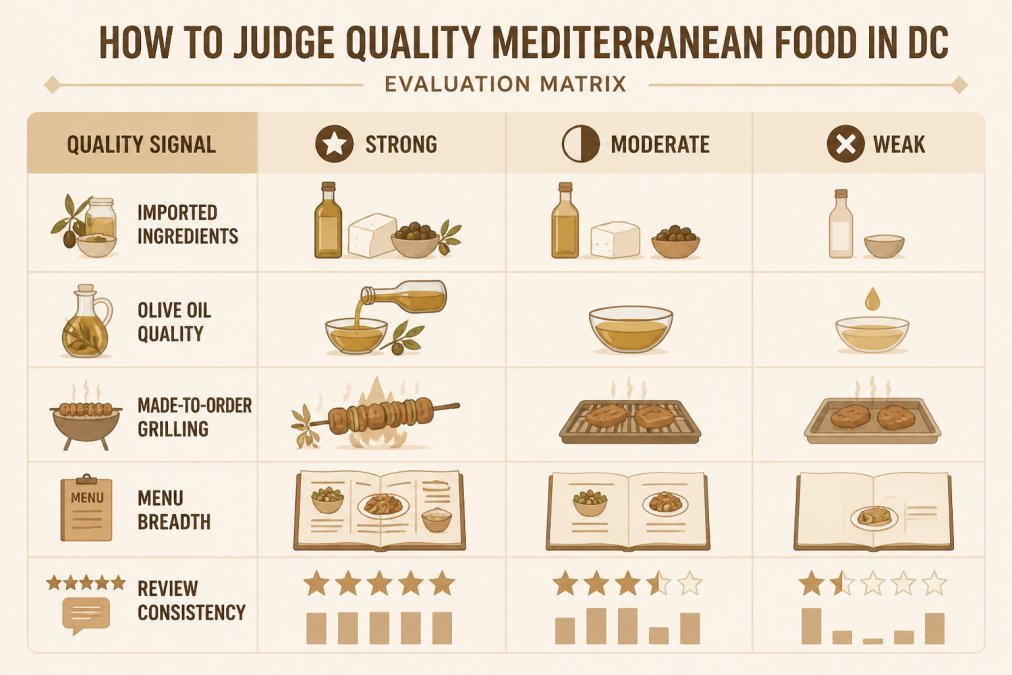
Quality in Mediterranean cooking is judged on four signals: ingredient sourcing, olive oil and freshness, whether grilled dishes are cooked to order, and consistency across repeat visits. Everything else, from décor to menu length, is secondary.
Most diners weigh the wrong things. They judge a restaurant by how many dishes are listed or how the room looks. A tight menu cooked well beats a sprawling one cooked from bags.
Ingredients, Olive Oil, and Freshness Signals
Start with the oil. Extra virgin olive oil should taste peppery or grassy on its own, and a kitchen that uses it well will not drown a salad in it. If the oil tastes flat or neutral, the rest of the plate usually follows.
Freshness shows in texture. Tomatoes should give slightly when pressed, not collapse. Feta should crumble cleanly rather than smear. Herbs like oregano and dill should smell like something when the plate lands.
Watch out: a menu that lists dozens of dishes across five cuisines usually means a freezer is doing the work. Narrow menus are often a sign of confidence.
Service, Atmosphere, and Consistency
Consistency is the hardest signal to fake. A restaurant that gets a dish right once can be lucky; one that gets it right on your third visit is doing something deliberate.
Ask a server how a dish is prepared. Staff who can explain what is in a dip or how a fish is grilled tend to work in kitchens that care. Vague answers are information too.
Atmosphere matters for the occasion. A loud room suits a group happy hour; a quieter one suits a business lunch. Match the space to the reason you are going out.
Greek Food vs. Mediterranean Food: What the Labels Actually Mean
Greek food is a specific regional cuisine within the broader Mediterranean category. Mediterranean food covers Greek, Turkish, Lebanese, Levantine, Italian, Spanish, and wider Middle Eastern cooking; Greek food refers to the dishes, ingredients, and techniques of Greece itself. The distinction matters when you are choosing a restaurant, because a kitchen that calls itself Mediterranean may pull from several traditions, which can mean a little of everything and mastery of nothing.
The traditions are not interchangeable, and the differences show up on the plate:
- Greek: olive oil rather than butter, oregano and lemon as the default seasoning, horiatiki salad with a slab of feta, grilled fish and octopus, souvlaki and gyro, moussaka, and phyllo desserts like baklava and galaktoboureko. Grilling over charcoal and finishing with lemon and oil is the signature technique.
- Turkish: charcoal-grilled kebabs, meze with a wider range of vegetable and yogurt preparations, pide and lahmacun, and a strong sweet-and-savory balance in dishes like manti. Yogurt is used as a sauce and a base, not just a side.
- Levantine (Lebanese and Syrian): hummus, baba ghanoush, tabbouleh, fattoush, kibbeh, and shawarma, with a heavier hand on herbs, sumac, and tahini. Meze is a full meal, not a starter.
- Broader Middle Eastern: overlaps with Levantine cooking but can include Egyptian, Persian, and North African influences, from grilled meats to rice and stew traditions.
Authenticity is not about a checklist. It is about whether the kitchen uses the ingredients the dish was built around, Greek olive oil and feta, Turkish yogurt and charcoal, Levantine sumac and tahini, and whether the technique matches the tradition. For a deeper look at what separates the real thing from a generic menu, read what makes Greek food authentic.
Essential Mediterranean Dishes for First-Time Diners
For a first visit, order a spread rather than a single plate: two or three meze, one salad, one grilled main, and a shared dessert. This lets you taste how the kitchen handles cold dishes, hot dishes, and grilled food in one sitting.
The dishes worth knowing:
- Meze and dips: hummus, tzatziki, taramasalata, and warm pita. These show whether the kitchen makes its own or buys in.
- Horiatiki salad: tomato, cucumber, onion, olives, and a slab of feta. Simple dishes expose weak ingredients fastest.
- Grilled fish or octopus: ordered whole or by the piece, dressed with lemon and oil.
- Souvlaki and gyro: skewered or shaved meat with pita, tomato, onion, and tzatziki.
- Moussaka and lamb dishes: layered or braised preparations that reward slow cooking.
- Phyllo desserts: baklava and galaktoboureko, best shared at the end.
To see the actual lineup before you go, explore the Greek restaurant menu and picture the meal in advance.
What to Order at a Greek Restaurant, Course by Course
Build the meal in four stages: shared meze first, then salad, then grilled mains, then a shared dessert with coffee. Ordering this way keeps the table busy, controls the pace, and lets you taste across the menu without overspending.
Start with two dips and a plate of grilled vegetables or saganaki. Add warm pita and let the table share.
Move to a salad. A horiatiki or a maroulosalata resets the palate and tells you how the kitchen handles raw ingredients.
For mains, mix one grilled fish or seafood dish with one meat dish. Grilled dishes arrive fast and are best eaten immediately, so do not let them sit while you finish the meze.
Finish with a phyllo dessert and Greek coffee. If you want a structured walkthrough of this order, our guide on what to order at a Greek restaurant lays it out step by step.
Neighborhoods, Prices, and Practical Logistics for DC Dining
The right Mediterranean restaurant depends on your route, your budget, and who is at the table. Pick the neighborhood first, then the occasion, then the menu.
| Factor | What to Check | Why It Matters |
|---|---|---|
| Neighborhood | Walkable from your office or Metro stop | Cuts travel time on a weeknight |
| Price band | Meze, mains, and drinks priced separately | Small plates add up fast |
| Dietary fit | Vegetarian, vegan, gluten-free, and halal options | Not every menu labels allergens |
| Occasion | Patio, private area, or bar seating | Groups need space, not just a table |
| Timing | Lunch, dinner, brunch, and happy hour windows | Kitchens slow down at off-peak hours |
| Access | Step-free entrance, accessible restroom, transit proximity | A good meal is not worth a bad arrival |
On price, Mediterranean food in DC generally falls into three bands. Pricing depends on the dishes you choose, the size of your group, and the time of your visit. For current menu prices or a catering quote, check the Parthenon website or contact the restaurant directly before you commit.
Dietary needs deserve a direct question rather than an assumption. Many Greek dishes are naturally vegetarian, and guests with allergies or dietary restrictions should ask the restaurant about its preparation before ordering.
Logistics beyond the reservation matter too. If anyone in your party uses a wheelchair or stroller, confirm step-free entry and restroom access when you call. For neighborhood details and directions, check whether we serve your area before you plan the trip.
Book a Table and Taste the Difference Yourself
The best way to judge Mediterranean food in DC is still to sit down and order. Reviews and rankings help you build a shortlist, but they cannot tell you whether the olive oil is real or the fish was grilled ten minutes ago.
A few habits make the decision easier. Pick the neighborhood first, then the occasion, then the menu. Ask about sourcing when you call. Order a spread rather than one plate. And give a restaurant a second visit before you decide, because consistency is the signal that matters most.
At Parthenon Greek Restaurant & Chevy Chase Lounge, we have served Greek food in the same tradition since 1989, using imported Greek products and extra virgin olive oil, with a patio for outdoor dining, a lounge for handcrafted cocktails, and private catering for larger gatherings. If you would like to Experience Greece in DC, reserve a table and see the difference for yourself.
National Restaurant Association State of the Restaurant Industry report
Frequently Asked Questions
What are the essential Mediterranean dishes to try for the first time?
Start with mezze: hummus, tzatziki, dolmades, and grilled halloumi. Move on to a gyro or souvlaki, then share a whole grilled fish or moussaka. A Greek salad with real feta and olive oil tells you quickly whether the kitchen cares about ingredients. Order three or four small plates per two people so you can taste across the menu without committing to one large dish.
What should I look for when choosing a Mediterranean restaurant?
Look for a focused menu rather than a 60-item list, visible grilling, olive oil that tastes peppery rather than neutral, and reviews that mention consistency over months rather than one lucky night. Ask whether the feta and olive oil are imported. A restaurant that has survived more than a decade in the same neighborhood usually has the fundamentals right.
What is the difference between Greek food and Mediterranean food?
Mediterranean food is the umbrella term covering Greek, Turkish, Lebanese, Italian, and other coastal cuisines. Greek food is a specific regional cuisine built on olive oil, oregano, lemon, feta, lamb, and seafood. A menu labeled Mediterranean may lean Lebanese or Turkish. If you want Greek specifically, check for gyros, souvlaki, moussaka, and horiatiki salad on the menu.
Where can I find Greek food in DC?
Greek options are spread across the District, and long-running family restaurants are one part of that mix. Parthenon Greek Restaurant & Chevy Chase Lounge has served Greek cuisine since 1989 and offers patio dining, a lounge for cocktails, and private catering. Reservations are available online.
Ready to compare a menu against everything above? Get started with Parthenon Greek Restaurant & Chevy Chase Lounge and reserve a table for lunch, dinner, or a weekend Greek brunch, then order a spread and judge the olive oil for yourself.