 How-to
Catering Portions for 50 Guests: A Step-by-Step Planning Guide
Last Updated: November 19, 2026
Quick Summary
To calculate catering portions for a 50 person party, multiply per-person baselines by 50 and add a 10 percent buffer: 5-6 appetizer pieces, 6-8 oz protein, 4-6 oz of each side, 2-3 oz dessert, and 2-3 beverage servings per guest. Then convert those totals into full and half pans, rounding up to the nearest full tray.
- Confirm a real headcount first, since invited guests are not the same as attending guests.
- Plan 8-10 appetizer pieces per guest if the event is appetizers only.
- A full-size 4-inch hotel pan holds roughly 35-45 servings.
- Buffet service calls for a 10-15 percent bump over plated portions.
- Hold hot foods at 140°F or above and cold foods at 40°F or below.
Table of Contents
- Start With a Confirmed Headcount, Not an Estimate
- Catering Portions Per Person: The Baseline Numbers
- How Much Food for 50 Guests: Running the Numbers
- Catering Trays for 50 Guests: Converting Servings to Pans
- Use a Food Quantity Calculator for Party Planning
- Adjust Quantities for Meal Time, Duration, and Service Style
- Dietary Restrictions, Allergens, and Food Safety
- Book Your 50-Person Greek Catering Event
- Frequently Asked Questions
Start With a Confirmed Headcount, Not an Estimate
The first rule of how to calculate catering portions for a 50 person party is simple: 50 is a number, not a guess. A confirmed headcount is the foundation every other quantity builds on.
Why does it matter so much? Because a swing of five guests changes your protein order, your tray count, and your budget. Lock the number down before you do any math.
Here's how to get to a real number:
- Send a save-the-date with a hard RSVP deadline
- Follow up with anyone who hasn't replied a week out
- Add your confirmed guest count to a separate line for staff and vendors
- Round up to the nearest five for a small cushion
A common mistake is using the invite list as the headcount. Invited is not the same as attending.
Catering Portions Per Person: The Baseline Numbers
Catering portions per person are the per-guest quantities you multiply by your headcount to get total food needs. Get the baseline right and the rest of the plan falls into place.
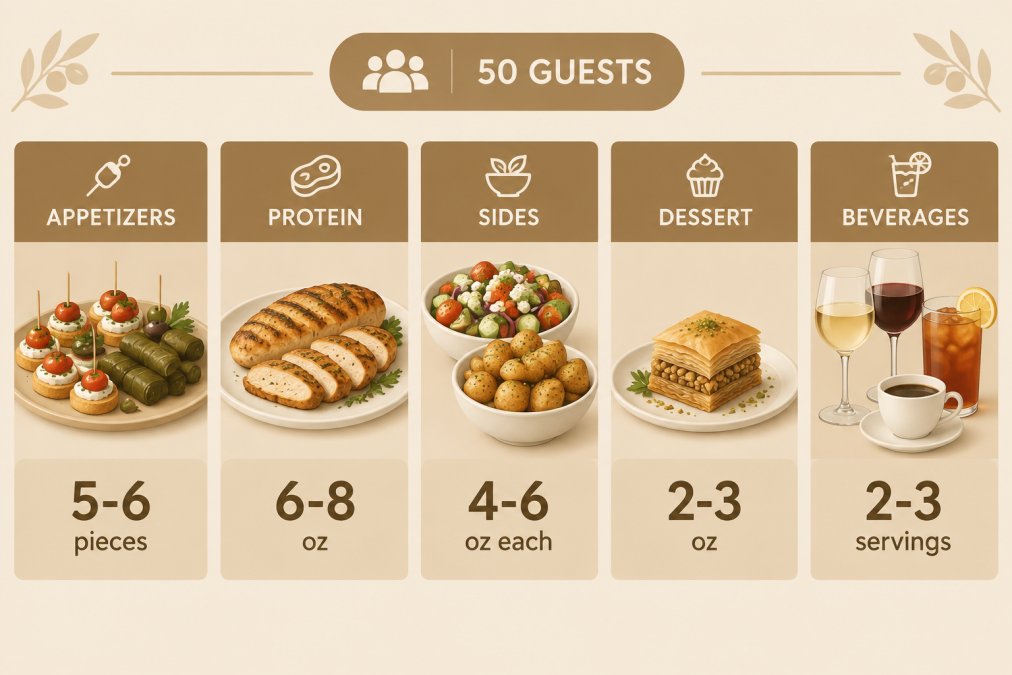
Here is a working baseline for a mixed adult crowd:
- Appetizers: 5-6 pieces per guest before a meal
- Protein: 6-8 ounces per guest for a main course
- Side dishes: 4-6 ounces of each side per guest
- Dessert: 2-3 ounces per guest
- Beverages: 2-3 servings per guest
These numbers assume adults with normal appetites and a meal that runs a couple of hours. We'll adjust them below for timing and service style.
Appetizer Pieces and Protein Ounces
Appetizers do the heavy lifting during the first hour. Plan 5-6 pieces per guest if a full meal follows, and closer to 8-10 if the event is appetizers only.
Protein is where hosts most often under-order. Six to eight ounces per guest covers a plated or buffet main. If you're serving two proteins, split the total between them rather than doubling it.
If you're building a meze-style spread, our guide to Greek appetizers and small plates walks through the categories so you can pick a balanced mix.
Side Dishes, Dessert, and Beverages
Sides add up fast because guests take a little of each. With three sides, plan 4-6 ounces of each per guest, not 4-6 ounces total.
Dessert is lighter: 2-3 ounces per guest is plenty after a full meal. Beverages run 2-3 servings per person, and you'll want more if the event is long or outdoors in warm weather.
Choosing the right sides matters as much as the quantity. Our guide to building a balanced Greek plate helps you pick sides that hold up well on a buffet line.
How Much Food for 50 Guests: Running the Numbers
How much food for 50 guests comes down to one move: multiply your per-person baseline by 50, then add a small buffer. Let's run it.
| Category | Per Guest | × 50 Guests | Add 10% Buffer |
|---|---|---|---|
| Appetizers | 5-6 pieces | 250-300 pieces | 275-330 pieces |
| Protein | 6-8 oz | 300-400 oz (19-25 lb) | 21-28 lb |
| Side dishes (each) | 4-6 oz | 200-300 oz (12-19 lb) | 14-21 lb |
| Dessert | 2-3 oz | 100-150 oz (6-9 lb) | 7-10 lb |
| Beverages | 2-3 servings | 100-150 servings | 110-165 servings |
That 10 percent buffer is your safety net. It covers a surprise guest, a hungry crowd, or a dish that goes faster than expected.
Catering Trays for 50 Guests: Converting Servings to Pans
Catering trays for 50 guests are easier to plan once you know how many servings a full tray holds and how deep that tray is. The conversion is where most hosts get stuck, because a "full tray" is not a standardized unit.
Start with these working yield assumptions:
- Full-size hotel pan, 2-inch depth: roughly 20-25 servings of a side dish or entrée
- Full-size hotel pan, 4-inch depth: roughly 35-45 servings
- Half pan, 2-inch depth: roughly 10-12 servings
- Half pan, 4-inch depth: roughly 18-22 servings
Those ranges assume a standard serving of about 4-6 ounces for sides and 6-8 ounces for proteins. A dense item like a potato gratin or a rice pilaf fills a pan faster than a leafy salad, so treat the ranges as planning bands, not exact counts.
Now convert the 50-guest totals from the previous section into pans. Using the buffered totals (with the 10 percent cushion already added):
| Category | Buffered total for 50 | Full pan, 2-inch | Full pan, 4-inch | Half pan, 2-inch | Half pan, 4-inch |
|---|---|---|---|---|---|
| Appetizers (pieces) | 275-330 pieces | 3-4 pans | 2 pans | 6-8 pans | 4-5 pans |
| Protein | 21-28 lb | 3-4 pans | 2 pans | 6-8 pans | 4-5 pans |
| Each side dish | 14-21 lb | 2-3 pans | 1-2 pans | 4-6 pans | 3-4 pans |
| Dessert | 7-10 lb | 2 pans | 1 pan | 4 pans | 2-3 pans |
Half pan, 4-inch
A few practical rules fall out of that table:
- Order by the pan, not by the ounce. Most caterers price and deliver in full and half pans, so round your ounce total up to the next full pan rather than trying to hit an exact weight.
- Use 4-inch pans for starches and 2-inch pans for proteins and vegetables. Deeper pans hold heat longer on a buffet line, which matters for items that sit out.
- Plan one backup half pan of your most popular item. For a 50-person party, that is usually the protein or the appetizer that guests return to.
- Count the pan, not the serving, when you have a mixed menu. If you serve three sides, each side needs its own pan count; do not divide one pan across three dishes.
Watch out: a shallow full pan can hold half the servings of a deep one, so confirm pan depth with your caterer before you finalize counts.
For office and group events, our complete guide to Greek restaurant catering for office events explains how tray counts shift with service style and delivery timing.
Use a Food Quantity Calculator for Party Planning
A food quantity calculator for party planning turns all of this into a quick estimate. You don't need special software, a simple formula works.
Total food needed = (per-person quantity × confirmed guests) + 10% buffer
Run it category by category. Here's the checklist:
- Confirm headcount
- Choose per-person quantity for each category
- Multiply by guest count
- Add a 10 percent buffer
- Convert total servings into trays or pans
- Round up to the nearest full tray
Do this once per category and you have a complete quantity estimate in minutes.
Adjust Quantities for Meal Time, Duration, and Service Style
Meal time, event duration, and service style all move your numbers. A brunch and a dinner party for the same 50 guests are not the same order.
Adjust like this:
- Morning or brunch events: lighter appetites, plan toward the low end
- Evening events: fuller appetites, plan toward the high end
- Events over three hours: add appetizers and beverages
- Buffet service: plan slightly more, guests serve themselves generously
- Plated service: portions are controlled, so you can plan tighter
Service style is the biggest swing factor. Buffet lines invite bigger portions, so a 10-15 percent bump is wise. Plated dinners let you hit exact counts.
Dietary Restrictions, Allergens, and Food Safety
Dietary needs change your quantities, not just your menu. When you add vegetarian or gluten-free options, you split the guest count across more dishes, and the split has to be planned rather than guessed.
Start with a simple allocation method. Collect restrictions on the RSVP with checkboxes for vegetarian, vegan, gluten-free, dairy-free, nut allergy, shellfish allergy, and "other." Then plan each dietary dish for the guests who need it plus a small buffer:
- Vegetarian entrée: plan for the confirmed vegetarian count plus 2-3 extra servings, since some omnivores will choose it
- Vegan entrée: plan for the confirmed vegan count plus 1-2 extra servings
- Gluten-free sides and entrées: plan for the confirmed gluten-free count plus 2-3 extra servings, and keep dedicated serving utensils
- Allergy-safe dishes: plan for the confirmed count plus 1-2 extra servings, and prepare them in a separate area when possible
A useful cross-check is to make sure every guest has at least two safe options on the buffet. If your menu is three sides and two entrées, that usually means one naturally vegetarian side, one gluten-free side, and one entrée that can be plated without the sauce or garnish that carries the allergen.
Allergen handling is a quantity and logistics decision as much as a menu decision.
Food safety is the other half of planning, and it has concrete numbers behind it. The common holding targets are:
- Hot foods: hold at 140°F or above
- Cold foods: hold at 40°F or below
- The danger zone: 40°F to 140°F, where bacteria multiply fastest
- Two-hour rule: perishable foods should not sit in the danger zone for more than two hours, or one hour if the room is above 90°F
For a 50-person buffet, that means planning replenishment rather than letting trays sit.
If you are building a Greek menu, our guide to Greek appetizers and small plates shows which items are naturally vegetarian or gluten-free, which makes the dietary allocation easier to plan.
Book Your 50-Person Greek Catering Event
You've got the numbers. Now let us handle the food. At Parthenon Greek Restaurant & Chevy Chase Lounge, we've been serving authentic Greek cuisine since 1989, using imported Greek products and extra virgin olive oil.
Our private catering services can support events like this. If you'd like to see the space for yourself before the big day, you can also Experience Greece in DC with a reservation.
Ready to plan your spread? Order Greek catering for your office lunch, family gathering, or celebration, and if you're local, see our Greek catering for Chevy Chase events.
Planning food for 50 guests is a math problem with a hospitality heart.
Frequently Asked Questions
How many catering trays do I need for 50 guests?
Plan on roughly 6 to 8 full-size trays for a buffet of 50. A standard full tray holds about 25 to 30 servings, so 50 guests at one serving each means 2 trays per item. With three mains and three sides, that lands around 6 to 8 trays, plus separate trays for appetizers and dessert. Add one extra tray on any item you expect guests to favor, and confirm tray dimensions with your caterer before ordering.
How much food should I plan per person for a 50 person party?
A workable baseline is 1 to 1.5 pounds of food per guest across the whole menu, or about 6 to 8 ounces of protein, 4 to 6 ounces of each side, 5 to 6 appetizer pieces, and 2 to 3 ounces of dessert. That puts a 50-person party at roughly 50 to 75 pounds of food total. Add a 10 percent buffer for guest appetite and no-shows, and confirm final catering portions per person with your caterer.
How do I adjust portions if my event runs longer than two hours?
Add extra appetizer pieces and beverages for events over two hours. A cocktail-style reception running three hours needs about 8 to 10 appetizer pieces per guest instead of 5 to 6, and beverages closer to 3 to 4 servings per person. For a seated dinner that stays under two hours, the standard baseline holds. Tell your caterer the start and end time so they can plan holding temperatures and replenishment.
What is the cheapest way to feed 50 people at a catered event?
Buffet service with fewer protein options and more filling sides keeps costs down. Choose one or two mains instead of three, lean on rice, potatoes, and pita, and serve appetizers in smaller counts. Skip plated service, which needs more staff. Ask your caterer for a per-person package rather than itemized trays, and confirm pricing directly since it depends on menu, quantity, and delivery.