 how-to
How to Evaluate Restaurant Price to Portion Value
Last Updated: November 7, 2026
Quick Summary
To evaluate restaurant price to portion value, divide the menu price by the edible ounces you will actually eat, not just the as-served weight. Then adjust for ingredient quality, preparation, and waste to see whether the dish is a fair deal.
- Price explains about 67% of perceived restaurant value, according to Deloitte's regression analysis.
- Compare price per edible ounce by subtracting bones, shells, excess fat, and garnish you will not eat.
- For shared dishes, divide the price by the number of people it realistically feeds.
- Compare only similar dishes, matching protein, preparation, and whether sides are included.
- If two dishes are within about 10% on price per edible ounce, let quality and preparation decide.
Table of Contents
- Why Portion Size Alone Doesn't Tell You Much
- Step 1: Gather the Price and Portion Details
- Step 2: Run a Restaurant Price to Portion Value Calculator
- Step 3: Work Through a Restaurant Price to Portion Value Example
- Step 4: How to Compare Restaurant Portion Sizes Across Menus
- Step 5: Factor in Quality, Preparation, and Usable Portion
- Step 6: Decide Whether the Meal Is Restaurant Meal Value for Money
- Booking a Visit to Test the Value Yourself
- Frequently Asked Questions
Restaurant prices have climbed sharply in recent years, and that jump has left many diners eating out less often and spending less. When a dish arrives at a higher price, most people ask a simple question: is this worth it? Here is how to evaluate restaurant price to portion value for yourself.
Price is only one piece of the puzzle. Deloitte's regression analysis found that price explains about 67% of perceived value in restaurants, leaving 33% to other factors Deloitte, How restaurants can win on value. That means portion size, taste, and ingredient quality all matter too.
Why Portion Size Alone Doesn't Tell You Much
A big plate is not automatically a good deal. Datassential reports that diners judge a menu item by four things: taste, price, portion size, and ingredient quality Datassential, How Consumers Define Value and How Restaurants Can Deliver It. A large portion of bland food can feel like poor value. A smaller portion of excellent food can feel like a bargain.
So the goal is to compare price against what you actually get. The steps below show you how.
Step 1: Gather the Price and Portion Details
Start with the numbers. You need three things for each dish:
- The menu price before tax and tip
- The portion weight or volume, in ounces or cups
- The number of servings, if the dish is meant to be shared
Many menus do not list portion sizes. If yours does not, ask your server. A good restaurant will usually tell you the approximate weight of a dish.
Step 2: Run a Restaurant Price to Portion Value Calculator
Divide the price by the portion size. The result is your price per ounce.
Price per ounce = menu price ÷ portion ounces
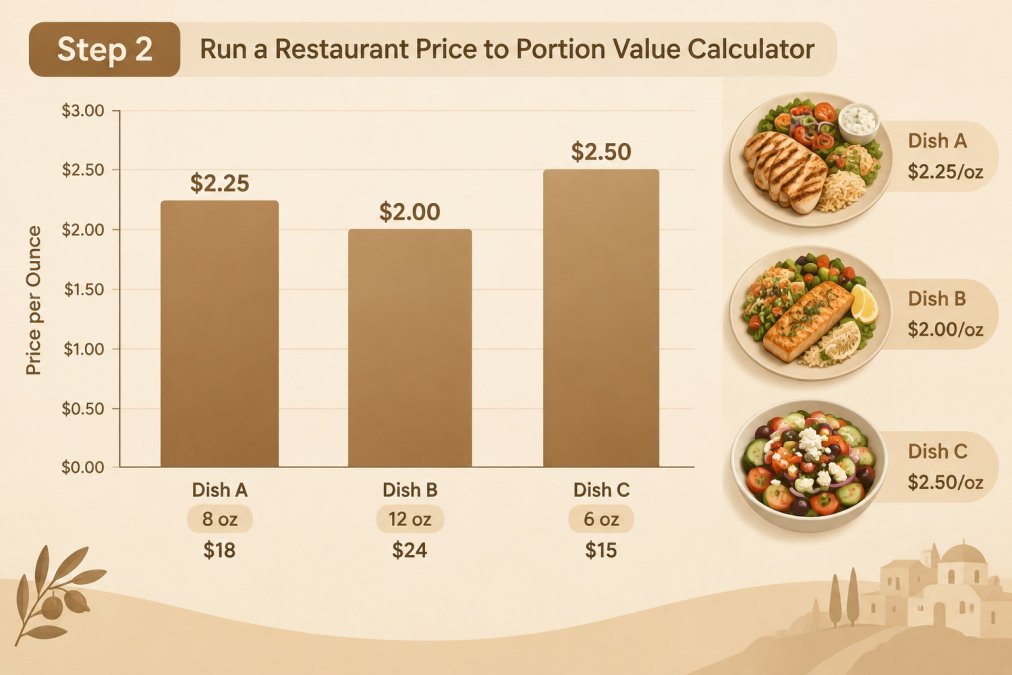
A lower number means more food for your money. Keep in mind that this is only a starting point. A $2.50-per-ounce dish of premium seafood can be a better value than a $2.00-per-ounce plate of filler.
Most diners stop at that one number, which is why price-per-ounce comparisons often mislead. The fix is to run three versions of the same calculation and compare like with like.
1. As-served price per ounce. Use the menu price before tax and tip and the portion weight the kitchen serves, including sauce, sides, and garnish. This is the number that matches what lands on your table.
2. Edible price per ounce. Subtract what you will not eat: bones, shells, excess fat, large garnishes, and breading you would leave behind. A 14-ounce lamb shank with a 3-ounce bone and 2 ounces of fat is closer to 9 edible ounces. At $22, that is about $2.44 per edible ounce, not $1.57.
3. Per-serving price. If a dish is meant to share, divide by the number of people it actually feeds, not the number the menu claims. A $32 mezze platter that comfortably feeds three is about $10.67 per person; the same platter split two ways is $16 per person.
A simple worksheet keeps the comparison honest. For each dish, write down the menu price, the as-served ounces, the edible ounces, and the number of servings. Then calculate price per edible ounce and price per serving.
Keep in mind that portion weights on menus may be as-served rather than edible, so a bone-in dish can look like a bargain on price per ounce while losing on price per edible ounce.
Use the same worksheet across a whole menu. On a Greek menu, for example, a grilled octopus meze and a lamb platter are not direct substitutes, but running both through the worksheet shows which one delivers more edible food per dollar before you factor in taste and occasion.
The article's worksheet compares three versions of the same calculation, so the figures can be scanned side by side.
| Calculation | Formula | Example |
|---|---|---|
| As-served price per ounce | Menu price ÷ as-served ounces | Lamb shank: $22 ÷ 14 oz ≈ $1.57 |
| Edible price per ounce | Menu price ÷ edible ounces | Lamb shank: $22 ÷ 9 oz ≈ $2.44 |
| Per-serving price | Menu price ÷ people it feeds | $32 platter: $10.67 for three, $16 for two |
Step 3: Work Through a Restaurant Price to Portion Value Example
Say you are choosing between two lamb dishes:
- Grilled lamb platter: $26 for 10 ounces. That is $2.60 per ounce.
- Lamb shank special: $22 for 14 ounces. That is about $1.57 per ounce.
On price per ounce alone, the shank wins. But check the rest of the picture. A braised shank has more bone and fat, so the usable meat may be less than 14 ounces. The platter may include sides and a sauce that add real value.
You can see the menu and portion styles on the Parthenon Greek restaurant menu. Use it to run the same math on dishes you are considering.
Step 4: How to Compare Restaurant Portion Sizes Across Menus
When you compare across restaurants, keep the comparison fair. Compare similar dishes, such as grilled lamb to grilled lamb, not lamb to a vegetable plate.
- Match the protein and preparation
- Note whether sides are included
- Check whether the dish is for one person or meant to share
- Compare weight after cooking when you can, since cooking shrinks meat
If you are new to Greek food, a first-timer's guide to ordering at a Greek restaurant can help you build a meal that fits your budget.
Step 5: Factor in Quality, Preparation, and Usable Portion
Numbers miss some things. Ask yourself:
- Ingredient quality: Is the olive oil and seafood fresh? Quality ingredients often justify a higher price.
- Preparation: Is the dish slow-cooked, grilled to order, or made from scratch?
- Usable portion: How much of the plate will you actually eat? Bones, excess fat, and heavy garnish reduce what you get.
- Dietary fit: If you avoid certain foods, a dish with more filler may not serve you well.
This step separates a good value from a cheap-looking one.
The useful move is to translate each factor into a rough adjustment to the price per edible ounce you calculated in Step 2. You are not looking for precision; you are looking for whether quality moves a dish across the line from poor value to fair value.
Ingredient quality. A dish made with fresh fish, whole cuts of meat, or good olive oil costs the kitchen more per ounce, so a higher price per ounce can still be fair. Premium proteins often cost more per edible ounce than chicken or filler-based dishes, and that premium is often justified. The reverse is the warning sign: a dish priced like premium seafood but built on breading, sauce, or a cheaper substitute is where price-to-portion value breaks down.
Preparation. Slow-cooked, grilled-to-order, and from-scratch dishes carry labor and time that a reheated or assembly-line dish does not. When two dishes are close on price per edible ounce, the one with more hands-on preparation usually delivers more value for the same money. Ask your server which dishes are made in-house; most kitchens will tell you.
Usable portion. This is the factor most diners skip. Bones, shells, excess fat, and heavy garnish reduce what you actually eat, so recalculate price per edible ounce before you judge. A large plate that is half garnish is not a large portion. The same logic applies to dietary needs: if a dish is padded with rice, bread, or filler you will not eat, the usable portion is smaller than the menu suggests, and the real value is lower.
Waste and leftovers. A portion you cannot finish is not automatically good value. If a large entrée means throwing away a third of it, the effective price per ounce you actually eat is higher than the menu math suggests. Leftovers you will genuinely eat the next day count in the dish's favor; leftovers that go in the trash do not.
Experience and consistency. Service, atmosphere, and whether the kitchen delivers the same plate every visit affect perceived value even though they do not change the ounce count. A restaurant that consistently serves the portion it promises is worth more than one that varies by night.
A practical rule: adjust your price-per-edible-ounce number up for fresh ingredients, hands-on preparation, and a portion you will finish, and down for filler, heavy garnish, and likely waste. If the adjusted number is still in line with comparable dishes, the meal is a fair value even if the raw price per ounce looked high.
Step 6: Decide Whether the Meal Is Restaurant Meal Value for Money
Put it together with a simple checklist:
- The price per ounce is reasonable for the protein
- The usable portion is what the menu suggests
- The ingredients and preparation justify the cost
- The total meal, with sides and drinks, fits your budget
- You would order it again
If most boxes are checked, the meal offers good restaurant meal value for money. If not, try a different dish or a smaller order.
Booking a Visit to Test the Value Yourself
The best way to judge restaurant price to portion value is to taste the food. Visit Parthenon Greek Restaurant & Chevy Chase Lounge and run the steps above on your own plate. You can reserve a table in Chevy Chase or explore our Washington, DC location to plan your visit. Our staff can help answer questions about dishes you are considering. You can also book directly through Experience Greece in DC to secure your table before you arrive.
Frequently Asked Questions
How do you calculate restaurant price per portion?
Divide the menu price by the number of ounces or grams served to get a price per ounce. Then compare that figure across dishes of similar type. If the menu does not list portion weight, estimate it by weighing a typical serving at home or asking the server for approximate amounts. Remember that the calculation shows only quantity per dollar. It does not capture taste, preparation, or whether the portion includes sides, so use it as one input rather than a final verdict.
Does a larger restaurant portion always mean better value?
No. A larger portion costs the restaurant more to produce, so it does not automatically give you more for your money. Datassential's research on menu items found that consumers judge value using four factors: taste, price, portion size, and ingredient quality. A generous portion of bland or poorly prepared food can feel like a worse deal than a smaller portion that is well seasoned and made with better ingredients. Weigh portion size together with the other three factors.
What should you compare besides portion size when judging restaurant value?
Look at ingredient quality, preparation, presentation, and how much of the plate you can actually eat. Ask whether the dish uses fresh or imported ingredients, whether it is cooked to order, and whether sides or bread are included. Also consider the overall experience, including service and atmosphere, since these affect perceived value. A dish that arrives hot, well plated, and made from quality ingredients often justifies a higher price than a similar-sized dish that does not.
How do you compare the value of similar dishes at different restaurants?
Choose dishes that are truly comparable, such as a gyro with fries or a grilled fish entree with the same side. Note each menu price, estimate the weight or size of each serving, and calculate the price per ounce. Then adjust your judgment for ingredient quality and preparation. Comparing two identical menu items at two Greek restaurants tells you more than comparing a gyro to a seafood platter, which differ in cost and ingredients.